
&w=3840&q=75)
&w=3840&q=75)
&w=3840&q=75)
&w=3840&q=75)
&w=3840&q=75)
&w=3840&q=75)


60
BENJAMIN-CONSTANT (1845-1902)
The item was sold for 600 €
Fees include commission and taxes.
BENJAMIN-CONSTANT (1845-1902)
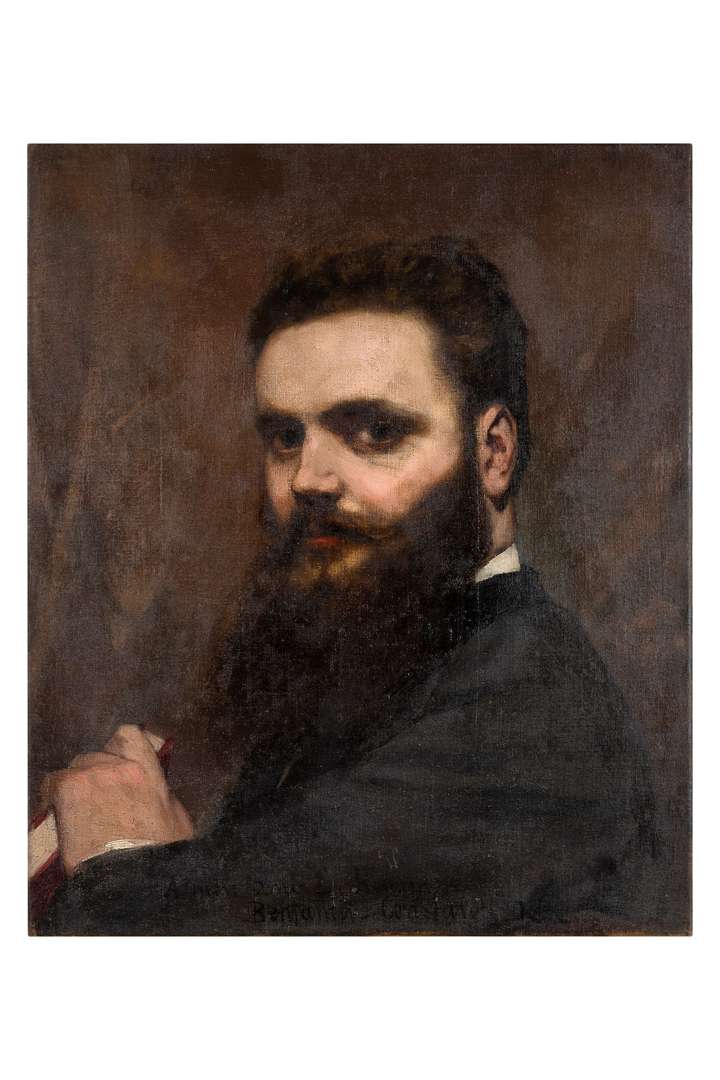
Bust portrait of Eugène Hénard (1849-1923), 18[7?]2
Oil on canvas
Signed, dedicated 'À mon ami E. Hénard' and dated '18[7?]2' lower center
(Folding and small superficial scratches)
Oil on lined canvas, signed, dedicated 'À mon ami E. Hénard' and dated '18[7?]2' lower middle
55,5 x 46,5 cm - 21 7/8 x 18 1/4 in.
Provenance
Private collection, France
Note
Eugène Hénard, a French architect and civil engineer who turned to urban planning as both a realist and a pioneer, was born in Paris on October 22, 1849, and played an important role in the preparations for the 1889 Universal Exhibition: Although his project for a continuous electric train, far ahead of its time, was not accepted, he was commissioned by Alphand, director of the Exposition, to supervise the construction of the Galerie des Machines by Dutert and Contamin| he published a description of the building and the progress of the work, an invaluable document for the understanding of this essential work. In 1894, with Girault and Paulin, he drew up a project for the 1900 Exhibition, which was awarded a prize, then called into question and finally adopted after a vigorous campaign by Hénard. He was responsible for the construction of the Grand and Petit Palais, the opening of Avenue Alexandre-III and the magnificent view of the Invalides. Following in Haussmann's footsteps, he was also concerned with preserving sites, trees and open spaces: he helped to safeguard the esplanade des Invalides and, later, the perspective of the Pont-Neuf, threatened by the creation of a Pont de la Monnaie (planned since Haussmann). His "Études sur les transformations de Paris" (1903-1909) had a great impact: they offered a lucid analysis of the present and future situation (lack of green spaces, traffic problems, foreseeable congestion) and proposed a green belt punctuated by twelve peripheral parks on the "zone". Hénard's prediction of the future of the automobile is remarkable, and goes hand in hand with the search for classic solutions (large, widened thoroughfares) or revolutionary ones (three-level intersections with differentiated traffic flow, artificial floors for pavements and sidewalks above the natural ground with accessible drains in between, multi-level streets and differentiated traffic flow in new towns). Hénard showed great interest in enlivening avenues with original building layouts (stepped houses). His design is entirely focused on opening up the city to motor vehicles at the expense of other urban functions, but the scientific study is remarkable| it is accompanied by a prophetic vision and key ideas later taken up by Le Corbusier and rationalist urbanism.
Bust portrait of Eugène Hénard (1849-1923), 18[7?]2
Oil on canvas
Signed, dedicated 'À mon ami E. Hénard' and dated '18[7?]2' lower center
(Folding and small superficial scratches)
Oil on lined canvas, signed, dedicated 'À mon ami E. Hénard' and dated '18[7?]2' lower middle
55,5 x 46,5 cm - 21 7/8 x 18 1/4 in.
Provenance
Private collection, France
Note
Eugène Hénard, a French architect and civil engineer who turned to urban planning as both a realist and a pioneer, was born in Paris on October 22, 1849, and played an important role in the preparations for the 1889 Universal Exhibition: Although his project for a continuous electric train, far ahead of its time, was not accepted, he was commissioned by Alphand, director of the Exposition, to supervise the construction of the Galerie des Machines by Dutert and Contamin| he published a description of the building and the progress of the work, an invaluable document for the understanding of this essential work. In 1894, with Girault and Paulin, he drew up a project for the 1900 Exhibition, which was awarded a prize, then called into question and finally adopted after a vigorous campaign by Hénard. He was responsible for the construction of the Grand and Petit Palais, the opening of Avenue Alexandre-III and the magnificent view of the Invalides. Following in Haussmann's footsteps, he was also concerned with preserving sites, trees and open spaces: he helped to safeguard the esplanade des Invalides and, later, the perspective of the Pont-Neuf, threatened by the creation of a Pont de la Monnaie (planned since Haussmann). His "Études sur les transformations de Paris" (1903-1909) had a great impact: they offered a lucid analysis of the present and future situation (lack of green spaces, traffic problems, foreseeable congestion) and proposed a green belt punctuated by twelve peripheral parks on the "zone". Hénard's prediction of the future of the automobile is remarkable, and goes hand in hand with the search for classic solutions (large, widened thoroughfares) or revolutionary ones (three-level intersections with differentiated traffic flow, artificial floors for pavements and sidewalks above the natural ground with accessible drains in between, multi-level streets and differentiated traffic flow in new towns). Hénard showed great interest in enlivening avenues with original building layouts (stepped houses). His design is entirely focused on opening up the city to motor vehicles at the expense of other urban functions, but the scientific study is remarkable| it is accompanied by a prophetic vision and key ideas later taken up by Le Corbusier and rationalist urbanism.