
&w=3840&q=75)
&w=3840&q=75)
&w=3840&q=75)
&w=3840&q=75)
&w=3840&q=75)
&w=3840&q=75)
&w=3840&q=75)
&w=3840&q=75)


169
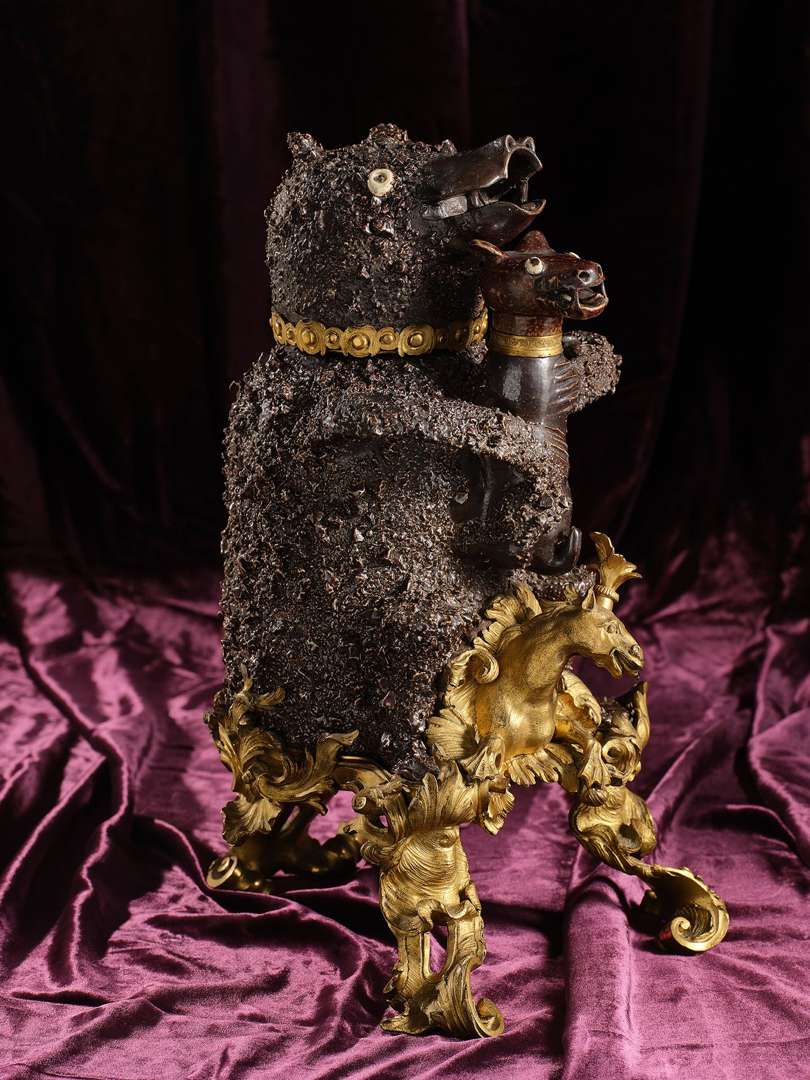
RARE FONTAINE DE TABLE AU COMBAT
The item was sold for 214 140 €
Fees include commission and taxes.
RARE TABLETOP FIGHTING FOUNTAIN
BEAR BAITING
the reservoir made of brown salt-glazed stoneware
in the shape of a bear in the attitude
bear-baiting attitude holding a dog in its forepaws
holding a dog in its front paws, with the bear's head
forming a removable lid. The object is mounted
on a large, specially designed and adapted
in finely chased and gilded bronze
and gilded with rocaille and foliage
foliage. Three Rocaille feet with strong
curves. The fountain tap
is a sea horse rising from its mount
whose mouth forms a spout and whose upper plume
is the tap's removable head.
England, Nottingham, 18th century,
for the ceramics.
Germany or France, 18th century, circa 1745
for the frame.
Total height: 38 cm - Width: 21.5 cm
Depth: 24.5 cm
(Wear, accidents and restorations)
The reservoir part of our table fountain belongs to a well-documented
belongs to a well-documented corpus of objects whose similar
similar examples can be found among the curiosities of many
collections. This pottery, a folk art from Staffordshire and Nottingham
of Staffordshire and Nottingham, were sold as wine or beer jugs and
a relative success as a souvenir of the extraordinary
and very bloody bear-baiting matches that galvanized
England from the 12th to the 19th century. This extremely cruel sport (which
particularly fascinated the monarchs Elizabeth I and Henry VIII)
consisted of tormenting a chained bear with dogs and burning
in an arena known as a "bear garden".
garden". On our ceramics, the bear holding a smaller animal
animal (which at first glance appears to be a bear cub), is actually holding
a dog, which he hugs to death. The bear's removable head
also forms the cup needed to consume the drink.
The Victoria & Albert Museum holds a copy that is extremely close
of our model [Accession number 3690&A-
1901] (Fig.1).
The perfectly unique gilded and chased bronze frame
which was made to sublimate this simple objet d'art populaire
is unmistakably the commission of a powerful man,
at the cutting edge of fashion in his day. He made it a luxury object,
central to his home, and even - by virtue of its function - at the heart
at the heart of table conversation, so that he could evoke
to evoke with his guests a battle he had seen in England
which we assume was a memorable one!
BEAR BAITING
the reservoir made of brown salt-glazed stoneware
in the shape of a bear in the attitude
bear-baiting attitude holding a dog in its forepaws
holding a dog in its front paws, with the bear's head
forming a removable lid. The object is mounted
on a large, specially designed and adapted
in finely chased and gilded bronze
and gilded with rocaille and foliage
foliage. Three Rocaille feet with strong
curves. The fountain tap
is a sea horse rising from its mount
whose mouth forms a spout and whose upper plume
is the tap's removable head.
England, Nottingham, 18th century,
for the ceramics.
Germany or France, 18th century, circa 1745
for the frame.
Total height: 38 cm - Width: 21.5 cm
Depth: 24.5 cm
(Wear, accidents and restorations)
The reservoir part of our table fountain belongs to a well-documented
belongs to a well-documented corpus of objects whose similar
similar examples can be found among the curiosities of many
collections. This pottery, a folk art from Staffordshire and Nottingham
of Staffordshire and Nottingham, were sold as wine or beer jugs and
a relative success as a souvenir of the extraordinary
and very bloody bear-baiting matches that galvanized
England from the 12th to the 19th century. This extremely cruel sport (which
particularly fascinated the monarchs Elizabeth I and Henry VIII)
consisted of tormenting a chained bear with dogs and burning
in an arena known as a "bear garden".
garden". On our ceramics, the bear holding a smaller animal
animal (which at first glance appears to be a bear cub), is actually holding
a dog, which he hugs to death. The bear's removable head
also forms the cup needed to consume the drink.
The Victoria & Albert Museum holds a copy that is extremely close
of our model [Accession number 3690&A-
1901] (Fig.1).
The perfectly unique gilded and chased bronze frame
which was made to sublimate this simple objet d'art populaire
is unmistakably the commission of a powerful man,
at the cutting edge of fashion in his day. He made it a luxury object,
central to his home, and even - by virtue of its function - at the heart
at the heart of table conversation, so that he could evoke
to evoke with his guests a battle he had seen in England
which we assume was a memorable one!