
&w=3840&q=75)
&w=3840&q=75)
&w=3840&q=75)
&w=3840&q=75)
&w=3840&q=75)
&w=3840&q=75)
&w=3840&q=75)
&w=3840&q=75)


123
ALEXANDRE NICOLAÏEVITCH BENOIS (1870-1960)
The item was sold for 2 899 €
Fees include commission and taxes.
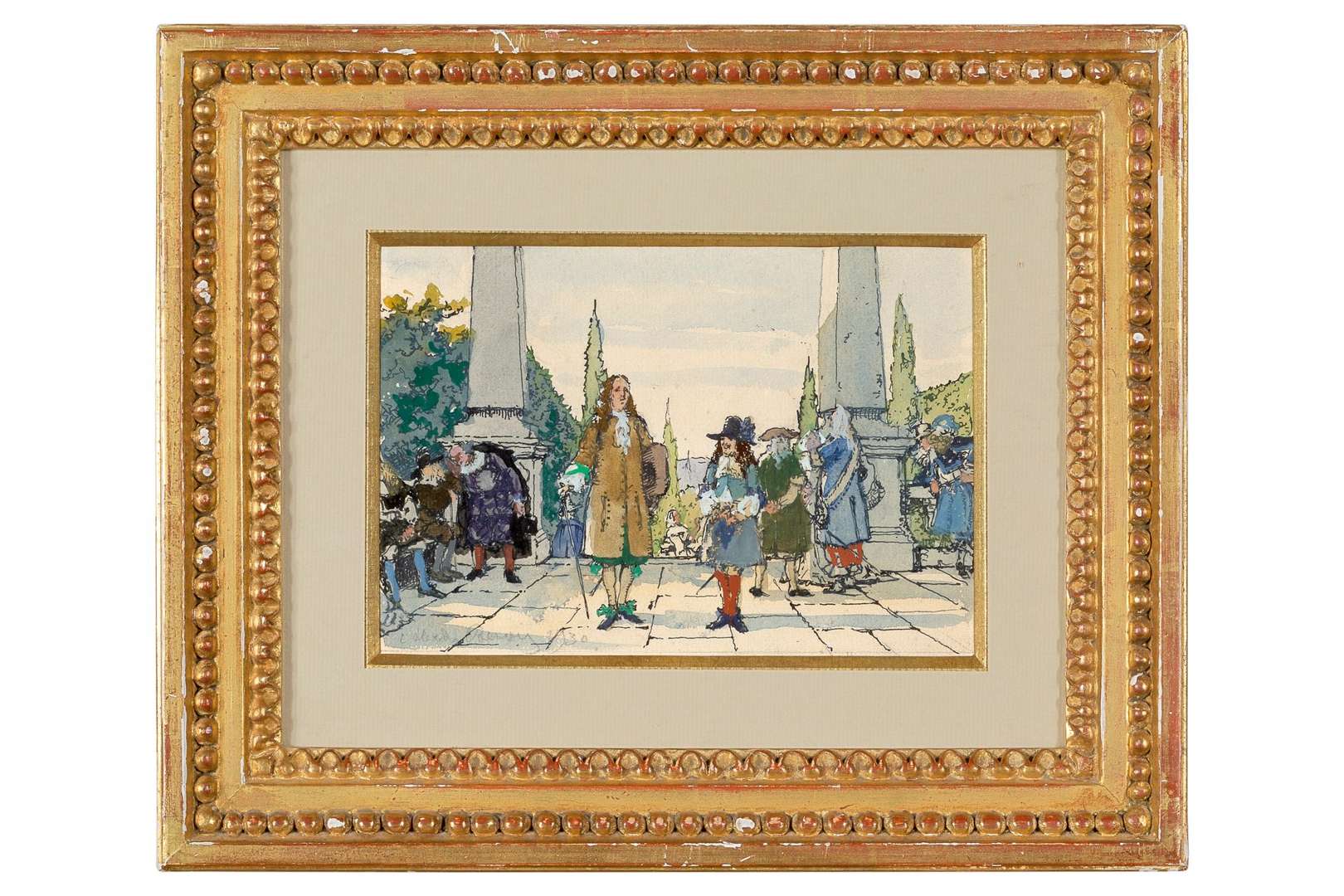
ALEXANDRE NICOLAÏEVITCH BENOIS (1870-1960)
The Séguiran family come for the inheritance
Illustration for 'La Pécheresse' by Henri de Régnier, 1930
Watercolor, gouache and India ink on paper
Signed and dated '1930' lower left
Titled and annotated on back
Watercolor, gouache and Indian ink on paper, signed and dated '1930' lower left, titled and inscribed on the reverse
13 x 19 cm - 5 1/8 x 7 1/2 in.
Provenance
Private collection, France (by descent)
Note
Described as a love story, this work by Henri de Regnier is dedicated to Gilbert de Voisins, poet and novelist, as a token of fraternal friendship. It is placed by its author under the auspices of the libertine moralist and critic Saint-Evremond, whose quotation appears in the book's exergue: "There are times when we weep for pleasures lost, times when we weep for sins committed." A vast program. And the author incipits as follows: "I've always been so curious about the peculiarities one discovers in the character of women that, not once, have I neglected to educate myself on the subject." The discerning reader will have noticed the "n'ai né" which gives rhythm to the sentence. Literature from another time. The narrator continues: "(...) the point where what nature has made them shows itself best and most openly, is that of love."
The Séguiran family come for the inheritance
Illustration for 'La Pécheresse' by Henri de Régnier, 1930
Watercolor, gouache and India ink on paper
Signed and dated '1930' lower left
Titled and annotated on back
Watercolor, gouache and Indian ink on paper, signed and dated '1930' lower left, titled and inscribed on the reverse
13 x 19 cm - 5 1/8 x 7 1/2 in.
Provenance
Private collection, France (by descent)
Note
Described as a love story, this work by Henri de Regnier is dedicated to Gilbert de Voisins, poet and novelist, as a token of fraternal friendship. It is placed by its author under the auspices of the libertine moralist and critic Saint-Evremond, whose quotation appears in the book's exergue: "There are times when we weep for pleasures lost, times when we weep for sins committed." A vast program. And the author incipits as follows: "I've always been so curious about the peculiarities one discovers in the character of women that, not once, have I neglected to educate myself on the subject." The discerning reader will have noticed the "n'ai né" which gives rhythm to the sentence. Literature from another time. The narrator continues: "(...) the point where what nature has made them shows itself best and most openly, is that of love."