
&w=3840&q=75)
&w=3840&q=75)
&w=3840&q=75)
&w=3840&q=75)
&w=3840&q=75)
&w=3840&q=75)
&w=3840&q=75)
&w=3840&q=75)


94
VICENTE DO REGO MONTEIRO (1899-1970)
The item was sold for 104 000 €
Fees include commission and taxes.
VICENTE DO REGO MONTEIRO (1899-1970)
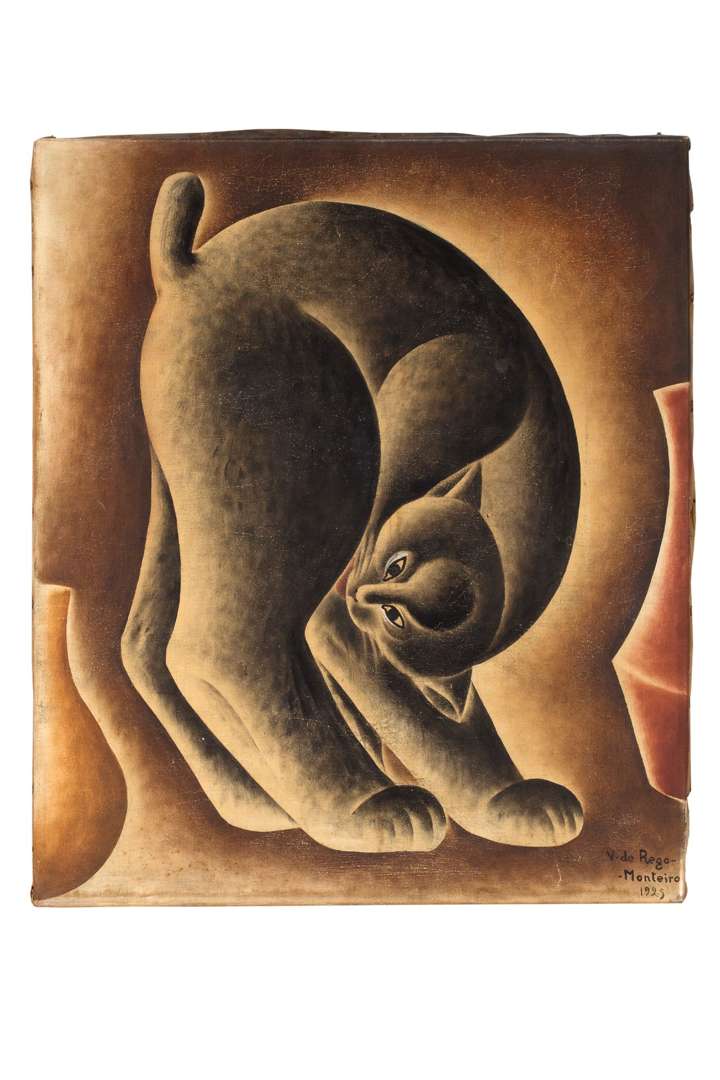
Bicho (Beast), 1925
Oil on canvas
Signed and dated '1925' lower right
(Minimal lacunae in the paint layer)
Oil on canvas, signed and dated '1925' lower right
53,5 x 45,5 cm - 21 x 17 7/8 in.
Provenance
Private collection, Belgium (acquired on the Brussels art market in the 2000s)
Related works
- Vicente do Rego Monteiro (1899-1970), The Cat and the Tortoise, mixed technique on paper mounted on panel, 55.5 x 46 cm, former collection of Charles Guyot (1892-1963), known as Géo-Charles, in. Sale, Florilège : Importants tableaux &| Objets d'art, wines, Haynault, Uccle, September 18, 2023, lot 41
- Vicente do Rego Monteiro (1899-1970), O menino e os bichos (The child and the beasts), 1925, oil on canvas, 65 x 81 cm, Paris, Centre Pompidou, JP 841 P
- Vicente do Rego Monteiro (1899-1970), A Onça, 1929, oil on canvas, 77 x 93 cm, private collection
- Vicente do Rego Monteiro (1899-1970), The Bear, 1929, oil on canvas, 62 x 76 cm, private collection
Note
From the 1920s onwards, Monteiro painted Brazilian myths and indigenous scenes. He used geometric figuration and ornamentation reminiscent of Marajoara ceramics, a pre-colonial Amazonian civilization. Our painting is a fine example, with its schematic animal, marked by muscular tension inspired by the work of Fernand Léger, and its simplified vessels. The reduced palette and chiaroscuro effects contribute to the gravity of the scene.
"Frontality, two-dimensionality of space, breadth of line are an example of the painter's formal code of the 1920s/1929s."
Elisabeth Chambon
"Monteiro's art is founded on a spirit of research and incessant curiosity, painting that doesn't seem to be painting at all, and which appears to be an exercise of the mind, an exercise in stripping things down. After a first international experience in Paris, from 1911 to 1914, he asserted himself at the 1920-1921 exhibitions, by participating in the "Week of Modern Art" in São Paulo. He exhibited a series of highly colored watercolors inspired by indigenous themes, borrowed from the life and mythology of the Amazonian Indians. These watercolors reveal a graphic hieraticism that was to become the essential characteristic of his personality. A formal language that already brings together the inflections that would blossom fully and definitively in the geometric style of the 1920s. The essence of Vicente Monteiro's creative energy was to be embodied in the "monumental" attitude he adopted in Paris, in his stripped-down figuration, dominated by a geometric and methodical articulation, where expression yielded to the monumental finality of construction. [...]
His preoccupation with full, dense form gives each object a sculptural breadth, exuding a sense of balance and plenitude characteristic of paintings from 1920 to 1929. At this point, [he] abandons the polytonality of watercolors for earthy browns and ochres, colors in cameo, which contribute to an idea of asceticism bordering on "poverty". These tones leave the precise line, the structural rigor of the form, imposed by the need to build blocks of images, rigidly arranged, in an outline that admits of no vacillation.
Frontality, two-dimensionality of space and breadth of line are an example of the painter's formal code in the 1920s/1929s. During these typically Parisian years, Vicente Monteiro's attention converged on a religious iconography that alternated with popular themes, urban landscape, portraiture and familiar scenes of men, women, children and animals. Monteiro's art at this time is essentially oriented towards this end: "abstract and tactile quality of drawing, grandiose and symmetrical composition, psychic adequacy of figures to the breadth of graphics, planar volume, accentuated by unitary color".
The years that followed this highly creative period were marked by a number of ruptures.
In 1930, Vicente Monteiro returned to Brazil, accompanied by Géo-Charles and some one hundred works by the École de Paris, which constituted the first major international exhibition of contemporary art to be held in Brazil. These included works by Braque, Derain, Dufy, Foujita, Gleizes Gromaire, Loutreuil, Picasso, Matisse, Masson, Monteiro and Survage."
Elisabeth Chambon, "Vicente do Rego Monteiro (Recife, 1899-1970), Un Brésilien de France", in. cat. expo. Brésilien de France, Vicente do Rego Monteiro, Échirolles, Musée Géo-Charles, May 13-June 25, 1986, Échirolles : Musée Géo-Charles, 1986, pp. 5-6
Bicho (Beast), 1925
Oil on canvas
Signed and dated '1925' lower right
(Minimal lacunae in the paint layer)
Oil on canvas, signed and dated '1925' lower right
53,5 x 45,5 cm - 21 x 17 7/8 in.
Provenance
Private collection, Belgium (acquired on the Brussels art market in the 2000s)
Related works
- Vicente do Rego Monteiro (1899-1970), The Cat and the Tortoise, mixed technique on paper mounted on panel, 55.5 x 46 cm, former collection of Charles Guyot (1892-1963), known as Géo-Charles, in. Sale, Florilège : Importants tableaux &| Objets d'art, wines, Haynault, Uccle, September 18, 2023, lot 41
- Vicente do Rego Monteiro (1899-1970), O menino e os bichos (The child and the beasts), 1925, oil on canvas, 65 x 81 cm, Paris, Centre Pompidou, JP 841 P
- Vicente do Rego Monteiro (1899-1970), A Onça, 1929, oil on canvas, 77 x 93 cm, private collection
- Vicente do Rego Monteiro (1899-1970), The Bear, 1929, oil on canvas, 62 x 76 cm, private collection
Note
From the 1920s onwards, Monteiro painted Brazilian myths and indigenous scenes. He used geometric figuration and ornamentation reminiscent of Marajoara ceramics, a pre-colonial Amazonian civilization. Our painting is a fine example, with its schematic animal, marked by muscular tension inspired by the work of Fernand Léger, and its simplified vessels. The reduced palette and chiaroscuro effects contribute to the gravity of the scene.
"Frontality, two-dimensionality of space, breadth of line are an example of the painter's formal code of the 1920s/1929s."
Elisabeth Chambon
"Monteiro's art is founded on a spirit of research and incessant curiosity, painting that doesn't seem to be painting at all, and which appears to be an exercise of the mind, an exercise in stripping things down. After a first international experience in Paris, from 1911 to 1914, he asserted himself at the 1920-1921 exhibitions, by participating in the "Week of Modern Art" in São Paulo. He exhibited a series of highly colored watercolors inspired by indigenous themes, borrowed from the life and mythology of the Amazonian Indians. These watercolors reveal a graphic hieraticism that was to become the essential characteristic of his personality. A formal language that already brings together the inflections that would blossom fully and definitively in the geometric style of the 1920s. The essence of Vicente Monteiro's creative energy was to be embodied in the "monumental" attitude he adopted in Paris, in his stripped-down figuration, dominated by a geometric and methodical articulation, where expression yielded to the monumental finality of construction. [...]
His preoccupation with full, dense form gives each object a sculptural breadth, exuding a sense of balance and plenitude characteristic of paintings from 1920 to 1929. At this point, [he] abandons the polytonality of watercolors for earthy browns and ochres, colors in cameo, which contribute to an idea of asceticism bordering on "poverty". These tones leave the precise line, the structural rigor of the form, imposed by the need to build blocks of images, rigidly arranged, in an outline that admits of no vacillation.
Frontality, two-dimensionality of space and breadth of line are an example of the painter's formal code in the 1920s/1929s. During these typically Parisian years, Vicente Monteiro's attention converged on a religious iconography that alternated with popular themes, urban landscape, portraiture and familiar scenes of men, women, children and animals. Monteiro's art at this time is essentially oriented towards this end: "abstract and tactile quality of drawing, grandiose and symmetrical composition, psychic adequacy of figures to the breadth of graphics, planar volume, accentuated by unitary color".
The years that followed this highly creative period were marked by a number of ruptures.
In 1930, Vicente Monteiro returned to Brazil, accompanied by Géo-Charles and some one hundred works by the École de Paris, which constituted the first major international exhibition of contemporary art to be held in Brazil. These included works by Braque, Derain, Dufy, Foujita, Gleizes Gromaire, Loutreuil, Picasso, Matisse, Masson, Monteiro and Survage."
Elisabeth Chambon, "Vicente do Rego Monteiro (Recife, 1899-1970), Un Brésilien de France", in. cat. expo. Brésilien de France, Vicente do Rego Monteiro, Échirolles, Musée Géo-Charles, May 13-June 25, 1986, Échirolles : Musée Géo-Charles, 1986, pp. 5-6