
&w=3840&q=75)
&w=3840&q=75)
&w=3840&q=75)
&w=3840&q=75)
&w=3840&q=75)
&w=3840&q=75)
&w=3840&q=75)
&w=3840&q=75)


71
MELA MUTER (1876-1967)
The item was sold for 35 100 €
Fees include commission and taxes.
MELA MUTER (1876-1967)
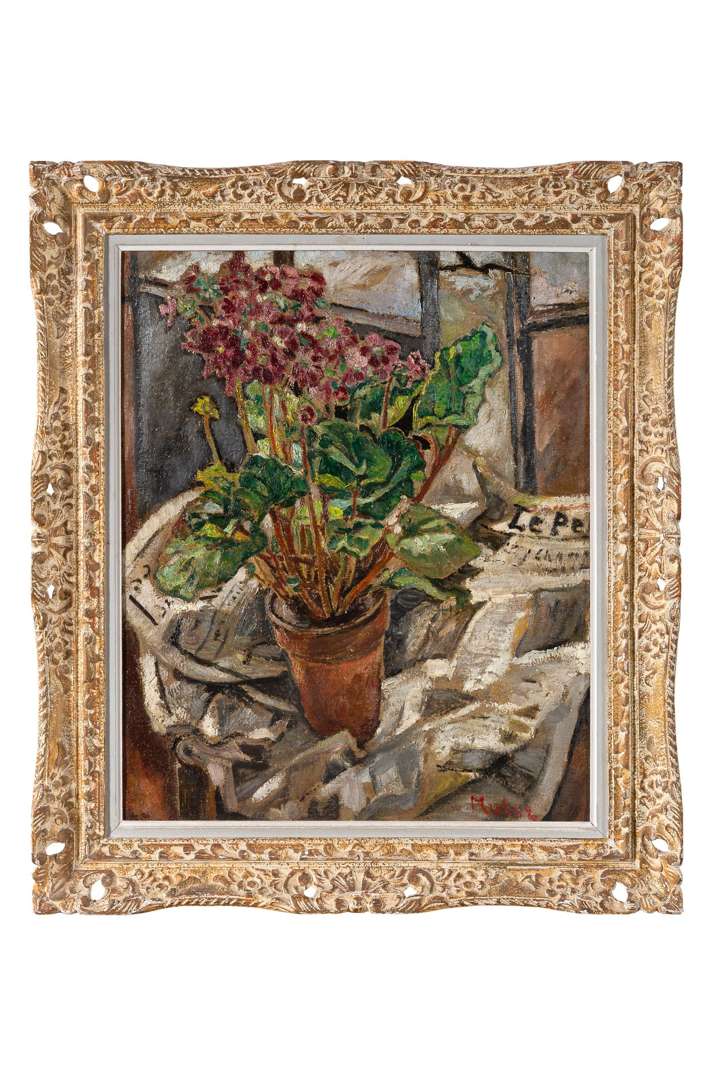
Flowerpot and newspaper
Oil on canvas
Signed lower right
(Minor restorations)
Oil on canvas, signed lower right
65 x 54 cm - 25 5/8 x 21 1/4 in.
Provenance
Private collection, France
Related work
Mela Muter (1876-1967), Geranium, circa 1920, oil on panel, signed upper left, 60.5 x 50.5 cm, former collections Oscar Ghez (Genève, Petit Palais) and Wojciech Fibak (purchased 1987), private collection, in. Sales, École de Paris and 19th Century and Modern Art, Desa Unicum, Warsaw, May 14, 2019, lot 20, and March 15, 2018, lot 55
"You have to be a little talkative in art, not tell all the details, only give the essential things."
Mela Muter
"With Mela Muter, every portrait becomes a self-confessed inner drama, a distress that grips you, with a predilection for the theme of maternity, where all her tenderness is expressed. His portraits are charged with a dramatic intensity rendered by a strong construction, a meticulous realism that reaches crudity and a baroque touch that makes the painting thrilling.
Her landscapes are harshly poetic, and Mela Muter takes hold of them, introduces herself into them and translates herself through them. Her still lifes show the same quivering temperament, with all her Slavic restlessness shining through:
"Peaceful Concarneau, far from Parisian anguish, as if out of danger, but my heart was heavy. I could feel the danger in every fibre of my heart. I locked myself in the hotel's empty attic and resorted, as I always do in cases of mortal sadness, to the only remedy that could relieve me. I began to paint, not figures - there was neither the time nor the patience to be a model. Still lifes - crustaceans and fish insensitive to human drama and folly - replaced them. One of these still lifes in particular was very marked by my psychic state| it was tragic, with the contortions of the enormous black eels, the red of the shells, the livid white of the paper." (September 1914).
His art is violent, close to the German Expressionists, the artist has integrated Gauguin's synthetism and the lyrical colors of the Fauves. It's a painting that disturbs by the shock it provokes, sometimes to the point of brutality, such is its haste.
Speaking of her painting, Mela Muter emphasizes:
"You have to be a little talkative in art, not tell all the details, only give the essential things. The great joy of the viewer is to bring his or her share of collaboration to the enjoyment of a work of art, and in the face of this sobriety, he or she must be able to complete, with his or her own creation, the vision evoked by the artist." So she leaves the canvas bare and white in certain places, a zone where memory freely reconstitutes the tone.
Mela Muter expresses her own temperament while being conditioned by her time and past| she belongs to the painters of Montparnasse, but retains her roots. The Polish imprint that permeates her vision of things and people is always palpable| there's a common denominator that underlies her paintings and contributes to this particular vibe of melancholy humanism, uprootedness and a tragic vision of life.
It's worth noting that the spiritual wrench that can be read in his works is the effect of his choice for the Parisian artistic avant-garde, which resulted in expatriation.
André Salmon wrote in Pologne Littéraire, December 15, 1933: "Mela Muter was, first and foremost, one of those strong individualities and one of the most eminent revelators of national art. It is only in this way that she is dependent on the École de Paris. What she owes to France is to have become, at the same time as one of the perfect representatives of living art, a great Polish painter." "
Catherine Puget, "Mela Muter. La rage de peindre d'une femme", in. cat. expo. Mela Muter, Musée de Pont-Aven, October 2, 1993-January 2, 1994, Pont-Aven: Musée de Pont-Aven, 1993, n.p.
Flowerpot and newspaper
Oil on canvas
Signed lower right
(Minor restorations)
Oil on canvas, signed lower right
65 x 54 cm - 25 5/8 x 21 1/4 in.
Provenance
Private collection, France
Related work
Mela Muter (1876-1967), Geranium, circa 1920, oil on panel, signed upper left, 60.5 x 50.5 cm, former collections Oscar Ghez (Genève, Petit Palais) and Wojciech Fibak (purchased 1987), private collection, in. Sales, École de Paris and 19th Century and Modern Art, Desa Unicum, Warsaw, May 14, 2019, lot 20, and March 15, 2018, lot 55
"You have to be a little talkative in art, not tell all the details, only give the essential things."
Mela Muter
"With Mela Muter, every portrait becomes a self-confessed inner drama, a distress that grips you, with a predilection for the theme of maternity, where all her tenderness is expressed. His portraits are charged with a dramatic intensity rendered by a strong construction, a meticulous realism that reaches crudity and a baroque touch that makes the painting thrilling.
Her landscapes are harshly poetic, and Mela Muter takes hold of them, introduces herself into them and translates herself through them. Her still lifes show the same quivering temperament, with all her Slavic restlessness shining through:
"Peaceful Concarneau, far from Parisian anguish, as if out of danger, but my heart was heavy. I could feel the danger in every fibre of my heart. I locked myself in the hotel's empty attic and resorted, as I always do in cases of mortal sadness, to the only remedy that could relieve me. I began to paint, not figures - there was neither the time nor the patience to be a model. Still lifes - crustaceans and fish insensitive to human drama and folly - replaced them. One of these still lifes in particular was very marked by my psychic state| it was tragic, with the contortions of the enormous black eels, the red of the shells, the livid white of the paper." (September 1914).
His art is violent, close to the German Expressionists, the artist has integrated Gauguin's synthetism and the lyrical colors of the Fauves. It's a painting that disturbs by the shock it provokes, sometimes to the point of brutality, such is its haste.
Speaking of her painting, Mela Muter emphasizes:
"You have to be a little talkative in art, not tell all the details, only give the essential things. The great joy of the viewer is to bring his or her share of collaboration to the enjoyment of a work of art, and in the face of this sobriety, he or she must be able to complete, with his or her own creation, the vision evoked by the artist." So she leaves the canvas bare and white in certain places, a zone where memory freely reconstitutes the tone.
Mela Muter expresses her own temperament while being conditioned by her time and past| she belongs to the painters of Montparnasse, but retains her roots. The Polish imprint that permeates her vision of things and people is always palpable| there's a common denominator that underlies her paintings and contributes to this particular vibe of melancholy humanism, uprootedness and a tragic vision of life.
It's worth noting that the spiritual wrench that can be read in his works is the effect of his choice for the Parisian artistic avant-garde, which resulted in expatriation.
André Salmon wrote in Pologne Littéraire, December 15, 1933: "Mela Muter was, first and foremost, one of those strong individualities and one of the most eminent revelators of national art. It is only in this way that she is dependent on the École de Paris. What she owes to France is to have become, at the same time as one of the perfect representatives of living art, a great Polish painter." "
Catherine Puget, "Mela Muter. La rage de peindre d'une femme", in. cat. expo. Mela Muter, Musée de Pont-Aven, October 2, 1993-January 2, 1994, Pont-Aven: Musée de Pont-Aven, 1993, n.p.