
&w=3840&q=75)
&w=3840&q=75)
&w=3840&q=75)
&w=3840&q=75)
&w=3840&q=75)
&w=3840&q=75)
&w=3840&q=75)
&w=3840&q=75)


13
GEORGES ROCHEGROSSE (1859-1938)
The item was sold for 26 000 €
Fees include commission and taxes.
GEORGES ROCHEGROSSE (1859-1938)
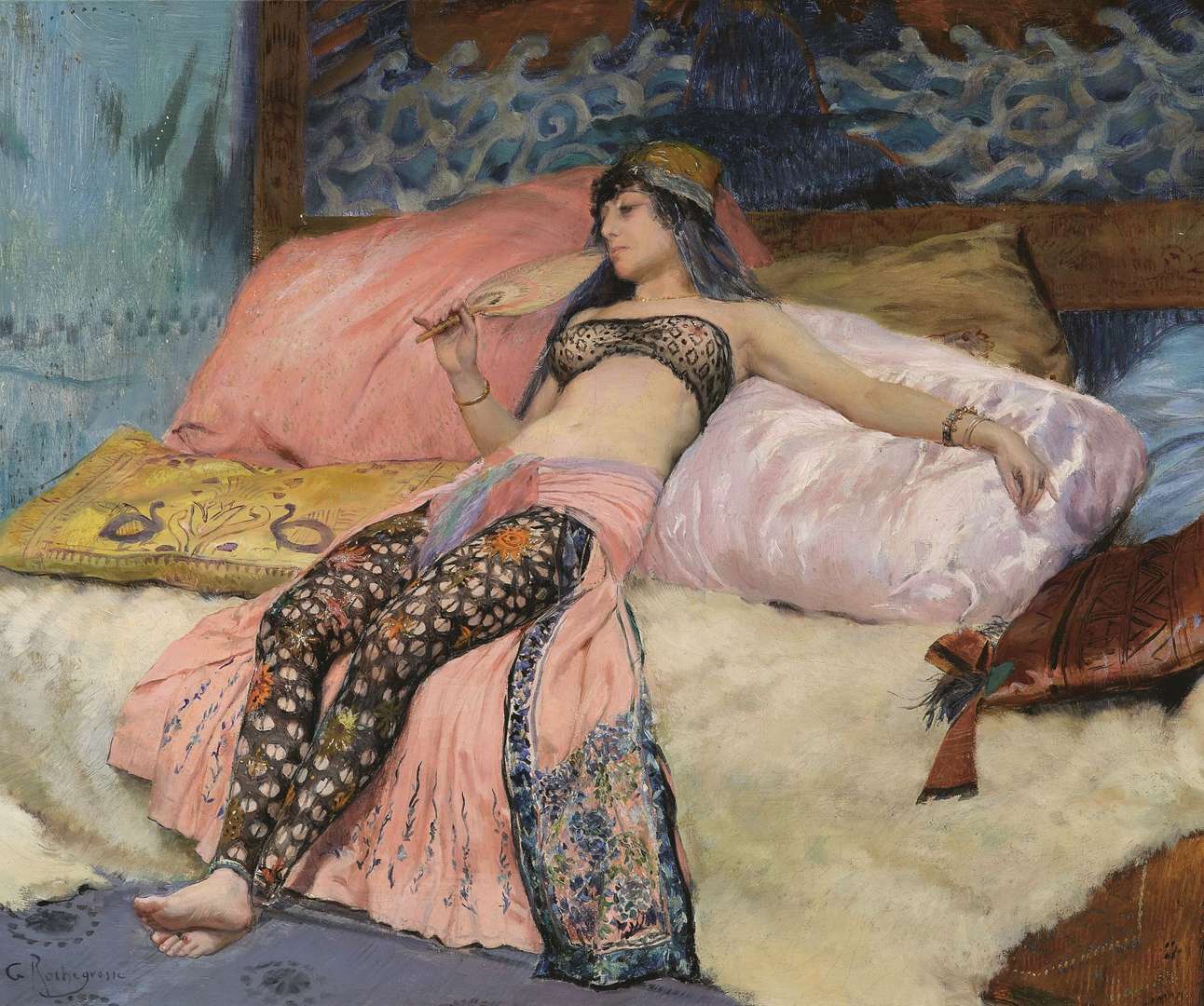
Presumed portrait of Sarah Bernhardt or Lying Odalisque
Oil on canvas
Signed lower left
Oil on canvas, signed lower left
50 x 61 cm - 19 3/4 x 24 in.
Provenance
- Private collection, France
- Acquired from the latter
Note
In 1895, Georges Rochegrosse delivered the costume designs for Salomé - a mimed scene in two acts, four tableaux and a prologue - by Armand Silvestre and Meltzer, with music by Gabriel Pierné and set design by Rubé, for the Comédie-Parisienne. The title role was played by Loïe Fuller.
Note
The Musée départemental Anne-de-Beaujeu in Moulins (Allier) devoted a major retrospective to our artist: Georges-Antoine Rochegrosse (1859-1938), les fastes de la dé cadence (June 29, 2013 - January 5, 2014). On this occasion, the exhibition curators lamented that the artist had never been the subject of a monographic exhibition, despite being one of the most famous history painters of the Third Republic. His catalog aims to redress this injustice in art history, by shedding light on the many facets of the work and of a man about whom his friend Claude Couturier wrote: "At twenty-four he was known| at thirty-two he was famous| he is now illustrious", just three years after Rochegrosse won the Medal of Honor at the Salon des Artistes Français.
In 1890, Georges Rochegrosse portrayed Sarah Bernhardt as Cleopatra (coll. part.) and, at an unknown date, as Tosca (former Toussaint Samat collection, Marseille), when he wasn't drawing inspiration from her stage performances for his own compositions. André Michel, for example, sees in the female figure who theatrically raises her arms in La mort de Babylone, "a kind of witch who must have taken lessons from Mme Sarah Bernhardt, and who testifies by her pantomime to the most violent stupor in front of her" ("Soirée parisienne. Marigny's overture", in. Le petit Parisien, May 17 1897). Some also claim, in the manner of Anatole France, that Sarah Bernhardt herself imitated Rochegrosse's sensational paintings: "Didn't she imagine, last year, staging Andromaque at the Porte Saint-Martin with weapons and utensils from the polished stone age? Or so I've heard. It was based on the idea that the Trojan War had taken place in prehistoric times, on M. Schliemann's excavations and on M. Rochegrosse's painting. Andromache would have been covered in shell necklaces and tattooed". The woman nicknamed "La Divine" by her contemporaries was also, in all likelihood, a great admirer of the works Rochegrosse regularly exhibited at the Salon. André Salmon, in 1924, indulged in nostalgic memories, recalling that "as a child, [he] admired Sarah Bernhardt in the costume of Tosca, leaning on a high cane and swooning over the work of this Rochegrosse, whom she took to be a disciple of her faithful Clairin" ("Tu seras amateur", in. Paris-Soir, April 25, 2024).
The recent exhibition Sarah Bernhardt, Et la femme créa la star (Paris, Petit Palais, April 14-August 27, 2023) featured a large canvas, Sarah Bernhardt dans un intérieur chinois (circa 1900, coll. part.), depicting the actress with the "divine mane of a goddess" (Banville) in the embroidered silk Asian dress she loved to wear, both in Paris and in Belle-Île-en-Mer. She also showed a Japanese woman in the studio (Portrait présumé de Sarah Bernhardt) dating from the 1880s (Paris, Petit Palais). What these two paintings have in common with our own is that they depict the actress in Asian costume, adorned with her favorite jewels, and surrounded by the chinoiseries she so enjoyed, as attested by Marie Desiré Bourgoin's watercolor, depicting Sarah Bernhardt's studio in 1879 (New York, The Metropolitan Museum of Art), and her famous lacquered and gilded wooden tiger (Japan, Edo period), acquired by her from Siegfried Bing and now kept at the Musée Cernuschi (M.C. 2162). She was obliged, not without regret, to part with the latter for financial reasons, if we are to believe Edmond de Goncourt's testimony. In his Diary of January 17, 1885, the famous writer recounts the letter the actress wrote to Cernuschi when she was playing the title role in Victorien Sardou's Théodora: "I'm poor like my grandfather Job: would you buy me 3,000 francs for my tiger, which I paid 6,000 francs for at Bing's?
Presumed portrait of Sarah Bernhardt or Lying Odalisque
Oil on canvas
Signed lower left
Oil on canvas, signed lower left
50 x 61 cm - 19 3/4 x 24 in.
Provenance
- Private collection, France
- Acquired from the latter
Note
In 1895, Georges Rochegrosse delivered the costume designs for Salomé - a mimed scene in two acts, four tableaux and a prologue - by Armand Silvestre and Meltzer, with music by Gabriel Pierné and set design by Rubé, for the Comédie-Parisienne. The title role was played by Loïe Fuller.
Note
The Musée départemental Anne-de-Beaujeu in Moulins (Allier) devoted a major retrospective to our artist: Georges-Antoine Rochegrosse (1859-1938), les fastes de la dé cadence (June 29, 2013 - January 5, 2014). On this occasion, the exhibition curators lamented that the artist had never been the subject of a monographic exhibition, despite being one of the most famous history painters of the Third Republic. His catalog aims to redress this injustice in art history, by shedding light on the many facets of the work and of a man about whom his friend Claude Couturier wrote: "At twenty-four he was known| at thirty-two he was famous| he is now illustrious", just three years after Rochegrosse won the Medal of Honor at the Salon des Artistes Français.
In 1890, Georges Rochegrosse portrayed Sarah Bernhardt as Cleopatra (coll. part.) and, at an unknown date, as Tosca (former Toussaint Samat collection, Marseille), when he wasn't drawing inspiration from her stage performances for his own compositions. André Michel, for example, sees in the female figure who theatrically raises her arms in La mort de Babylone, "a kind of witch who must have taken lessons from Mme Sarah Bernhardt, and who testifies by her pantomime to the most violent stupor in front of her" ("Soirée parisienne. Marigny's overture", in. Le petit Parisien, May 17 1897). Some also claim, in the manner of Anatole France, that Sarah Bernhardt herself imitated Rochegrosse's sensational paintings: "Didn't she imagine, last year, staging Andromaque at the Porte Saint-Martin with weapons and utensils from the polished stone age? Or so I've heard. It was based on the idea that the Trojan War had taken place in prehistoric times, on M. Schliemann's excavations and on M. Rochegrosse's painting. Andromache would have been covered in shell necklaces and tattooed". The woman nicknamed "La Divine" by her contemporaries was also, in all likelihood, a great admirer of the works Rochegrosse regularly exhibited at the Salon. André Salmon, in 1924, indulged in nostalgic memories, recalling that "as a child, [he] admired Sarah Bernhardt in the costume of Tosca, leaning on a high cane and swooning over the work of this Rochegrosse, whom she took to be a disciple of her faithful Clairin" ("Tu seras amateur", in. Paris-Soir, April 25, 2024).
The recent exhibition Sarah Bernhardt, Et la femme créa la star (Paris, Petit Palais, April 14-August 27, 2023) featured a large canvas, Sarah Bernhardt dans un intérieur chinois (circa 1900, coll. part.), depicting the actress with the "divine mane of a goddess" (Banville) in the embroidered silk Asian dress she loved to wear, both in Paris and in Belle-Île-en-Mer. She also showed a Japanese woman in the studio (Portrait présumé de Sarah Bernhardt) dating from the 1880s (Paris, Petit Palais). What these two paintings have in common with our own is that they depict the actress in Asian costume, adorned with her favorite jewels, and surrounded by the chinoiseries she so enjoyed, as attested by Marie Desiré Bourgoin's watercolor, depicting Sarah Bernhardt's studio in 1879 (New York, The Metropolitan Museum of Art), and her famous lacquered and gilded wooden tiger (Japan, Edo period), acquired by her from Siegfried Bing and now kept at the Musée Cernuschi (M.C. 2162). She was obliged, not without regret, to part with the latter for financial reasons, if we are to believe Edmond de Goncourt's testimony. In his Diary of January 17, 1885, the famous writer recounts the letter the actress wrote to Cernuschi when she was playing the title role in Victorien Sardou's Théodora: "I'm poor like my grandfather Job: would you buy me 3,000 francs for my tiger, which I paid 6,000 francs for at Bing's?