
&w=3840&q=75)
&w=3840&q=75)
&w=3840&q=75)
&w=3840&q=75)
&w=3840&q=75)
&w=3840&q=75)
&w=3840&q=75)
&w=3840&q=75)


92
Philippe-Jacques van BRÉE
The item was sold for 19 500 €
Fees include commission and taxes.
PHILIPPE-JACQUES VAN BRÉE ANTWERP, 1786 - 1871, SAINT-JOSSE-TEN-NOODE
Child masquerade
Canvas
91 x 107 cm - 35 13/16 x 42 1/8 in.
Child masquerade, canvas
PROVENANCE:
Galerie Thémis, Brussels (in 1998)| Acquired from the latter by the present owner| Belgian private collection.
BIBLIOGRAPHY:
Philippe Farcy, "Découverte d'une toile de
Philippe Van Brée", in La Libre Belgique, June 6 & 7, 1998 (ill.)
Born in Brussels in 1786, Philippe-Jacques Van Brée's first master was his brother Mathieu-Ignace (1773-1839), thirteen years his senior. By 1811, he was exhibiting at the Brussels Salon.
The same year, he left for Paris and joined the studio of Girodet (1767-1824), from whom he inherited the smooth neoclassical style. Between 1816 and 1818, he set off for Rome, financed by the Pankaufe family, a wealthy couple of patrons.
Too unproductive for the taste of his patrons, his Italian sojourn was interrupted for two years, during which he returned to France. From his first stay in Italy, Van Brée confirmed his taste for drawing and a style inherited from the school of David (1748-1825). His painting was smooth, glazed, almost porcelain-like, and resolutely focused on the observation of Antiquity, but he softened its coldness with the delicacy and charming expressiveness of his figures.
The painter also nuanced his palette, expressing his liking for bright, bold colors.
By 1821, Van Brée was back in Rome, from where he spread his fame throughout Europe.
Close to his fellow Belgians, he also frequented local high society. At the turn of the 1830s, he returned to Brussels and resumed his participation in the triennial Salons, where he was present for several years before he saw his style fall into disuse to the benefit of a new generation of Romantics, as was the case at the same time for his contemporary François-Joseph Navez.
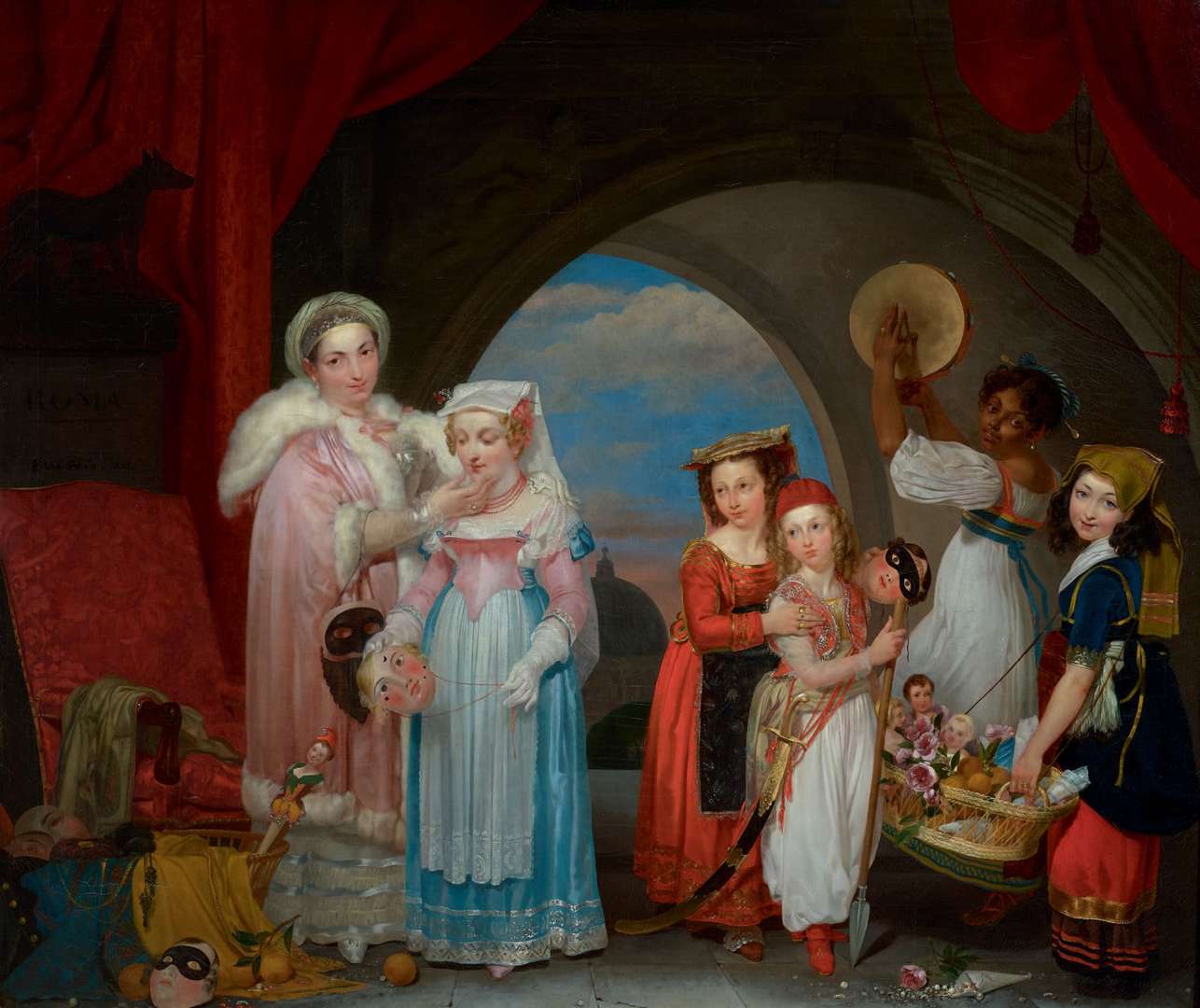
François-Joseph Navez (1787-1869). In 1823, Van Brée was in Rome, and it was in the Eternal City that he produced this charming and, to say the least, amusing
charming and, to say the least, amusing children's masquerade. Like a theatrical scene being revealed to the spectator, the curtains have been raised, revealing the cute actresses of the day. Dressed in clothes that blend Orient,
contemporary Italian picturesque, Renaissance motifs and Venetian masks, the merry company prepares to set off to the tinkling beat of a drum. A mother makes a few final adjustments to her daughter, who is eagerly awaited by her friends. With their bodies already turned towards the exit, their eyes clamoring for their latest friend, they're sure to want to get away from their mother's yoke. The clothes, masks, fruit and flowers littering the floor suggest that a moment earlier, a whole mess of pretty things had been twirled in the hands of these young children, all too happy with the games to come. The theme is light and the atmosphere joyous, but the apparent frivolity of the whole should not obscure the beauty of the brushwork, nor the references to the earlier masters Van Brée so admired. In the shadow of a loggia's vaulted ceiling, the references to the Italian Renaissance are manifold, from the opening against a sky backdrop and the distant silhouette of a dome, to the architecture of the place itself, which suggests a palazzo, to the outfits chosen.
the painter condenses references from the classics he knows. In addition, he blends his own style with the influences of his training: the frieze-like composition of the neoclassical painters, and the meticulous rendering of silky, shiny, almost brittle fabrics in precious colors.
David, Ingres (1780-1867), Girodet and his brother Mathieu-Ignace are among the models that Van Brée absorbed and made his own, combining brightly-dressed figures with delightfully mischievous expressions.
Child masquerade
Canvas
91 x 107 cm - 35 13/16 x 42 1/8 in.
Child masquerade, canvas
PROVENANCE:
Galerie Thémis, Brussels (in 1998)| Acquired from the latter by the present owner| Belgian private collection.
BIBLIOGRAPHY:
Philippe Farcy, "Découverte d'une toile de
Philippe Van Brée", in La Libre Belgique, June 6 & 7, 1998 (ill.)
Born in Brussels in 1786, Philippe-Jacques Van Brée's first master was his brother Mathieu-Ignace (1773-1839), thirteen years his senior. By 1811, he was exhibiting at the Brussels Salon.
The same year, he left for Paris and joined the studio of Girodet (1767-1824), from whom he inherited the smooth neoclassical style. Between 1816 and 1818, he set off for Rome, financed by the Pankaufe family, a wealthy couple of patrons.
Too unproductive for the taste of his patrons, his Italian sojourn was interrupted for two years, during which he returned to France. From his first stay in Italy, Van Brée confirmed his taste for drawing and a style inherited from the school of David (1748-1825). His painting was smooth, glazed, almost porcelain-like, and resolutely focused on the observation of Antiquity, but he softened its coldness with the delicacy and charming expressiveness of his figures.
The painter also nuanced his palette, expressing his liking for bright, bold colors.
By 1821, Van Brée was back in Rome, from where he spread his fame throughout Europe.
Close to his fellow Belgians, he also frequented local high society. At the turn of the 1830s, he returned to Brussels and resumed his participation in the triennial Salons, where he was present for several years before he saw his style fall into disuse to the benefit of a new generation of Romantics, as was the case at the same time for his contemporary François-Joseph Navez.
François-Joseph Navez (1787-1869). In 1823, Van Brée was in Rome, and it was in the Eternal City that he produced this charming and, to say the least, amusing
charming and, to say the least, amusing children's masquerade. Like a theatrical scene being revealed to the spectator, the curtains have been raised, revealing the cute actresses of the day. Dressed in clothes that blend Orient,
contemporary Italian picturesque, Renaissance motifs and Venetian masks, the merry company prepares to set off to the tinkling beat of a drum. A mother makes a few final adjustments to her daughter, who is eagerly awaited by her friends. With their bodies already turned towards the exit, their eyes clamoring for their latest friend, they're sure to want to get away from their mother's yoke. The clothes, masks, fruit and flowers littering the floor suggest that a moment earlier, a whole mess of pretty things had been twirled in the hands of these young children, all too happy with the games to come. The theme is light and the atmosphere joyous, but the apparent frivolity of the whole should not obscure the beauty of the brushwork, nor the references to the earlier masters Van Brée so admired. In the shadow of a loggia's vaulted ceiling, the references to the Italian Renaissance are manifold, from the opening against a sky backdrop and the distant silhouette of a dome, to the architecture of the place itself, which suggests a palazzo, to the outfits chosen.
the painter condenses references from the classics he knows. In addition, he blends his own style with the influences of his training: the frieze-like composition of the neoclassical painters, and the meticulous rendering of silky, shiny, almost brittle fabrics in precious colors.
David, Ingres (1780-1867), Girodet and his brother Mathieu-Ignace are among the models that Van Brée absorbed and made his own, combining brightly-dressed figures with delightfully mischievous expressions.