
&w=3840&q=75)
&w=3840&q=75)
&w=3840&q=75)
&w=3840&q=75)
&w=3840&q=75)
&w=3840&q=75)
&w=3840&q=75)
&w=3840&q=75)


91
ALFRED DE DREUX PARIS, 1810-1860
The item was sold for 26 000 €
Fees include commission and taxes.
ALFRED DE DREUX PARIS, 1810-1860
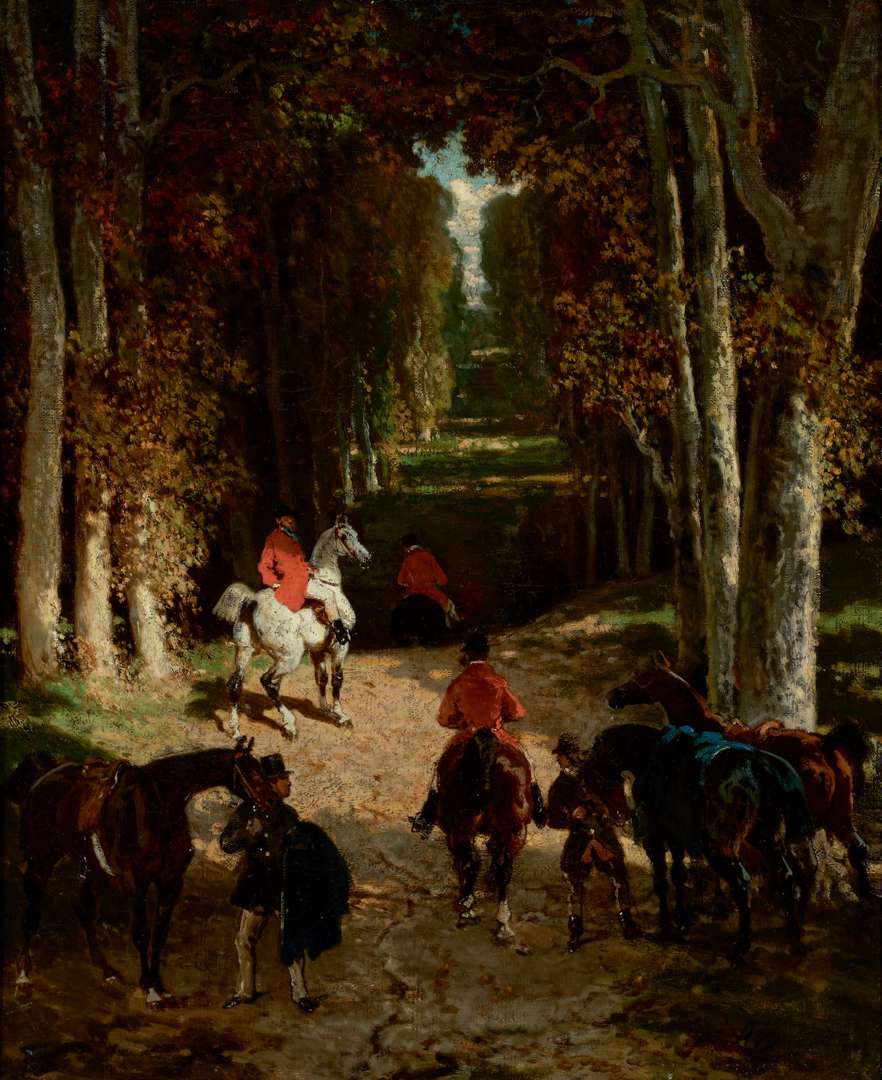
The start of a hunt
Canvas
Signed lower right Alfred D.D
45 x 37,5 cm - 17 3/4 x 14 3/4 in.
The start of a hound hunt, canvas, signed lower right
PROVENANCE:
Private collection, France.
BIBLIOGRAPHY:
Marie-Christine RENAULD, Alfred de Dreux, Paris, 2008, p. 52 [ill.], under an erroneous description.
Alfred De Dreux was a child of the 19th century, becoming one of its greatest painters of portraits and animals. As a young man, he frequented Théodore Géricault (1791-1824), who profoundly renewed the equestrian portrait and the painting of horses, of which there are countless representations| he then entered the studio of Léon Cogniet (1794- 1880), painter of L'Enlèvement de Rebecca.
An artist of undeniable success, De Dreux became particularly appreciated by a segment of society that he portrayed as neither frivolous nor idle, but all beauty and elegance.
Standing at the edge of a long driveway shaded by tall trees, Alfred De Dreux invites us to the start of a hunt. The crew is getting ready, the animals are harnessed, the last riders are waiting. The bright red jackets of those already present enhance the cold hues of this autumn forest.
The light peeking through the foliage adds a lovely luminosity to the scene, but in the end gives no hint of the event's course or outcome. Although the painter has retained the tradition of classical landscape painting, his brushwork is freer, thicker and reminiscent of contemporary English painting, discovered by French artists at the 1824 Salon. A theme close to the artist's heart, venison allows him to combine the depiction of riders, their mounts and nature. The diminishing size of the protagonists accentuates the effect of perspective, drawing our gaze towards the horizon.
Captured in a variety of poses, De Dreux also shows himself to be an excellent painter of horses. While he is extremely attentive to a meticulous rendering of their anatomy, he is also interested in their attitudes, something that Degas (1834-1917) would draw inspiration from when he looked at his elder's work. In contrast to the sporty and brutal nature of the practice, the painter favors the elegant spirit of the poses and outfits.
A true cultural and social testimony to the years 1840-1860, he succeeded in capturing the spirit of an era.
The start of a hunt
Canvas
Signed lower right Alfred D.D
45 x 37,5 cm - 17 3/4 x 14 3/4 in.
The start of a hound hunt, canvas, signed lower right
PROVENANCE:
Private collection, France.
BIBLIOGRAPHY:
Marie-Christine RENAULD, Alfred de Dreux, Paris, 2008, p. 52 [ill.], under an erroneous description.
Alfred De Dreux was a child of the 19th century, becoming one of its greatest painters of portraits and animals. As a young man, he frequented Théodore Géricault (1791-1824), who profoundly renewed the equestrian portrait and the painting of horses, of which there are countless representations| he then entered the studio of Léon Cogniet (1794- 1880), painter of L'Enlèvement de Rebecca.
An artist of undeniable success, De Dreux became particularly appreciated by a segment of society that he portrayed as neither frivolous nor idle, but all beauty and elegance.
Standing at the edge of a long driveway shaded by tall trees, Alfred De Dreux invites us to the start of a hunt. The crew is getting ready, the animals are harnessed, the last riders are waiting. The bright red jackets of those already present enhance the cold hues of this autumn forest.
The light peeking through the foliage adds a lovely luminosity to the scene, but in the end gives no hint of the event's course or outcome. Although the painter has retained the tradition of classical landscape painting, his brushwork is freer, thicker and reminiscent of contemporary English painting, discovered by French artists at the 1824 Salon. A theme close to the artist's heart, venison allows him to combine the depiction of riders, their mounts and nature. The diminishing size of the protagonists accentuates the effect of perspective, drawing our gaze towards the horizon.
Captured in a variety of poses, De Dreux also shows himself to be an excellent painter of horses. While he is extremely attentive to a meticulous rendering of their anatomy, he is also interested in their attitudes, something that Degas (1834-1917) would draw inspiration from when he looked at his elder's work. In contrast to the sporty and brutal nature of the practice, the painter favors the elegant spirit of the poses and outfits.
A true cultural and social testimony to the years 1840-1860, he succeeded in capturing the spirit of an era.