
&w=3840&q=75)
&w=3840&q=75)
&w=3840&q=75)
&w=3840&q=75)
&w=3840&q=75)
&w=3840&q=75)
&w=3840&q=75)
&w=3840&q=75)

85
JEAN-FRÉDÉRIC SCHALL STRABSOURG, 1752 - 1825, PARIS
The item was sold for 3 900 €
Fees include commission and taxes.
JEAN-FRÉDÉRIC SCHALL STRABSOURG, 1752 - 1825, PARIS
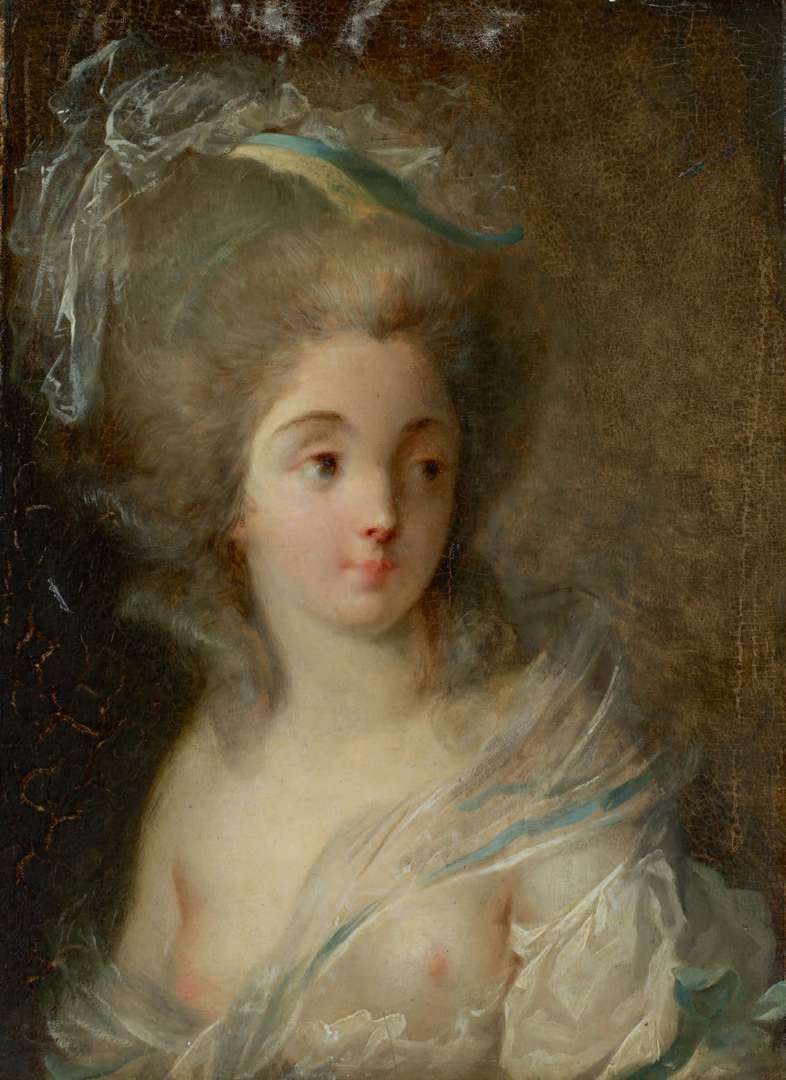
Portrait of a Young Woman with Bare Breasts
Panel
23 x 16 cm - 9 1/16 x 6 5/16 in.
Portrait of a young woman with bare chest, panel
PROVENANCE:
Sale of the M. L. Tabourier collection, Me Chevallier, Hôtel Drouot, June 20-21-22, 1898, no. 95 as "Fragonard (Honoré), Portrait de Mme Dubarry" |
Private collection, France.
Born in Strasbourg, Jean-Frédéric Schall entered the École des élèves protégés de l'Académie royale directed by Nicolas-Guy Brenet (1728-1792) at the age of 20. At the same time, he studied with Francesco Casanova (1727-1803), Nicolas-René Jollain (1732-1804) and Nicolas-Bernard Lépicié (1735-1784). Five years later, he completed his training and turned to a clientele of private amateurs rather than public commissions. His new patrons included merchant and banker Johann Heinrich Eberts (1726-1793), engraver Johann Georg Wille (1715-1808) and Strasbourg piano maker Sebastian Erard (1752- 1831). His work was further disseminated by the colored engravings of Augustin Legrand (1765- 1856) and Louis-Marin Bonnet (1736/1743-1793) in particular.
Strongly influenced by Fragonard (1732-1806), a few years his senior, Schall was also influenced by contemporary love literature, which is reflected in his choice of subjects, dominated by gallant scenes with more or less explicit erotic overtones.
This licentious aspect is reflected in this small portrait, once thought to be of Jeanne du Barry (1743-1793), the last favorite of Louis XV (1710-1774). Born in Strasbourg, Jean-Frédéric Schall entered the École des élèves protégés de l'Académie royale at the age of 20, under the direction of Nicolas-Guy Brenet.
Nicolas-Guy Brenet (1728-1792). At the same time, he studied with Francesco Casanova (1727-1803), Nicolas-René Jollain (1732-1804) and Nicolas-Bernard Lépicié (1735-1784). Five years later, he completed his training and turned to a clientele of private amateurs rather than public commissions. His new patrons included merchant and banker Johann Heinrich Eberts (1726-1793), engraver Johann Georg Wille (1715-1808) and Strasbourg piano maker Sebastian Erard (1752- 1831). His work was further disseminated by the colored engravings of Augustin Legrand (1765- 1856) and Louis-Marin Bonnet (1736/1743-1793) in particular.
Strongly influenced by Fragonard (1732-1806), a few years his senior, Schall was also influenced by contemporary love literature, which is reflected in his choice of subjects, dominated by gallant scenes with more or less explicit erotic overtones.
This licentious aspect is reflected in this small portrait, once thought to be of Jeanne du Barry (1743-1793), the last favorite of Louis XV (1710-1774). The model, who ultimately remained anonymous, is presented in bust, three-quarter view, slightly turned to the right.
Without any ambition to conceal her, a light fabric covers part of her chest, while the other part is completely revealed. The evanescent brushstroke seems reminiscent of Fragonesque, which undoubtedly fooled those responsible for the 1898 sale, who attributed the work to the master of Grasse.
Portrait of a Young Woman with Bare Breasts
Panel
23 x 16 cm - 9 1/16 x 6 5/16 in.
Portrait of a young woman with bare chest, panel
PROVENANCE:
Sale of the M. L. Tabourier collection, Me Chevallier, Hôtel Drouot, June 20-21-22, 1898, no. 95 as "Fragonard (Honoré), Portrait de Mme Dubarry" |
Private collection, France.
Born in Strasbourg, Jean-Frédéric Schall entered the École des élèves protégés de l'Académie royale directed by Nicolas-Guy Brenet (1728-1792) at the age of 20. At the same time, he studied with Francesco Casanova (1727-1803), Nicolas-René Jollain (1732-1804) and Nicolas-Bernard Lépicié (1735-1784). Five years later, he completed his training and turned to a clientele of private amateurs rather than public commissions. His new patrons included merchant and banker Johann Heinrich Eberts (1726-1793), engraver Johann Georg Wille (1715-1808) and Strasbourg piano maker Sebastian Erard (1752- 1831). His work was further disseminated by the colored engravings of Augustin Legrand (1765- 1856) and Louis-Marin Bonnet (1736/1743-1793) in particular.
Strongly influenced by Fragonard (1732-1806), a few years his senior, Schall was also influenced by contemporary love literature, which is reflected in his choice of subjects, dominated by gallant scenes with more or less explicit erotic overtones.
This licentious aspect is reflected in this small portrait, once thought to be of Jeanne du Barry (1743-1793), the last favorite of Louis XV (1710-1774). Born in Strasbourg, Jean-Frédéric Schall entered the École des élèves protégés de l'Académie royale at the age of 20, under the direction of Nicolas-Guy Brenet.
Nicolas-Guy Brenet (1728-1792). At the same time, he studied with Francesco Casanova (1727-1803), Nicolas-René Jollain (1732-1804) and Nicolas-Bernard Lépicié (1735-1784). Five years later, he completed his training and turned to a clientele of private amateurs rather than public commissions. His new patrons included merchant and banker Johann Heinrich Eberts (1726-1793), engraver Johann Georg Wille (1715-1808) and Strasbourg piano maker Sebastian Erard (1752- 1831). His work was further disseminated by the colored engravings of Augustin Legrand (1765- 1856) and Louis-Marin Bonnet (1736/1743-1793) in particular.
Strongly influenced by Fragonard (1732-1806), a few years his senior, Schall was also influenced by contemporary love literature, which is reflected in his choice of subjects, dominated by gallant scenes with more or less explicit erotic overtones.
This licentious aspect is reflected in this small portrait, once thought to be of Jeanne du Barry (1743-1793), the last favorite of Louis XV (1710-1774). The model, who ultimately remained anonymous, is presented in bust, three-quarter view, slightly turned to the right.
Without any ambition to conceal her, a light fabric covers part of her chest, while the other part is completely revealed. The evanescent brushstroke seems reminiscent of Fragonesque, which undoubtedly fooled those responsible for the 1898 sale, who attributed the work to the master of Grasse.