
&w=3840&q=75)
&w=3840&q=75)
&w=3840&q=75)
&w=3840&q=75)
&w=3840&q=75)
&w=3840&q=75)
&w=3840&q=75)
&w=3840&q=75)


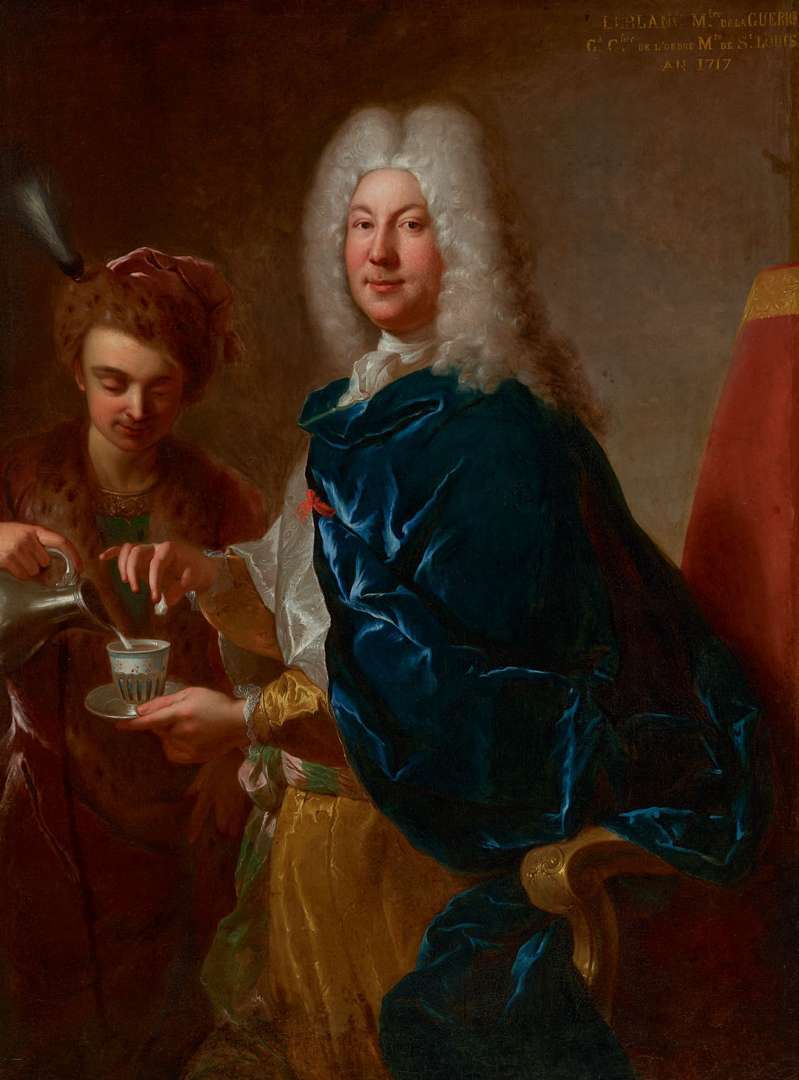
FRANÇOIS DE TROY TOULOUSE, 1645 - 1730, PARIS
Portrait of Claude Le Blanc (1669-1728), Minister of War
Canvas
131 x 98 cm - 51 9/16 x 38 9/16 in.
Portrait of Claude Le Blanc (1669-1728), canvas
PROVENANCE:
Christie's sale, New York, April 6, 2006, n°73 |
Christie's sale, New York, January 29, 2014, no. 21.
At top right, an inscription LEBLANC M.tre
DE LA GUERRE / Gd. Ctier. DE L'ORDRE Mre
DE St. LOUIS / YEAR 1717
Claude Le Blanc was forty-eight years old when François de Troy painted his portrait. A civil servant, he began his career as a councillor at the Parliament of Metz in 1696, before becoming intendant of Auvergne in 1704 and then intendant of maritime Flanders between 1708 and 1715. He oversaw the construction of the Mardyck canal, near Dunkirk, after the latter's fortifications had been dismantled under the provisions of the Treaty of Utrecht (1713). A close friend of Philippe d'Orléans (1674-1723), the latter appointed him Secretary of State for War when he himself became regent during the minority of Louis XV (1710-1774). Le Blanc held the post from 1718 to 1723, until he was dismissed
less than six months after the king assumed full powers. Disgraced, he went into exile and died in Versailles in 1728. Claude Le Blanc and his portrait should be understood in the light of the description given by the Comte de Saint-Simon (1760-1825) in his Mémoires: "Highly intelligent, capable, enterprising, very charming, also a
hard worker and a man who knew the world and always knew how to please those who dealt with him". Almost at the pinnacle of his career, de Troy presents his model as a microbody, three-quarter turned to the left, looking in our direction. Instead of a rich environment of heavy drapery and richly ornamented furniture, the painter prefers a sober background
background against which Le Blanc and his servant stand out. His virtuosity in rendering complexions and materials is devoted solely to his model, dressed in a yellow silk habit, a chromatic counterpoint to the heavy blue velvet coat on which the light refracts marvelously. Since the 1710s, the painter had been in the habit of applying a few
white highlights to illuminate the fabrics and lighten the shapes of the motifs. Cleverly, de Troy avoids the pitfall of stasis and presents Le Blanc about to sweeten his cup of chocolate, which his servant pours for him in the background.
in the background. By staggering Le Blanc's presence in this way, the painter is able to create depth despite the sobriety of the background. This young boy, dressed in oriental style with a feathered hat and a velvet coat trimmed with fur, is also found in the painter's Portrait de la duchesse de la Force (Fig. 1).
Between facial realism, singular expressiveness, attention to rendering skin tones and sumptuous materials, François de Troy once again illustrates himself as one of the most virtuoso portraitists of his time.
Portrait of Claude Le Blanc (1669-1728), Minister of War
Canvas
131 x 98 cm - 51 9/16 x 38 9/16 in.
Portrait of Claude Le Blanc (1669-1728), canvas
PROVENANCE:
Christie's sale, New York, April 6, 2006, n°73 |
Christie's sale, New York, January 29, 2014, no. 21.
At top right, an inscription LEBLANC M.tre
DE LA GUERRE / Gd. Ctier. DE L'ORDRE Mre
DE St. LOUIS / YEAR 1717
Claude Le Blanc was forty-eight years old when François de Troy painted his portrait. A civil servant, he began his career as a councillor at the Parliament of Metz in 1696, before becoming intendant of Auvergne in 1704 and then intendant of maritime Flanders between 1708 and 1715. He oversaw the construction of the Mardyck canal, near Dunkirk, after the latter's fortifications had been dismantled under the provisions of the Treaty of Utrecht (1713). A close friend of Philippe d'Orléans (1674-1723), the latter appointed him Secretary of State for War when he himself became regent during the minority of Louis XV (1710-1774). Le Blanc held the post from 1718 to 1723, until he was dismissed
less than six months after the king assumed full powers. Disgraced, he went into exile and died in Versailles in 1728. Claude Le Blanc and his portrait should be understood in the light of the description given by the Comte de Saint-Simon (1760-1825) in his Mémoires: "Highly intelligent, capable, enterprising, very charming, also a
hard worker and a man who knew the world and always knew how to please those who dealt with him". Almost at the pinnacle of his career, de Troy presents his model as a microbody, three-quarter turned to the left, looking in our direction. Instead of a rich environment of heavy drapery and richly ornamented furniture, the painter prefers a sober background
background against which Le Blanc and his servant stand out. His virtuosity in rendering complexions and materials is devoted solely to his model, dressed in a yellow silk habit, a chromatic counterpoint to the heavy blue velvet coat on which the light refracts marvelously. Since the 1710s, the painter had been in the habit of applying a few
white highlights to illuminate the fabrics and lighten the shapes of the motifs. Cleverly, de Troy avoids the pitfall of stasis and presents Le Blanc about to sweeten his cup of chocolate, which his servant pours for him in the background.
in the background. By staggering Le Blanc's presence in this way, the painter is able to create depth despite the sobriety of the background. This young boy, dressed in oriental style with a feathered hat and a velvet coat trimmed with fur, is also found in the painter's Portrait de la duchesse de la Force (Fig. 1).
Between facial realism, singular expressiveness, attention to rendering skin tones and sumptuous materials, François de Troy once again illustrates himself as one of the most virtuoso portraitists of his time.