
&w=3840&q=75)
&w=3840&q=75)
&w=3840&q=75)
&w=3840&q=75)
&w=3840&q=75)
&w=3840&q=75)
&w=3840&q=75)
&w=3840&q=75)


66
DIRCK HALS HAARLEM, 1591 - 1656
The item was sold for 13 000 €
Fees include commission and taxes.
DIRCK HALS HAARLEM, 1591 - 1656
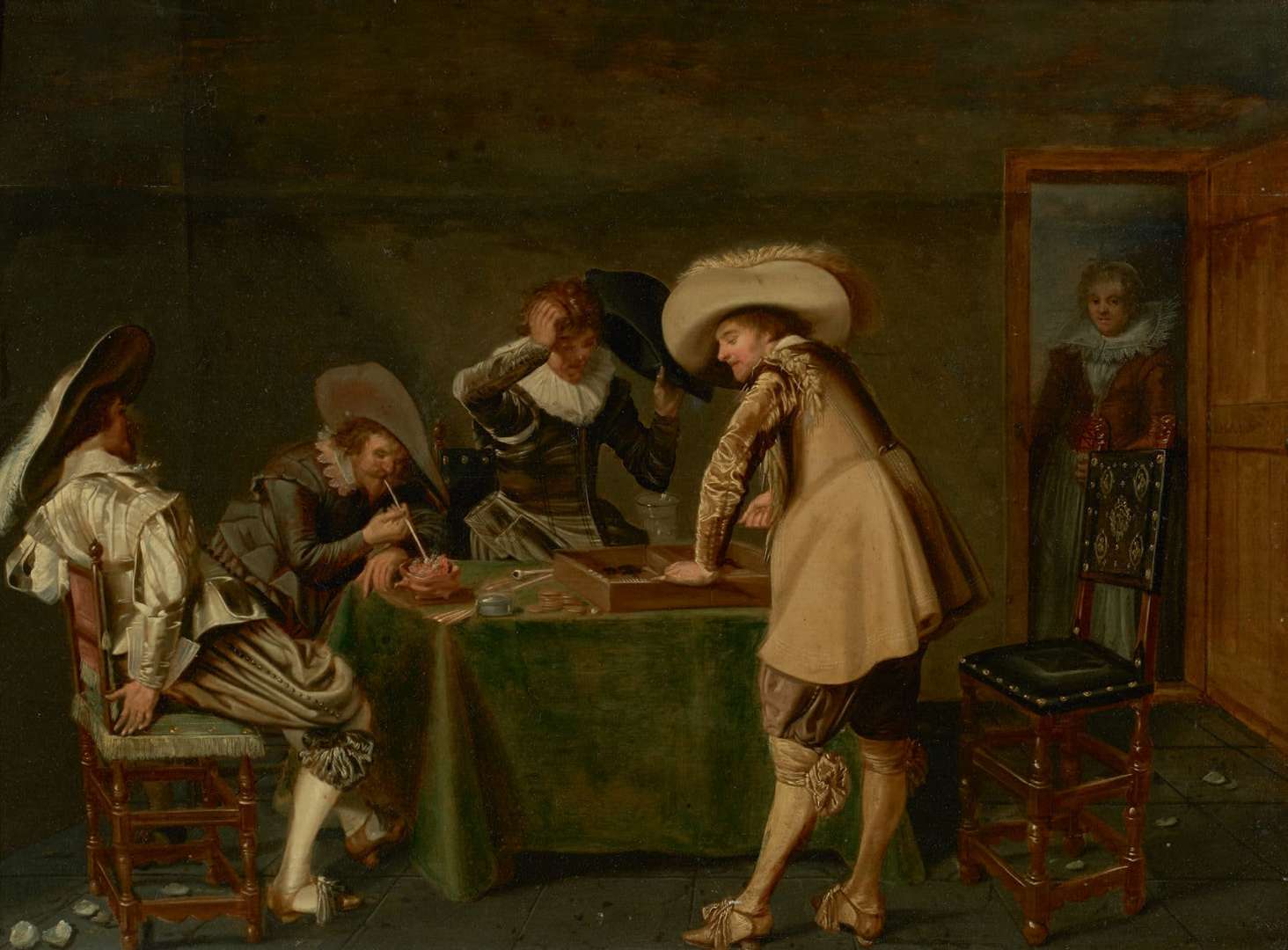
The backgammon game
Oak panel (two boards| parqueted)
Signed and dated on the right in the middle of the door D Hals 1621
37.7 x 51.5 cm - 14 13/16 x 20 1/4 in.
The backgammon game, oak panel, signed and dated middle right
PROVENANCE:
Sale by Maître Benon, Paris, February 11, 1845 |
Acquired at this sale, then by descent, private collection, France.
Born in Haarlem, Dirck Hals was the younger brother of Frans (1580-1666), whose influence can be seen in his pictorial technique and understanding of color. Although his early years are less well documented than those of his illustrious brother, he was undoubtedly a pupil of Willem Buytewech (1591-1624) for a time, before being admitted to the Guild of Saint-Luc
in 1627. In these same years, he also collaborated with Dirck van Delen (1605-1671), an architectural painter. Following in the footsteps of Buytewech and Esaias van de Velde (1587-1630), who were the pioneers of the genre, Dirck specialized in depicting vrolijke gezelschap, literally "merry companies" of elegantly dressed figures gathered around large tables. In an atmosphere of apparent lightness
In an atmosphere of apparent lightness, the protagonists engage in a variety of activities, from card games to gallant conversation, from impromptu concerts to lively exchanges. Yet it will not escape the eye of the beholder that all these situations often suggest hidden vices that they invoke through cheating, drunkenness, deceit or sauciness. Almost systematic symbols
in the previous century, the moralizing aspect of these scenes, which warned viewers against falling into the trap of such behavior, is no longer the priority here.
Here, the painter's attention is focused on the prettiness and elegance of his characters, the beauty of their fabrics and the delicacy of their expressions. Although morality is not at the heart of the scene's interpretation, Hals does not forsake the hidden meanings that it is up to us to decipher. Opposite the unfortunate player, visibly overwhelmed by the outcome of the game,
is his much more fortunate opponent, as evidenced by the satisfied smile on his face and the coins accumulated on his side.
The scene is witnessed by a gentleman busy lighting his pipe, while a fourth companion observes the gaming table. Lurking in the shadows, the only female character in the ensemble stares at us from the doorway. A slight smile of connivance on her lips, she invites us to enter directly into the composition, as well as to assume that all the
protagonists here are not the most well-meaning.
The theme is a recurrent one in the Antwerp painter's corpus, a sign that it was a popular subject for him and his clientele. In declining the motif of backgammon players, he also replaces certain figures found in our
in our composition. It was common practice for artists to repeat certain motifs applied to different settings, and the left-most figure can be found in a similar work (Fig. 1) in the Palais des Beaux-Arts in Lille (inv. P 242), just as the gentleman standing in front of the gaming table can be found in two other variations of the theme in private collections.
in private collections.
Appropriating the genre of Joyeuse compagnie, Dirck Hals preferred the simplicity of an unadorned room to flowery gardens and elegant interiors. Like his brother, his brushstroke is lively and rapid, and wonderfully captures the richness and preciousness of the fabrics. A painter eminently recognized by his peers, his style is known
Hals inspired even the Amsterdam painters Pieter Codde (1599-1678) and Willem Duyster (1599-1635).
Our painting is similar to the one sold by Neuemeister on May 4, 1977, and to a preparatory study for the figure on the left in the former Vosmaer collection in Leiden (Britta Nehlensen-Marten, Dirk Hals (1591-1656) n°246).
The backgammon game
Oak panel (two boards| parqueted)
Signed and dated on the right in the middle of the door D Hals 1621
37.7 x 51.5 cm - 14 13/16 x 20 1/4 in.
The backgammon game, oak panel, signed and dated middle right
PROVENANCE:
Sale by Maître Benon, Paris, February 11, 1845 |
Acquired at this sale, then by descent, private collection, France.
Born in Haarlem, Dirck Hals was the younger brother of Frans (1580-1666), whose influence can be seen in his pictorial technique and understanding of color. Although his early years are less well documented than those of his illustrious brother, he was undoubtedly a pupil of Willem Buytewech (1591-1624) for a time, before being admitted to the Guild of Saint-Luc
in 1627. In these same years, he also collaborated with Dirck van Delen (1605-1671), an architectural painter. Following in the footsteps of Buytewech and Esaias van de Velde (1587-1630), who were the pioneers of the genre, Dirck specialized in depicting vrolijke gezelschap, literally "merry companies" of elegantly dressed figures gathered around large tables. In an atmosphere of apparent lightness
In an atmosphere of apparent lightness, the protagonists engage in a variety of activities, from card games to gallant conversation, from impromptu concerts to lively exchanges. Yet it will not escape the eye of the beholder that all these situations often suggest hidden vices that they invoke through cheating, drunkenness, deceit or sauciness. Almost systematic symbols
in the previous century, the moralizing aspect of these scenes, which warned viewers against falling into the trap of such behavior, is no longer the priority here.
Here, the painter's attention is focused on the prettiness and elegance of his characters, the beauty of their fabrics and the delicacy of their expressions. Although morality is not at the heart of the scene's interpretation, Hals does not forsake the hidden meanings that it is up to us to decipher. Opposite the unfortunate player, visibly overwhelmed by the outcome of the game,
is his much more fortunate opponent, as evidenced by the satisfied smile on his face and the coins accumulated on his side.
The scene is witnessed by a gentleman busy lighting his pipe, while a fourth companion observes the gaming table. Lurking in the shadows, the only female character in the ensemble stares at us from the doorway. A slight smile of connivance on her lips, she invites us to enter directly into the composition, as well as to assume that all the
protagonists here are not the most well-meaning.
The theme is a recurrent one in the Antwerp painter's corpus, a sign that it was a popular subject for him and his clientele. In declining the motif of backgammon players, he also replaces certain figures found in our
in our composition. It was common practice for artists to repeat certain motifs applied to different settings, and the left-most figure can be found in a similar work (Fig. 1) in the Palais des Beaux-Arts in Lille (inv. P 242), just as the gentleman standing in front of the gaming table can be found in two other variations of the theme in private collections.
in private collections.
Appropriating the genre of Joyeuse compagnie, Dirck Hals preferred the simplicity of an unadorned room to flowery gardens and elegant interiors. Like his brother, his brushstroke is lively and rapid, and wonderfully captures the richness and preciousness of the fabrics. A painter eminently recognized by his peers, his style is known
Hals inspired even the Amsterdam painters Pieter Codde (1599-1678) and Willem Duyster (1599-1635).
Our painting is similar to the one sold by Neuemeister on May 4, 1977, and to a preparatory study for the figure on the left in the former Vosmaer collection in Leiden (Britta Nehlensen-Marten, Dirk Hals (1591-1656) n°246).