
&w=3840&q=75)
&w=3840&q=75)
&w=3840&q=75)
&w=3840&q=75)
&w=3840&q=75)
&w=3840&q=75)
&w=3840&q=75)
&w=3840&q=75)


121
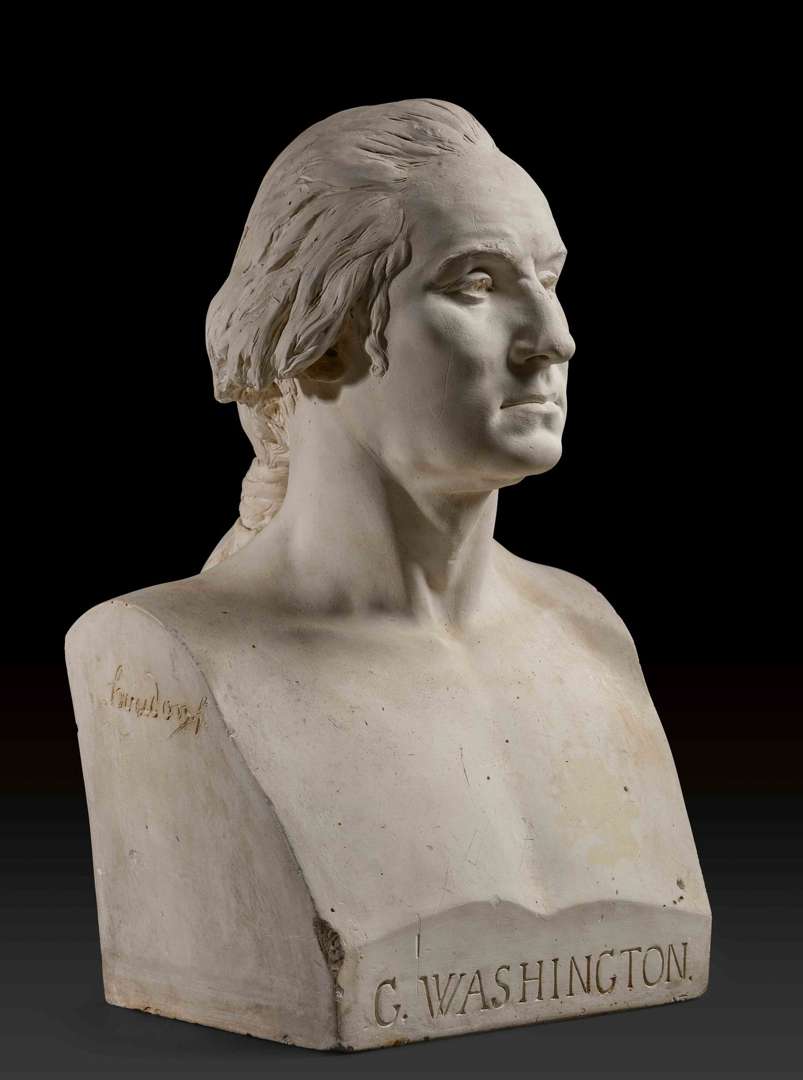
D’APRÈS JEAN-ANTOINE HOUDON
The item was sold for 13 000 €
Fees include commission and taxes.
AFTER JEAN-ANTOINE HOUDON
(1741 - 1828)
Bust portrait of George Washington
as Hermes. Plaster with unpublished variants
after the original model created in 1785.
Titled on the front "G. Washington.
Signed on the left side in cursive
houdon f." in the fresh plaster.
Height: 53.5 cm - Width: 33.5 cm
Depth: 31.5 cm
(Minor accidents and missing parts)
In 1785, the famous French sculptor Jean-Antoine
Houdon accepted a commission from the
Virginia State Legislature to create a life-size marble
life-size marble statue of George
Washington for the state capitol. The sculptor,
accompanied by Benjamin Franklin and
three assistants, set sail for Philadelphia
in July 1785.
During his two-week stay at Mount Vernon
Mount Vernon, Houdon sculpted the model head
of this bust from locally quarried clay.
Houdon left the bust in Washington
and took a live mask and detailed physical
detailed physical measurements to complete the
the final sculpture in France [today
preserved at the Morgan Library and Museum,
New York]. Generally speaking, Houdon's portrait
of Washington by Houdon is today
considered to be the most faithful likeness
likeness of the first president of the
of the United States of America.
In his catalog analytique et descriptif
of the works of Jean-Antoine Houdon, published
in 1918, Georges Giacometti simply specifies
in the entry for Washigton's portraits
portraits of Washigton by Houdon: "divers exemplaires (matières
different materials)", so it's very difficult to be
as to the number of plaster busts by Houdon.
by Houdon.
It is accepted, however, that Houdon produced three
portraits of Washington in three different
different versions:
- The "antique" version, based on the original terracotta
original Mount Vernon terracotta [inv.
W-369] (fig.1)
- The "tunic and toga" version based on the
plaster from the New-York Historical Society [inv.
inv. no.: 1832.4] (fig.2)
- The "shirt and scarf" version based on the
Louvre terracotta [inv. no. RF 350] (fig.3)
However, the version we are presenting here differs singularly
and constitutes an entirely new fourth type
type that we can call "Hermes" according to the
according to the classic canons of this typology:
that of a bust whose shoulders, chest and back
back are cut by planes.
The novelty of this "Hermes" typology,
the very fine cursive signature in the still-fresh plaster
fresh plaster and the singular details in the treatment
of the pupils of the eyes and the hair of our
make our sculpture a plaster of the highest quality
a precious discovery.
(1741 - 1828)
Bust portrait of George Washington
as Hermes. Plaster with unpublished variants
after the original model created in 1785.
Titled on the front "G. Washington.
Signed on the left side in cursive
houdon f." in the fresh plaster.
Height: 53.5 cm - Width: 33.5 cm
Depth: 31.5 cm
(Minor accidents and missing parts)
In 1785, the famous French sculptor Jean-Antoine
Houdon accepted a commission from the
Virginia State Legislature to create a life-size marble
life-size marble statue of George
Washington for the state capitol. The sculptor,
accompanied by Benjamin Franklin and
three assistants, set sail for Philadelphia
in July 1785.
During his two-week stay at Mount Vernon
Mount Vernon, Houdon sculpted the model head
of this bust from locally quarried clay.
Houdon left the bust in Washington
and took a live mask and detailed physical
detailed physical measurements to complete the
the final sculpture in France [today
preserved at the Morgan Library and Museum,
New York]. Generally speaking, Houdon's portrait
of Washington by Houdon is today
considered to be the most faithful likeness
likeness of the first president of the
of the United States of America.
In his catalog analytique et descriptif
of the works of Jean-Antoine Houdon, published
in 1918, Georges Giacometti simply specifies
in the entry for Washigton's portraits
portraits of Washigton by Houdon: "divers exemplaires (matières
different materials)", so it's very difficult to be
as to the number of plaster busts by Houdon.
by Houdon.
It is accepted, however, that Houdon produced three
portraits of Washington in three different
different versions:
- The "antique" version, based on the original terracotta
original Mount Vernon terracotta [inv.
W-369] (fig.1)
- The "tunic and toga" version based on the
plaster from the New-York Historical Society [inv.
inv. no.: 1832.4] (fig.2)
- The "shirt and scarf" version based on the
Louvre terracotta [inv. no. RF 350] (fig.3)
However, the version we are presenting here differs singularly
and constitutes an entirely new fourth type
type that we can call "Hermes" according to the
according to the classic canons of this typology:
that of a bust whose shoulders, chest and back
back are cut by planes.
The novelty of this "Hermes" typology,
the very fine cursive signature in the still-fresh plaster
fresh plaster and the singular details in the treatment
of the pupils of the eyes and the hair of our
make our sculpture a plaster of the highest quality
a precious discovery.