
&w=3840&q=75)
&w=3840&q=75)
&w=3840&q=75)
&w=3840&q=75)
&w=3840&q=75)
&w=3840&q=75)
&w=3840&q=75)
&w=3840&q=75)


64
Médaille - Libertas Americana
The item was sold for 12 024 €
Fees include commission and taxes.
RARE MEDAL
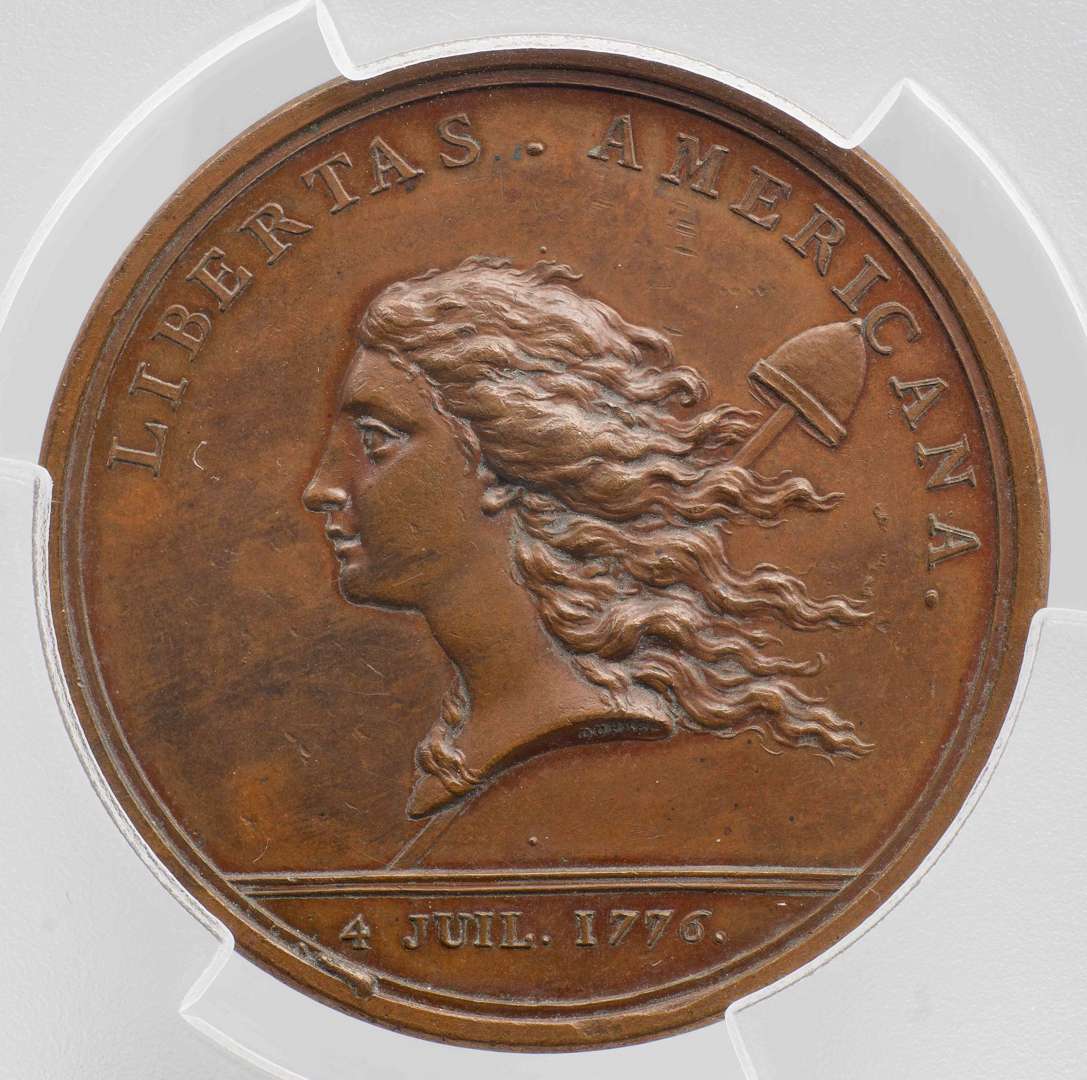
"LIBERTAS AMERICANA" MEDAL
Circular, patinated bronze by Augustin
Dupré. The obverse shows, under the legend
"libertas.americana. "a bust of a slender young woman
of a slender young woman, signed by the engraver,
her untied hair flowing in the wind,
a flagpole surmounted by the bonnet of liberty
resting on her right shoulder. In the exergue
the date "July 4, 1776" in French.
On the reverse, under the legend "non sine diis
animosus infans." is an allegorical composition
where France, in the guise of Minerva
of Minerva protects young America
in the guise of Hercules the child, from the
British leopard. In the exergue, the dates "17 /
Oct. 19, 1777 / 1781. (dates of victories
victories over the armies of generals
Burgoyne at Saratoga and Cornwallis
at Yorktown). Signature "dupré f.
under the leopard's tail.
France, late 18th century.
Diameter: 47.5 mm
(A very fine example with the characteristic obverse
under the 4 and behind the hair on the obverse
of the hair, which are the result of missing parts
of the wedge, with PCGS certification
n°151815.58/37151809. Reference Betts.615)
Rare example of the U.S. Congress commission
to Augustin Dupré, via Benjamin Franklin.
Benjamin Franklin. This is one of the most famous
medals in American history. According to historical records,
the inventor of the medal and its designs was none other
is none other than Benjamin Franklin.
In a March 1782 letter to Robert Livingston, Franklin wrote
Livingston, Franklin wrote: "This reminds me of a medal
of a medal I intended to strike...
representing the United States by the figure of a
young Hercules in his cradle, strangling
the two serpents| and France by that of
Minerva, seated beside her like her nurse,
with her spear and helmet, and her dress
spotted with a few fleurs-de-lis. (in The
Medallic History of the United States of America
by Joseph Loubat).
"LIBERTAS AMERICANA" MEDAL
Circular, patinated bronze by Augustin
Dupré. The obverse shows, under the legend
"libertas.americana. "a bust of a slender young woman
of a slender young woman, signed by the engraver,
her untied hair flowing in the wind,
a flagpole surmounted by the bonnet of liberty
resting on her right shoulder. In the exergue
the date "July 4, 1776" in French.
On the reverse, under the legend "non sine diis
animosus infans." is an allegorical composition
where France, in the guise of Minerva
of Minerva protects young America
in the guise of Hercules the child, from the
British leopard. In the exergue, the dates "17 /
Oct. 19, 1777 / 1781. (dates of victories
victories over the armies of generals
Burgoyne at Saratoga and Cornwallis
at Yorktown). Signature "dupré f.
under the leopard's tail.
France, late 18th century.
Diameter: 47.5 mm
(A very fine example with the characteristic obverse
under the 4 and behind the hair on the obverse
of the hair, which are the result of missing parts
of the wedge, with PCGS certification
n°151815.58/37151809. Reference Betts.615)
Rare example of the U.S. Congress commission
to Augustin Dupré, via Benjamin Franklin.
Benjamin Franklin. This is one of the most famous
medals in American history. According to historical records,
the inventor of the medal and its designs was none other
is none other than Benjamin Franklin.
In a March 1782 letter to Robert Livingston, Franklin wrote
Livingston, Franklin wrote: "This reminds me of a medal
of a medal I intended to strike...
representing the United States by the figure of a
young Hercules in his cradle, strangling
the two serpents| and France by that of
Minerva, seated beside her like her nurse,
with her spear and helmet, and her dress
spotted with a few fleurs-de-lis. (in The
Medallic History of the United States of America
by Joseph Loubat).