
&w=3840&q=75)
&w=3840&q=75)
&w=3840&q=75)
&w=3840&q=75)
&w=3840&q=75)
&w=3840&q=75)
&w=3840&q=75)
&w=3840&q=75)


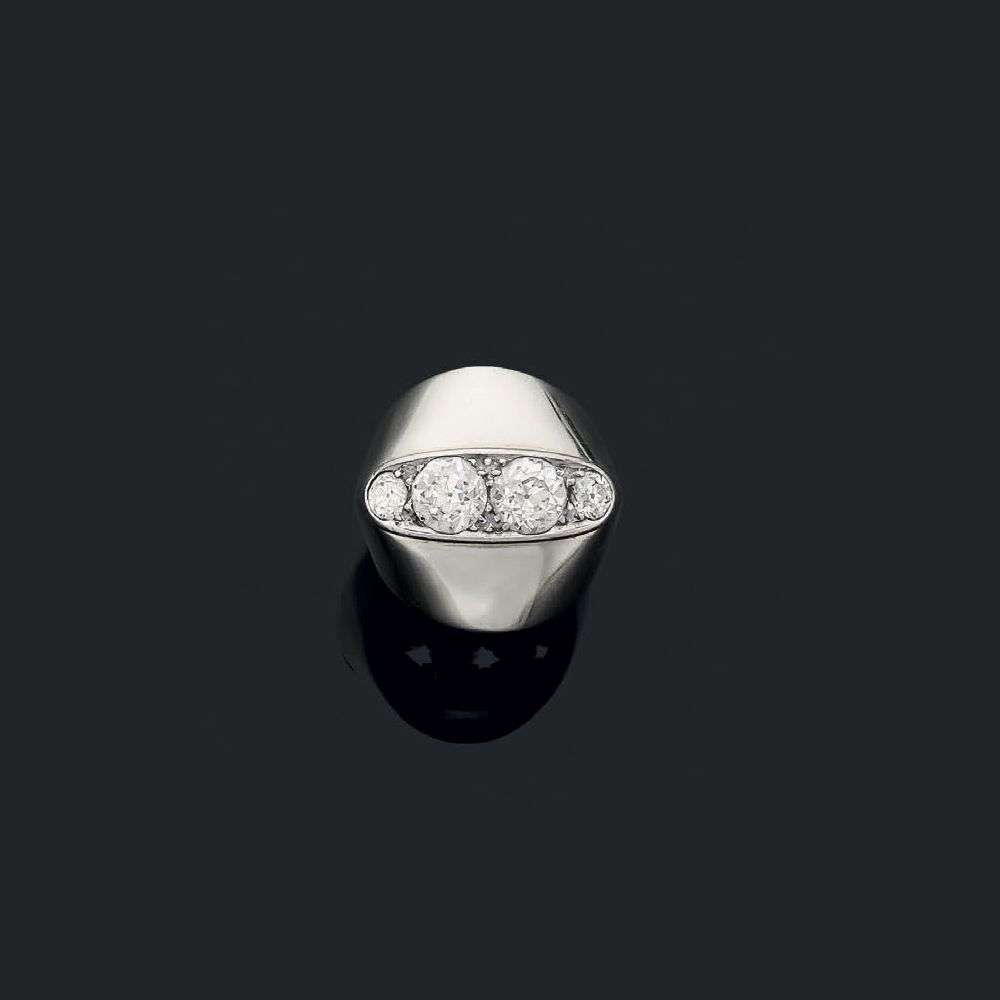
SUZANNE BELPERRON
‘Ribbon’ ring
Fees include commission and taxes.
‘Ribbon’ ring
Antique-cut diamonds
Platinum (950), 18k white gold (750) Groené & Darde
maker’s
mark Dimensions: 45 mm – Weight: 11.1 g
Accompanied by a certificate of authenticity from Mr Olivier BAROIN stating that this is a creation by Suzanne Belperron from the Mallet-Stevens collection, circa 1935.
The collection of Madame Robert Mallet-Stevens, which has remained in the family to this day.
A personality, a character… An iconic figure in the world of modern jewellery. Having won first prize at the École des Beaux-Arts in Besançon in 1918, Suzanne Belperron began her brilliant career in 1919 alongside Jeanne Boivin, who hired her as a designer and model-maker. In March 1932, tired of seeing her image reflected in the mirror of the late René Boivin, Madame Belperron—who had been co-director of the House for nearly ten years—resigned, leaving behind an indelible mark. Bernard Herz, a leading dealer in fine pearls and precious stones, who had offered her the chance to take the reins of his company, would allow her to flourish in complete freedom. Suzanne Belperron would henceforth rank among the most fashionable designers of the Roaring Twenties. Her designs revolutionised the world of jewellery; her materials, volumes and creations sometimes bordered on the extravagant, both artistically and sculpturally. Even if the jewellery is at times somewhat exuberant, it remains nonetheless elegant. Her creativity never oversteps the bounds of good taste: therein lies the key to the Belperron mystery. Suzanne Belperron’s work is unique. It takes the form of jewellery that is certainly graphic and pure, but above all sensual, not to say carnal. A prestigious clientele sought her out, as evidenced by her order books, which list royal families, aristocrats, bankers and film stars... All over the world, people marvel at the jewellery sets designed for the Duchess of Windsor, the Begum Aga Khan, the Maharani of Baroda, the Baroness de Rothschild, Elsa Schiaparelli, Nina Ricci, Daisy Fellowes, Ganna Walska and Merle Oberon... Unlike most great jewellers, Suzanne Belperron never signed her jewellery. A woman of strong character, the artist’s sole motto was ‘my style is my signature’. Indeed, her work continues to inspire many of them to this day. Olivier Baroin
From architecture to avant-garde jewellery:
Modernity and simplicity of form
An avant-garde architect, Robert Mallet-Stevens (1886–1945) is one of the iconic figures of 20th-century architecture. As the founding president of the Union des Artistes Modernes in 1929, he was a key figure in the Modernist movement.
Born into a family of artists, collectors and art lovers ahead of their time, elegance and refinement were the very foundations of his thinking.
A man of many talents, Robert Mallet-Stevens was, in turn, an architect and builder, an interior designer, a furniture designer, a teacher, an aviation photographer during the First World War, and then a set designer and film decorator for some twenty films in the 1920s, including Marcel l’Herbier’s famous film L’Inhumaine (1924).
In 1925, the International Exhibition of Modern Industrial and Decorative Arts brought him international recognition. Working alongside other artists of his generation, he designed the lobby of a French embassy and the Tourism Pavilion for the event. For it was indeed in architecture that he excelled, rejecting any imitation of the past in favour of a pared-back style characterised by pure geometric lines. For his granddaughter, “The Mallet-Stevens style, as I experienced and loved it, is mainly about keeping things simple (undoubtedly the most difficult thing), limiting oneself to the strictly necessary elements and striving for what he called ‘the right taste’”.
Alongside his contemporaries, Le Corbusier and Auguste Perret, Robert Mallet-Stevens reimagined architecture, seeking to adapt it
to the demands of his time. He was commissioned to build several iconic villas. The Villa Paul Poiret remained
unfinished, followed by the Villa du Comte de Noailles in 1925 in Hyères, for which he enlisted all the leading figures of his
time: Eileen Gray, Francis Jourdain, Djo-Bourgeois, Charlotte Perriand, Sonia Delaunay, Pierre Chareau, Jean Prouvé… Rue
Mallet-Stevens in Auteuil in 1927 would prove to be a landmark. The Villa Cavrois would be his masterpiece.
Robert Mallet-Stevens met Andrée Rose Guggenheim (1891–1978) in 1921; it was ‘the love of a lifetime’, recalls their
granddaughter, who is now consigning two pieces of jewellery from her grandmother’s collection to the sale—a woman described as ‘beautiful, kind, lovely and gifted with the ability to be happy’.
The close-knit couple lived the avant-garde lifestyle amidst the effervescence of the Roaring Twenties. This period of intense social and
cultural activity between the wars revolutionised all artistic fields. The exploration of new, more geometric and functional aesthetics, and of new materials, was evident in the decorative arts as well as in architecture, fashion and jewellery. “Mallet-Stevens wanted to design everything. Not only the Cubist sketches for his wife’s handbags, but also her nightgowns, book labels, jewellery created with the goldsmith Templier, cigarette cases, and even the design of his own writing paper.”