
&w=3840&q=75)
&w=3840&q=75)
&w=3840&q=75)
&w=3840&q=75)
&w=3840&q=75)
&w=3840&q=75)
&w=3840&q=75)
&w=3840&q=75)


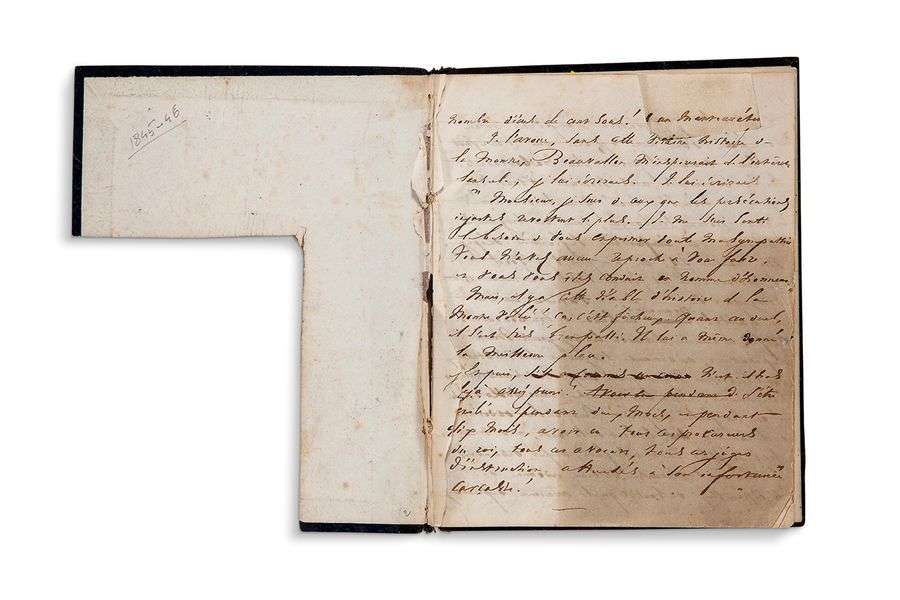
HUGO Charles (1826 - 1871) MANUSCRIT autograph, [circa 1845]| small notebook in-4
(19 x 15 cm) of 22 pages plus blank ff., original black embossed paper boards with vegetal motifs, black basane spine (cut on the first cover, small cut at the top of the 1st f., a few ff. torn at the beginning of the notebook), midnight blue half-maroquin folder, slipcase.
Curious unpublished document, reporting remarks by Victor Hugo, and a chat about Mme de Staël.
Charles Hugo, whose handwriting imitates that of his father, reports Victor Hugo's remarks in the first part. The text (incomplete at the beginning) moves from the end of a story about a stolen watch, to an account of a crime committed by Basque brigands, known as "traboucaires", on February 21, 1845: the theft of passengers from a stagecoach, and the kidnapping, confinement, mutilation and murder of one of them. The story is peppered with amusing details, as well as anecdotes from travelers in the Basque country (where Hugo had visited in
Hugo had visited in 1843)| then the memory of the Brest penal colony (which Victor Hugo visited in 1834), where Hugo meets the man "who single-handedly stopped the Toulouse stagecoach. He had put clothes and hats on the stiles that lined the road. Then he put other stilts across the road, like rifles making the movement of laying at gunpoint. [...] He was sentenced to the galleys for life. I saw him in Brest prison. He looked intelligent and fine. I approached him and said: "There was spirit in your idea. He replied: "And stupidity too, since that's why I'm here.
The second part, entitled M. de Lacretelle et Mme de Staël, is a kind of record of a conversation between Hugo and Mme de Staël.
LACRETELLE jeune, and their wives about Mme de STAËL, who is attributed with charm, buttons and the impropriety of receiving high-ranking characters during her toilette: "Victor Hugo. Incredible. Always between two shirts?
M. de Lacretelle. Yes, always. She leaned her bare arm nonchalantly on my shoulder. I was speechless. I confess that in that moment I was the silliest boy in the world"... Lacretelle goes on to multiply his memories of Corinne, Benjamin Constant, Soumet, M. de ***, M. de Rocca, Mme.
de Rocca, Mme Tallien... "Victor Hugo - One can't imagine such impudence as that of Mme de Staël. One day, the Emperor was at the bath| she wanted to enter despite the instructions| she forced her way in, exclaiming: "Genius knows no sex! The Emperor received her as she deserved, with severity. I confess that I would feel an inexpressible repugnance for such a woman.
I fully understand M. de Lacretelle's disdain.
Besides, she had no talent. It's a prejudice that Mme de
Staël. She wrote works of empire, and invented heroes in the style of the Pendulum"...
(19 x 15 cm) of 22 pages plus blank ff., original black embossed paper boards with vegetal motifs, black basane spine (cut on the first cover, small cut at the top of the 1st f., a few ff. torn at the beginning of the notebook), midnight blue half-maroquin folder, slipcase.
Curious unpublished document, reporting remarks by Victor Hugo, and a chat about Mme de Staël.
Charles Hugo, whose handwriting imitates that of his father, reports Victor Hugo's remarks in the first part. The text (incomplete at the beginning) moves from the end of a story about a stolen watch, to an account of a crime committed by Basque brigands, known as "traboucaires", on February 21, 1845: the theft of passengers from a stagecoach, and the kidnapping, confinement, mutilation and murder of one of them. The story is peppered with amusing details, as well as anecdotes from travelers in the Basque country (where Hugo had visited in
Hugo had visited in 1843)| then the memory of the Brest penal colony (which Victor Hugo visited in 1834), where Hugo meets the man "who single-handedly stopped the Toulouse stagecoach. He had put clothes and hats on the stiles that lined the road. Then he put other stilts across the road, like rifles making the movement of laying at gunpoint. [...] He was sentenced to the galleys for life. I saw him in Brest prison. He looked intelligent and fine. I approached him and said: "There was spirit in your idea. He replied: "And stupidity too, since that's why I'm here.
The second part, entitled M. de Lacretelle et Mme de Staël, is a kind of record of a conversation between Hugo and Mme de Staël.
LACRETELLE jeune, and their wives about Mme de STAËL, who is attributed with charm, buttons and the impropriety of receiving high-ranking characters during her toilette: "Victor Hugo. Incredible. Always between two shirts?
M. de Lacretelle. Yes, always. She leaned her bare arm nonchalantly on my shoulder. I was speechless. I confess that in that moment I was the silliest boy in the world"... Lacretelle goes on to multiply his memories of Corinne, Benjamin Constant, Soumet, M. de ***, M. de Rocca, Mme.
de Rocca, Mme Tallien... "Victor Hugo - One can't imagine such impudence as that of Mme de Staël. One day, the Emperor was at the bath| she wanted to enter despite the instructions| she forced her way in, exclaiming: "Genius knows no sex! The Emperor received her as she deserved, with severity. I confess that I would feel an inexpressible repugnance for such a woman.
I fully understand M. de Lacretelle's disdain.
Besides, she had no talent. It's a prejudice that Mme de
Staël. She wrote works of empire, and invented heroes in the style of the Pendulum"...