
&w=3840&q=75)
&w=3840&q=75)
&w=3840&q=75)
&w=3840&q=75)
&w=3840&q=75)
&w=3840&q=75)
&w=3840&q=75)
&w=3840&q=75)


350
DUHAMEL DU MONCEAU (Henri-Louis)| LOISELEUR-DESLONGCHAMPS (Jean) / Traité
The item was sold for 54 064 €
Fees include commission and taxes.
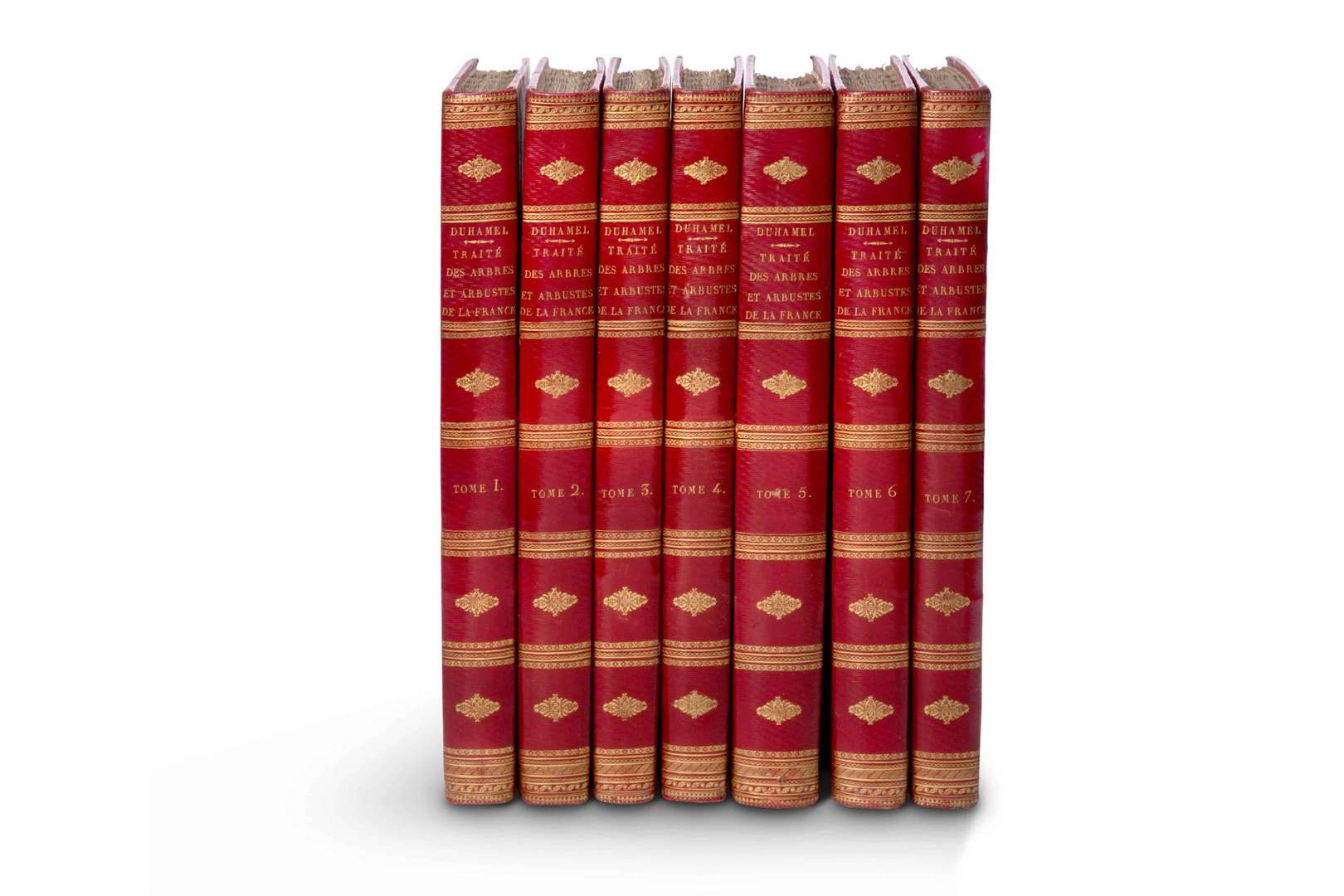
DUHAMEL DU MONCEAU (Henri-Louis)| LOISELEUR-DESLONGCHAMPS (Jean) / Traité des arbres et arbustes qui se cultivent en France en pleine terre.
Second edition considerably enlarged. À Paris, chez Didot aîné, Michel, Lamy, [c. 1800] - 1819. 7 volumes in-folio, half red long-grained morocco with period corners, smooth spine, gilt author, title, rouettes and fleurons, untrimmed (corners rubbed, 2 small snags on spine of t.5| qq. scattered flaws not serious, condition report on request).
A fine copy of one of the most beautiful botanical works ever published in France, combining scientific precision with remarkable aesthetic qualities.
It is illustrated with 498 plates printed in color and hand-enhanced from drawings by Pierre-Joseph Redouté.
When he published the first edition of his Traité des arbres et arbustes qui se cultivent en France in 1755, botanist and agronomist Henri Louis Duhamel Du Monceau, an eminent member of the Académie des Sciences, offered the public a brilliant synthesis of arboricultural knowledge at the time. Although recognized and appreciated by the scientific community, the book was not republished until after its author's death in 1782.
It wasn't until around 1800 that Parisian publishers Pierre Didot, Étienne Michel and P.-M. Lamy brought out this new publication of remarkable scope and quality. In folio format, it consisted of eighty-three issues, each containing six plates and the corresponding text, for a total of 498 plates. The text was considerably enriched, in particular in three additional volumes entitled "Nouveau Duhamel", written by the botanist Jean Loiseleur-Deslongchamps, a pupil of Lamarck. Publication continued until 1819, forming a seven-volume set that was both a monument to botanical science and a jewel in the crown of bibliophily.
The entirely renewed iconography was the work of Pierre-Joseph Redouté, the famous painter of roses, nicknamed the "Raphael of flowers", whose reputation was at its height at the time. His pupil Pancrace Bessa, also a renowned flower painter, contributed to the work. The plants were drawn from observed specimens, particularly those in the collection of the Paris Natural History Museum. The technique employed, long tried and tested by Redouté in his previous publications, consists of extremely precise stipple engraving, enabling the plates to be printed in color and then enhanced with watercolor. The result is of exceptional quality, highlighting the finest details of the plants and reflecting their original colors to best effect.
(Brunet II, 871| Great Flower Books, p.55| Nissen 549| Pritzel 2470)
Second edition considerably enlarged. À Paris, chez Didot aîné, Michel, Lamy, [c. 1800] - 1819. 7 volumes in-folio, half red long-grained morocco with period corners, smooth spine, gilt author, title, rouettes and fleurons, untrimmed (corners rubbed, 2 small snags on spine of t.5| qq. scattered flaws not serious, condition report on request).
A fine copy of one of the most beautiful botanical works ever published in France, combining scientific precision with remarkable aesthetic qualities.
It is illustrated with 498 plates printed in color and hand-enhanced from drawings by Pierre-Joseph Redouté.
When he published the first edition of his Traité des arbres et arbustes qui se cultivent en France in 1755, botanist and agronomist Henri Louis Duhamel Du Monceau, an eminent member of the Académie des Sciences, offered the public a brilliant synthesis of arboricultural knowledge at the time. Although recognized and appreciated by the scientific community, the book was not republished until after its author's death in 1782.
It wasn't until around 1800 that Parisian publishers Pierre Didot, Étienne Michel and P.-M. Lamy brought out this new publication of remarkable scope and quality. In folio format, it consisted of eighty-three issues, each containing six plates and the corresponding text, for a total of 498 plates. The text was considerably enriched, in particular in three additional volumes entitled "Nouveau Duhamel", written by the botanist Jean Loiseleur-Deslongchamps, a pupil of Lamarck. Publication continued until 1819, forming a seven-volume set that was both a monument to botanical science and a jewel in the crown of bibliophily.
The entirely renewed iconography was the work of Pierre-Joseph Redouté, the famous painter of roses, nicknamed the "Raphael of flowers", whose reputation was at its height at the time. His pupil Pancrace Bessa, also a renowned flower painter, contributed to the work. The plants were drawn from observed specimens, particularly those in the collection of the Paris Natural History Museum. The technique employed, long tried and tested by Redouté in his previous publications, consists of extremely precise stipple engraving, enabling the plates to be printed in color and then enhanced with watercolor. The result is of exceptional quality, highlighting the finest details of the plants and reflecting their original colors to best effect.
(Brunet II, 871| Great Flower Books, p.55| Nissen 549| Pritzel 2470)