
&w=3840&q=75)
&w=3840&q=75)
&w=3840&q=75)
&w=3840&q=75)
&w=3840&q=75)
&w=3840&q=75)
&w=3840&q=75)
&w=3840&q=75)


291
[MANUSCRIT ENLUMINÉ DU XVe SIÈCLE]. [NORMANDIE] Heures à l'usage de Rouen,
The item was sold for 19 500 €
Fees include commission and taxes.
[15th century illuminated manuscript]. [NORMANDIE] Hours for the use of Rouen, northern France, late 15th century, circa 1470.
Volume 180 × 142 × 50 mm, [143] vellum leaves.
Page: 173 × 130. Calendar: lower margin 50 mm| upper margin 21 mm| inner margin 25 mm| outer margin 42 mm| writing area: 92 × 65 mm, one column of 16 lines, line spacing 6 mm. Hours: lower margin
50 to 55 mm| sup. 28 mm| int. 20 mm| ext. 40 mm| writing area: 92 × 65 mm, one column of 15 lines. Brown and red ink. Some leaves missing.
Bound in 17th-century glazed brown calf, spine with 4 nerves, gilt fleurons, boards edged with 2 fillets with angular fleurons and in the center in fleurons the motif of a cross with instruments of the Passion, all gilt, gilt edges, remains of clasps (flaws including splits to the jaws, dull corners, superf. scratches to the boards).
Calendar (f. 1r-12v).
The calendar (complete), written in French, follows the custom of the diocese of Rouen. First, we note the name of Saint Sever (February 1st), mentioned in a 15th-century breviary used in Rouen (Leroq. B. 539), which also commemorates Saint Austreberte on the same date.
Austreberte on the 10th of the same month. Saint Honorine (February 28) is celebrated on the 27th in four 15th-century breviaries for Bayeux, Coutances and Sées (Leroq. B.572, B.571, B.631, B.661). Saint Valery (April 1st) is mentioned in several 15th-century Rouen manuscripts, as is Saint Eutrope (April 30th) (Leroq. M.725, M.724, Lat. 1334). The translation of the relics of Saint Ouen (May 5) confirms the use of the diocese of Rouen, as does Saint Didier (May 23), who appears in a breviary, a diurnal and three missals for use in Rouen and Lisieux (Leroq. B.539, Lat. 1323, M.725, M.724, M.248, Lat. 1334).
Hours of the Virgin (f. 27r-): matins (f. 27r-38r)| lauds (f. 38v- 50r) [f. 50 blank sheet, ruled, ornate margins]| prime (f. 51r-57r)| tierce (f. 57r-64r)| none (f. 64r-67v) [f. 68: blank sheet, ruled, ornate margins]| vespers [beginning missing]| continuation of psalm 122, 4 (f. 69r)| Compline (f. 74r- 78v) [missing beginning]| Psalm 13 (f. 74r)| [f. 79 blank, ruled, ornate margins]| f. 80r continuation of Psalm 6| Litany (f. 92v-95v)| [f. 96 blank, ruled, ornate margins].
Hours of the Cross (f. 97r-103r): matins (f. 97r-98r)| prime (f. 98r-100r) [f. 100v blank, ruled, ornate margins]| f. 101r continuation of the prayer to the Holy Spirit "Et renovabis faciem terrae".
Hours of the Dead (f. 104r-143v) [f. 142v-143v blank, ruled, ornate margins].
Decor
The calendar is adorned with 12 gold-ink lettering on a blue and purple background, highlighted with white (approx. 30 × 12 mm).
The outer margin is decorated with blue and gold scrolls, alternating with floral scrolls and wild berries (90 × 25 to 100 × 30 mm). 8 large initials mark the beginning of the main sections of the service (25 × 20 to 32 × 25 mm). Painted on a gold background, they feature pale blue and crimson coiled leather decorations, and are decorated with bunches of grapes and plants. 120 medium-sized initials (17 × 12 mm) punctuate the text, marking the beginning of psalms and orations| small initials (12 × 7 mm) embellish the initial of each verse.
Several leaves also feature full-page marginal ornamentation (f. 17r, 74r). The margins are lined with blue and gold scrolls, alternating with carnation scrolls, and feature gold-ground escutcheons of various shapes, containing bunches of pansies, violets and strawberries. The taste for these ornaments, relatively frequent in Parisian production at the end of the 15th century, seems to have been stimulated by the influence of renowned workshops such as that of the Master of Cardinal de Bourbon, active between 1470 and 1500 (Autun, BM, ms. S.
191| Paris, BnF, ms. Smith-Lesouëf 24).
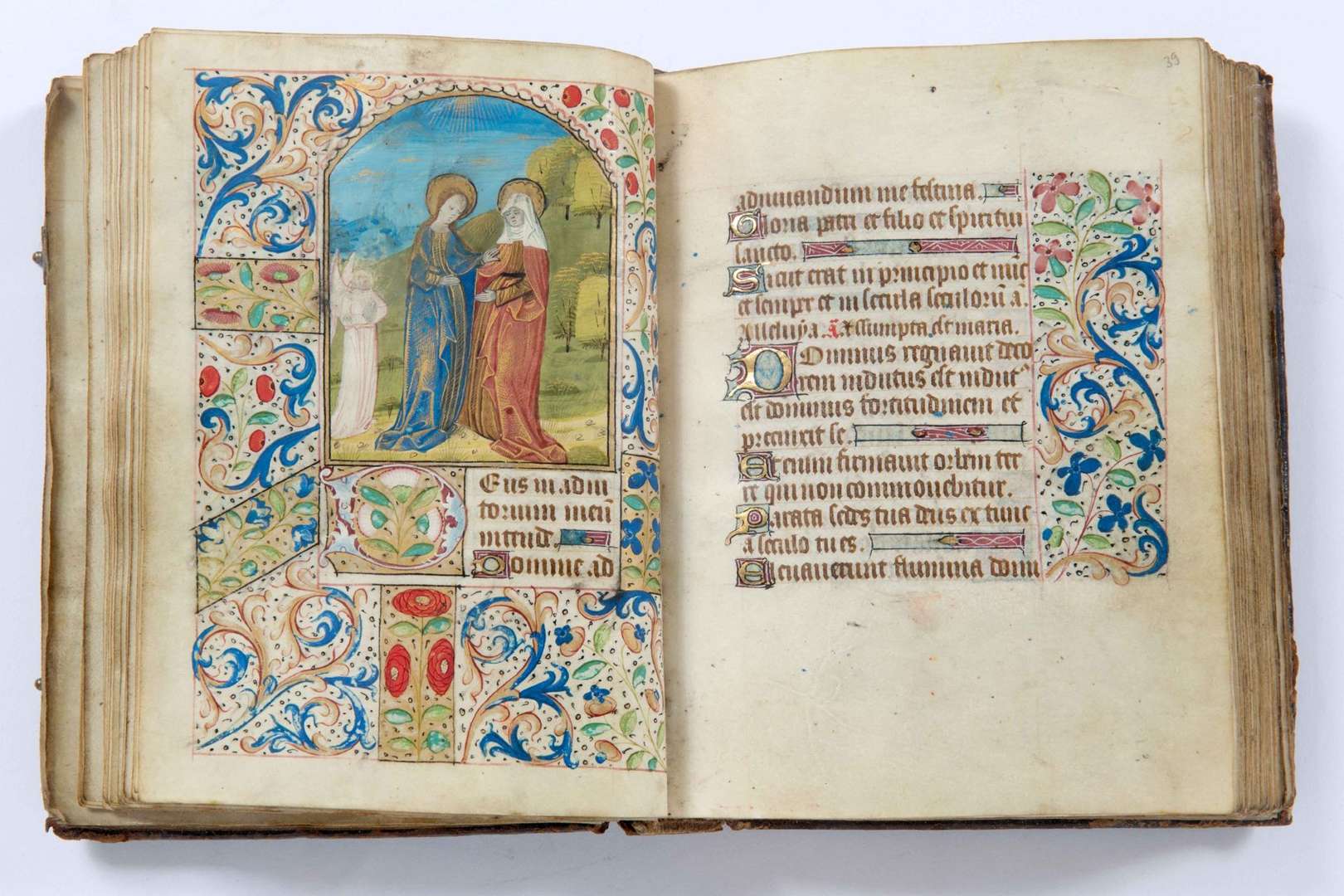
The decoration is completed by five miniatures (86 × 65 mm) set in curved quadrangular frames, surrounded by floral margins covering a full page (155 × 111 mm). The
Hours of the Virgin Mary open with the image of the Annunciation, which accompanies matins (f. 27r)| the Visitation precedes lauds (f. 38v) and the Nativity takes precedence (f. 51r). The matins of the Cross are adorned with a Crucifixion (f. 97r) and the Office of the Dead with a representation of a funeral (f. 104r). The treatment of the faces, with their elongated, barely differentiated features, is reminiscent of the touch of the Master of Philippe de Croÿ (Université de Liège ms.
Wittert 14), although the palette and treatment of the drapery are different. Similarly, the green and brown tones of the landscape offer similar nuances to those of several miniatures executed in the circle of this illuminator.
Saint Taurin d'Évreux (April 11) appears in five manuscripts used in Avranches, Coutances and Rouen at the same time (Leroq. B.661, B.660, M.725, M.724, Lat. 1334). The festival
Volume 180 × 142 × 50 mm, [143] vellum leaves.
Page: 173 × 130. Calendar: lower margin 50 mm| upper margin 21 mm| inner margin 25 mm| outer margin 42 mm| writing area: 92 × 65 mm, one column of 16 lines, line spacing 6 mm. Hours: lower margin
50 to 55 mm| sup. 28 mm| int. 20 mm| ext. 40 mm| writing area: 92 × 65 mm, one column of 15 lines. Brown and red ink. Some leaves missing.
Bound in 17th-century glazed brown calf, spine with 4 nerves, gilt fleurons, boards edged with 2 fillets with angular fleurons and in the center in fleurons the motif of a cross with instruments of the Passion, all gilt, gilt edges, remains of clasps (flaws including splits to the jaws, dull corners, superf. scratches to the boards).
Calendar (f. 1r-12v).
The calendar (complete), written in French, follows the custom of the diocese of Rouen. First, we note the name of Saint Sever (February 1st), mentioned in a 15th-century breviary used in Rouen (Leroq. B. 539), which also commemorates Saint Austreberte on the same date.
Austreberte on the 10th of the same month. Saint Honorine (February 28) is celebrated on the 27th in four 15th-century breviaries for Bayeux, Coutances and Sées (Leroq. B.572, B.571, B.631, B.661). Saint Valery (April 1st) is mentioned in several 15th-century Rouen manuscripts, as is Saint Eutrope (April 30th) (Leroq. M.725, M.724, Lat. 1334). The translation of the relics of Saint Ouen (May 5) confirms the use of the diocese of Rouen, as does Saint Didier (May 23), who appears in a breviary, a diurnal and three missals for use in Rouen and Lisieux (Leroq. B.539, Lat. 1323, M.725, M.724, M.248, Lat. 1334).
Hours of the Virgin (f. 27r-): matins (f. 27r-38r)| lauds (f. 38v- 50r) [f. 50 blank sheet, ruled, ornate margins]| prime (f. 51r-57r)| tierce (f. 57r-64r)| none (f. 64r-67v) [f. 68: blank sheet, ruled, ornate margins]| vespers [beginning missing]| continuation of psalm 122, 4 (f. 69r)| Compline (f. 74r- 78v) [missing beginning]| Psalm 13 (f. 74r)| [f. 79 blank, ruled, ornate margins]| f. 80r continuation of Psalm 6| Litany (f. 92v-95v)| [f. 96 blank, ruled, ornate margins].
Hours of the Cross (f. 97r-103r): matins (f. 97r-98r)| prime (f. 98r-100r) [f. 100v blank, ruled, ornate margins]| f. 101r continuation of the prayer to the Holy Spirit "Et renovabis faciem terrae".
Hours of the Dead (f. 104r-143v) [f. 142v-143v blank, ruled, ornate margins].
Decor
The calendar is adorned with 12 gold-ink lettering on a blue and purple background, highlighted with white (approx. 30 × 12 mm).
The outer margin is decorated with blue and gold scrolls, alternating with floral scrolls and wild berries (90 × 25 to 100 × 30 mm). 8 large initials mark the beginning of the main sections of the service (25 × 20 to 32 × 25 mm). Painted on a gold background, they feature pale blue and crimson coiled leather decorations, and are decorated with bunches of grapes and plants. 120 medium-sized initials (17 × 12 mm) punctuate the text, marking the beginning of psalms and orations| small initials (12 × 7 mm) embellish the initial of each verse.
Several leaves also feature full-page marginal ornamentation (f. 17r, 74r). The margins are lined with blue and gold scrolls, alternating with carnation scrolls, and feature gold-ground escutcheons of various shapes, containing bunches of pansies, violets and strawberries. The taste for these ornaments, relatively frequent in Parisian production at the end of the 15th century, seems to have been stimulated by the influence of renowned workshops such as that of the Master of Cardinal de Bourbon, active between 1470 and 1500 (Autun, BM, ms. S.
191| Paris, BnF, ms. Smith-Lesouëf 24).
The decoration is completed by five miniatures (86 × 65 mm) set in curved quadrangular frames, surrounded by floral margins covering a full page (155 × 111 mm). The
Hours of the Virgin Mary open with the image of the Annunciation, which accompanies matins (f. 27r)| the Visitation precedes lauds (f. 38v) and the Nativity takes precedence (f. 51r). The matins of the Cross are adorned with a Crucifixion (f. 97r) and the Office of the Dead with a representation of a funeral (f. 104r). The treatment of the faces, with their elongated, barely differentiated features, is reminiscent of the touch of the Master of Philippe de Croÿ (Université de Liège ms.
Wittert 14), although the palette and treatment of the drapery are different. Similarly, the green and brown tones of the landscape offer similar nuances to those of several miniatures executed in the circle of this illuminator.
Saint Taurin d'Évreux (April 11) appears in five manuscripts used in Avranches, Coutances and Rouen at the same time (Leroq. B.661, B.660, M.725, M.724, Lat. 1334). The festival