
&w=3840&q=75)
&w=3840&q=75)
&w=3840&q=75)
&w=3840&q=75)
&w=3840&q=75)
&w=3840&q=75)


187
CHINE FIN DU XIXe - DÉBUT DU XXe SIÈCLE
The item was sold for 9 446 €
Fees include commission and taxes.
CHINE FIN DU XIXe - DÉBUT DU XXe SIÈCLE
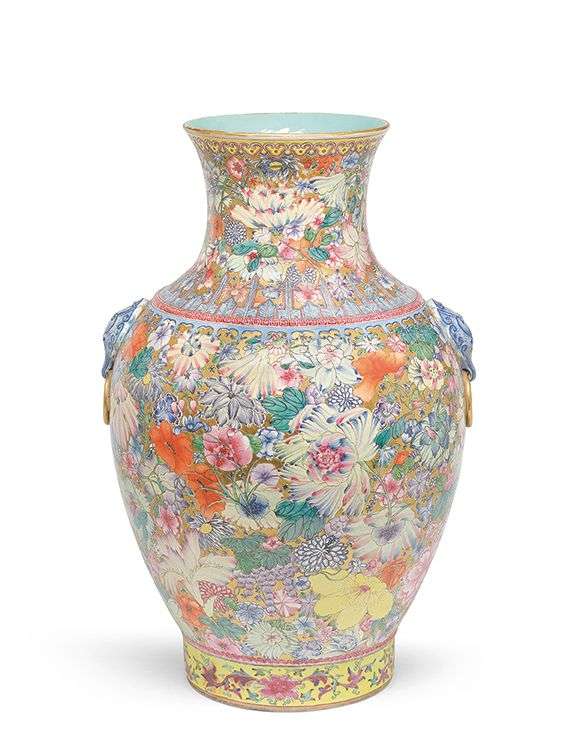
= Large porcelain vase with "mille-fleurs" decoration
Baluster-shaped, the shoulder decorated with two heads of fabulous animals holding molded rings, the body entirely decorated with polychrome enamels of a semiset of varied flowers on a gold background. The interior is enameled turquoise blue. The turquoise-blue enameled base with a six-character Qianlong mark in iron-red zhuanshu.
H. 51 cm
PROVENANCE
French private collection
An identical vase sold by Sotheby's, Paris, sale of June 10, 2014, lot no. 268
NOTE
The "mille-fleurs" decoration, which juxtaposes a multitude of flower varieties (chrysanthemum, peony, rose, lotus, magnolia, iris, aster...) with an acute sense of detail and observation, is an artistic feat of 18th century China, as each family of enamels must be fired at a particular temperature. This technical tour de force was made possible by the mastery of "Cassius purple", which produces the pink color, and opaque white enamel, which allows for pastel nuances. The present vase is based on the composition of the famous "mille-fleurs" imperial vase from the Ernest Grandidier collection at the Musée National des Arts Asiatiques Guimet (G 3344).
= Large porcelain vase with "mille-fleurs" decoration
Baluster-shaped, the shoulder decorated with two heads of fabulous animals holding molded rings, the body entirely decorated with polychrome enamels of a semiset of varied flowers on a gold background. The interior is enameled turquoise blue. The turquoise-blue enameled base with a six-character Qianlong mark in iron-red zhuanshu.
H. 51 cm
PROVENANCE
French private collection
An identical vase sold by Sotheby's, Paris, sale of June 10, 2014, lot no. 268
NOTE
The "mille-fleurs" decoration, which juxtaposes a multitude of flower varieties (chrysanthemum, peony, rose, lotus, magnolia, iris, aster...) with an acute sense of detail and observation, is an artistic feat of 18th century China, as each family of enamels must be fired at a particular temperature. This technical tour de force was made possible by the mastery of "Cassius purple", which produces the pink color, and opaque white enamel, which allows for pastel nuances. The present vase is based on the composition of the famous "mille-fleurs" imperial vase from the Ernest Grandidier collection at the Musée National des Arts Asiatiques Guimet (G 3344).