
&w=3840&q=75)
&w=3840&q=75)
&w=3840&q=75)
&w=3840&q=75)
&w=3840&q=75)
&w=3840&q=75)
&w=3840&q=75)
&w=3840&q=75)


27
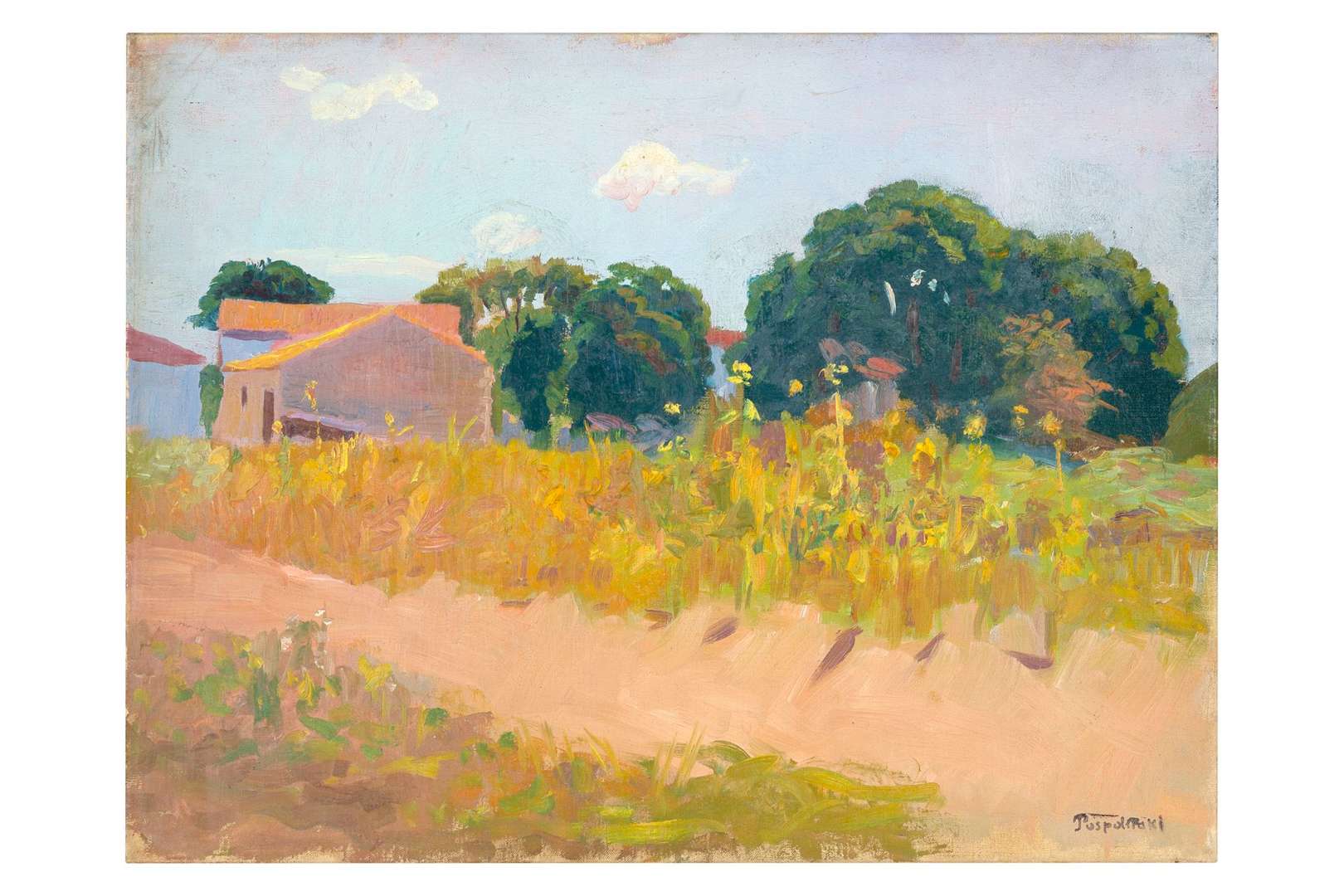
EVGENI IVANOVITCH POSPOLITAKI (1852-VERS 1915)
The item was sold for 1 120 €
Fees include commission and taxes.
EVGENI IVANOVITCH POSPOLITAKI (1852-CIRCA 1915)
Reunion of two paintings
Path in the countryside - Rocky seashore
Oil on canvas
Signed with the signature stamp [non Lugt] lower right
(Small perforations, missing paint layer and soiling)
A set of two paintings, oil on canvas, stamped with the signature's mark lower right
46 x 60 cm - 18 1/8 x 23 5/8 in.
50 x 60 cm - 19 3/4 x 23 5/8 in.
Provenance
Private collection, France
Note
Evgeni Ivanovitch Pospolitaki, known as Eugène Pospolitaki, was born in 1852 in Temriouk, in southwest Russia. He was the son of a sergeant in the Russian army. At the age of 21, after training in civil engineering and construction, he enrolled at the St. Petersburg Academy of Fine Arts. After graduating, he went to Moscow, where he stayed from 1875 to 1879. The Tretyakov Gallery acquired a painting for him in 1877: "Evening". The following year, the artist moved to Paris, then the capital of the arts. Sensitive to the work on light undertaken by the Impressionists, he painted seashores with a palette divided into vivid tones. Back in Russia, Pospolitaki took part in the Moscow Salon of Art Lovers alongside Viktor Mikhailovich Vasnetsov (1848-1926), Isaac Ilitch Levitan (1860-1900) and Valentin Aleksandrovich Serov (1865-1911). He returned to Paris in 1889 and lent a painting entitled "Sommet de l'Elbrouss | - Caucase" to the Universal Exhibition. On this occasion, he received an Honorable Mention. In 1892, he presented "Mount Uzhba" at the XIIth Periodical Exhibition of the Muscovite Society of Fine Arts. The following year, he moved to Yekaterinodar (Krasnodar) to teach at the first Academy of Painting for Women. In conjunction with this activity, and thanks to his father's inheritance, Pospolitaki founded the first private drawing school on the first floor of his house. The school was taken over in 1905 by one of his pupils, a certain Stupnikov. Pospolitaki then returned to Paris and tried his hand at art criticism. Four years later, in Russia, he exhibited a series of Caucasian landscapes at the IVth Painting Exhibition of the St. Petersburg Society of Non-Party Artists. Back in Paris in 1911, the artist painted "La Tour Clovis (Paris), ancienne tour de l'Abbaye Sainte-Geneviève, peinte depuis l'arrière du Panthéon". A label on the back of the painting mentions the 4th Salon du mobilier, section Beaux-Arts (Paris, Grand Palais des Champs-Élysées). The end of Pospolitaki's life is poorly documented. He probably lived in St. Petersburg until his death around 1915.
Reunion of two paintings
Path in the countryside - Rocky seashore
Oil on canvas
Signed with the signature stamp [non Lugt] lower right
(Small perforations, missing paint layer and soiling)
A set of two paintings, oil on canvas, stamped with the signature's mark lower right
46 x 60 cm - 18 1/8 x 23 5/8 in.
50 x 60 cm - 19 3/4 x 23 5/8 in.
Provenance
Private collection, France
Note
Evgeni Ivanovitch Pospolitaki, known as Eugène Pospolitaki, was born in 1852 in Temriouk, in southwest Russia. He was the son of a sergeant in the Russian army. At the age of 21, after training in civil engineering and construction, he enrolled at the St. Petersburg Academy of Fine Arts. After graduating, he went to Moscow, where he stayed from 1875 to 1879. The Tretyakov Gallery acquired a painting for him in 1877: "Evening". The following year, the artist moved to Paris, then the capital of the arts. Sensitive to the work on light undertaken by the Impressionists, he painted seashores with a palette divided into vivid tones. Back in Russia, Pospolitaki took part in the Moscow Salon of Art Lovers alongside Viktor Mikhailovich Vasnetsov (1848-1926), Isaac Ilitch Levitan (1860-1900) and Valentin Aleksandrovich Serov (1865-1911). He returned to Paris in 1889 and lent a painting entitled "Sommet de l'Elbrouss | - Caucase" to the Universal Exhibition. On this occasion, he received an Honorable Mention. In 1892, he presented "Mount Uzhba" at the XIIth Periodical Exhibition of the Muscovite Society of Fine Arts. The following year, he moved to Yekaterinodar (Krasnodar) to teach at the first Academy of Painting for Women. In conjunction with this activity, and thanks to his father's inheritance, Pospolitaki founded the first private drawing school on the first floor of his house. The school was taken over in 1905 by one of his pupils, a certain Stupnikov. Pospolitaki then returned to Paris and tried his hand at art criticism. Four years later, in Russia, he exhibited a series of Caucasian landscapes at the IVth Painting Exhibition of the St. Petersburg Society of Non-Party Artists. Back in Paris in 1911, the artist painted "La Tour Clovis (Paris), ancienne tour de l'Abbaye Sainte-Geneviève, peinte depuis l'arrière du Panthéon". A label on the back of the painting mentions the 4th Salon du mobilier, section Beaux-Arts (Paris, Grand Palais des Champs-Élysées). The end of Pospolitaki's life is poorly documented. He probably lived in St. Petersburg until his death around 1915.