
&w=3840&q=75)
&w=3840&q=75)
&w=3840&q=75)
&w=3840&q=75)
&w=3840&q=75)
&w=3840&q=75)


81
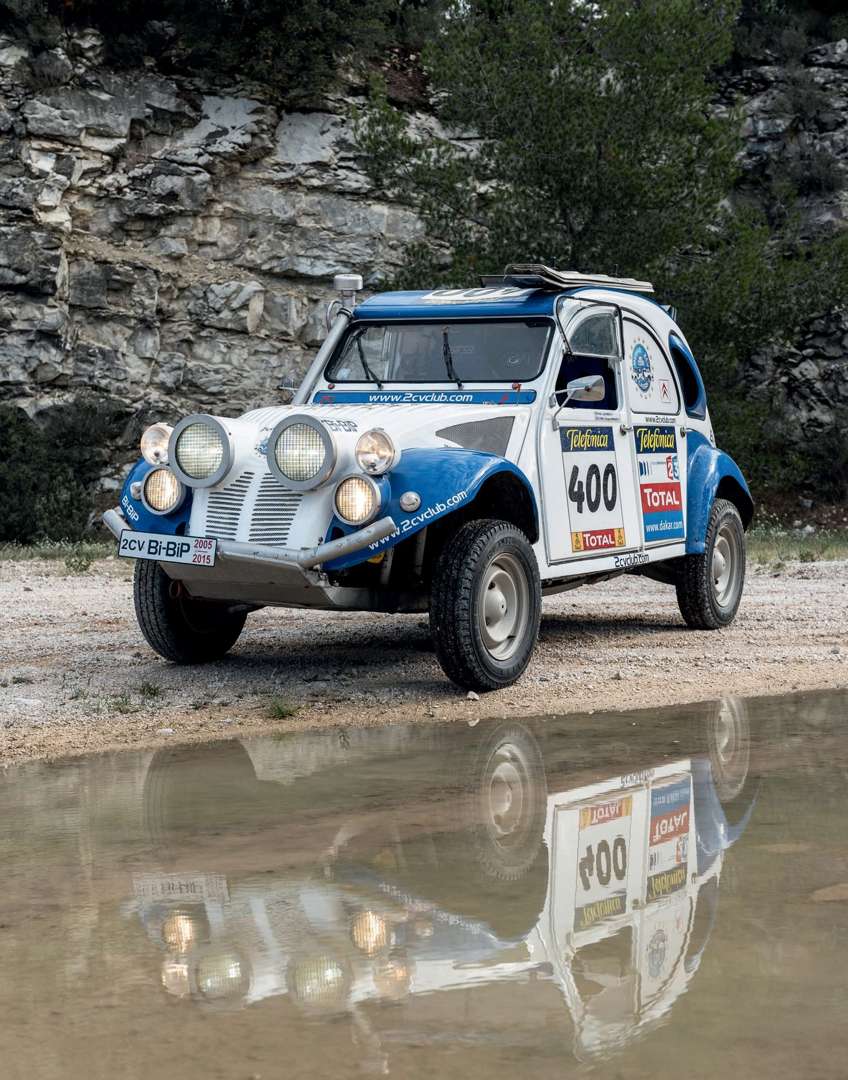
2005 - CITROËN 2 CV Bimoteur Bi-Bip
The item was sold for 57 636 €
Fees include commission and taxes.
2005 - CITROËN 2 CV Bimoteur Bi-Bip
Non registered competition prototype
The undisputed star of the 2005 Dakar, one of the last “real” Dakars
A showcase for the expertise and high standards of the unrivalled Mehari Club
Cassis dealership
One of the rare 2CVs to finish a Dakar (not classified)
Identical twin-engined 4x4 design to the legendary Sahara, with exceptional crossing capacity and traction
A unique car, ideal for taking part in the Dakar
Classic or any other historic Rally-Raid
31st December 2004, Barcelona| an improbable blue and white Citroën 2CV drives into the middle of the 4x4s, motor-bikes, quads and trucks on the starting podium of the 27th Dakar, the toughest and most publi-cised rally-raid in the world. Since the first edition in 1979, organised by “guru” Thierry Sabine, the famous Dakar caravan has seen a whole host of vehicles, each more improbable than the last, from Thierry de Montcorgé’s Rolls-Royce Corniche (sold in 2021 by Aguttes, and soon to be at the start of the Dakar Classic) to Citroën ZX Rallye-Raid cars (also an Aguttes speciality...), authentic Gr. Bs transformed into desert F1s. The 2CV that illustrates these pages is closer to the Rolls Jules than to a factory Pajero, in terms of its history, design and performance.To understand the genesis and history of Bi-Bip, as it is called, we need to delve back into the history of the Mehari Club Cassis, the unmissable garage specialising in the renovation and rebuilding of Mehari and 2 CV cars, under the watchful and official eye of Citroën. The adventure began in the 1980s, when three brothers, Georges, Gilles and Philippe Marquès, set up their business close to their father’s Citroën agency.
They began by renovating and customising Mehari cars, before creating their own spare parts catalogue a few years later. In 1998, Citroën, in recognition of their work to keep the passion for cars with the chevrons alive, entrusted them with its original tooling to repro-duce the parts for the Mehari it was disconti-nuing. The same handover took place in the early 2000s with the 2CV. Since then, the teams at Cassis have carried on this tradition and this unique expertise, enabling them to pre-serve this part of France’s automotive heritage. This unwavering commitment to excellence has been rewarded with the Living Heritage Company label, which recognises French companies with exceptional craftsmanship and industrial know-how, and makes it the benchmark for all lovers of the chevron brand and its legendary models: the 2 CV, the Méhari and the Dyane.In the early 2000s, the intrepid Georges Marquès dreamt of the Dakar and managed to get the family business on board for this great media and technical adventure, which would do a great deal for the brand’s image. With his mechanics, they decided to build a prototype based on the principle of the 2 CV Sahara, which had already proved its worth. It was the only production car in the world to have two engines and two gearboxes. Built in less than 700 examples between 1958 and 1966, this Deuche is a true 4x4 off-roader, capable of climbing gradients of more than 45% and exceeding 100 km/h! Given the rarity and value of Saharas (some have fetched over €100,000!), Mehari Club Cassis decided to start from new parts and build a Sahara 2.0. Lighter body, full skis, prepared engines, made-to-measure chassis, polyester bonnet, set of headlights adapted to the darkness of the desert, full roll bar, large fuel tank, bucket seats, harnesses, etc...
Flanked by the number 400, the 2CV christened Bi-Bip (an amalgam of Bip-Bip, the big, very fast blue bird constantly chased by Coyote in the cartoon of the same name, and Bi, for twin-en-gined) looked very good at the start of the 2005 Dakar. Up until 4 January, it completed a series of honourable special stages, even if its low power meant that it only finished at the bottom of the standings. On 5 January, clutch problems caused it to cross the finish line out of time... Nevertheless, buoyed by its status as a star of the paddocks and a media darling, the valiant 2 CV Bi-Bip made its way to Dakar via the track. A real feat, even if it wasn’t in the standings.Since then, the iconic blue-white twin-engined 2CV has played the star at a number of motor shows, and in the showroom of the Mehari Club Cassis, which decided it was time for it to come out of its under-active retirement. It’s waiting for a 2CV enthusiast who’d like to complete his collection with a historic racing prototype, or a gentleman driver looking for a media car for the next Dakar Classic. Don’t miss your chance!
Non registered competition prototype
The undisputed star of the 2005 Dakar, one of the last “real” Dakars
A showcase for the expertise and high standards of the unrivalled Mehari Club
Cassis dealership
One of the rare 2CVs to finish a Dakar (not classified)
Identical twin-engined 4x4 design to the legendary Sahara, with exceptional crossing capacity and traction
A unique car, ideal for taking part in the Dakar
Classic or any other historic Rally-Raid
31st December 2004, Barcelona| an improbable blue and white Citroën 2CV drives into the middle of the 4x4s, motor-bikes, quads and trucks on the starting podium of the 27th Dakar, the toughest and most publi-cised rally-raid in the world. Since the first edition in 1979, organised by “guru” Thierry Sabine, the famous Dakar caravan has seen a whole host of vehicles, each more improbable than the last, from Thierry de Montcorgé’s Rolls-Royce Corniche (sold in 2021 by Aguttes, and soon to be at the start of the Dakar Classic) to Citroën ZX Rallye-Raid cars (also an Aguttes speciality...), authentic Gr. Bs transformed into desert F1s. The 2CV that illustrates these pages is closer to the Rolls Jules than to a factory Pajero, in terms of its history, design and performance.To understand the genesis and history of Bi-Bip, as it is called, we need to delve back into the history of the Mehari Club Cassis, the unmissable garage specialising in the renovation and rebuilding of Mehari and 2 CV cars, under the watchful and official eye of Citroën. The adventure began in the 1980s, when three brothers, Georges, Gilles and Philippe Marquès, set up their business close to their father’s Citroën agency.
They began by renovating and customising Mehari cars, before creating their own spare parts catalogue a few years later. In 1998, Citroën, in recognition of their work to keep the passion for cars with the chevrons alive, entrusted them with its original tooling to repro-duce the parts for the Mehari it was disconti-nuing. The same handover took place in the early 2000s with the 2CV. Since then, the teams at Cassis have carried on this tradition and this unique expertise, enabling them to pre-serve this part of France’s automotive heritage. This unwavering commitment to excellence has been rewarded with the Living Heritage Company label, which recognises French companies with exceptional craftsmanship and industrial know-how, and makes it the benchmark for all lovers of the chevron brand and its legendary models: the 2 CV, the Méhari and the Dyane.In the early 2000s, the intrepid Georges Marquès dreamt of the Dakar and managed to get the family business on board for this great media and technical adventure, which would do a great deal for the brand’s image. With his mechanics, they decided to build a prototype based on the principle of the 2 CV Sahara, which had already proved its worth. It was the only production car in the world to have two engines and two gearboxes. Built in less than 700 examples between 1958 and 1966, this Deuche is a true 4x4 off-roader, capable of climbing gradients of more than 45% and exceeding 100 km/h! Given the rarity and value of Saharas (some have fetched over €100,000!), Mehari Club Cassis decided to start from new parts and build a Sahara 2.0. Lighter body, full skis, prepared engines, made-to-measure chassis, polyester bonnet, set of headlights adapted to the darkness of the desert, full roll bar, large fuel tank, bucket seats, harnesses, etc...
Flanked by the number 400, the 2CV christened Bi-Bip (an amalgam of Bip-Bip, the big, very fast blue bird constantly chased by Coyote in the cartoon of the same name, and Bi, for twin-en-gined) looked very good at the start of the 2005 Dakar. Up until 4 January, it completed a series of honourable special stages, even if its low power meant that it only finished at the bottom of the standings. On 5 January, clutch problems caused it to cross the finish line out of time... Nevertheless, buoyed by its status as a star of the paddocks and a media darling, the valiant 2 CV Bi-Bip made its way to Dakar via the track. A real feat, even if it wasn’t in the standings.Since then, the iconic blue-white twin-engined 2CV has played the star at a number of motor shows, and in the showroom of the Mehari Club Cassis, which decided it was time for it to come out of its under-active retirement. It’s waiting for a 2CV enthusiast who’d like to complete his collection with a historic racing prototype, or a gentleman driver looking for a media car for the next Dakar Classic. Don’t miss your chance!