
&w=3840&q=75)
&w=3840&q=75)
&w=3840&q=75)
&w=3840&q=75)
&w=3840&q=75)
&w=3840&q=75)
&w=3840&q=75)
&w=3840&q=75)


186
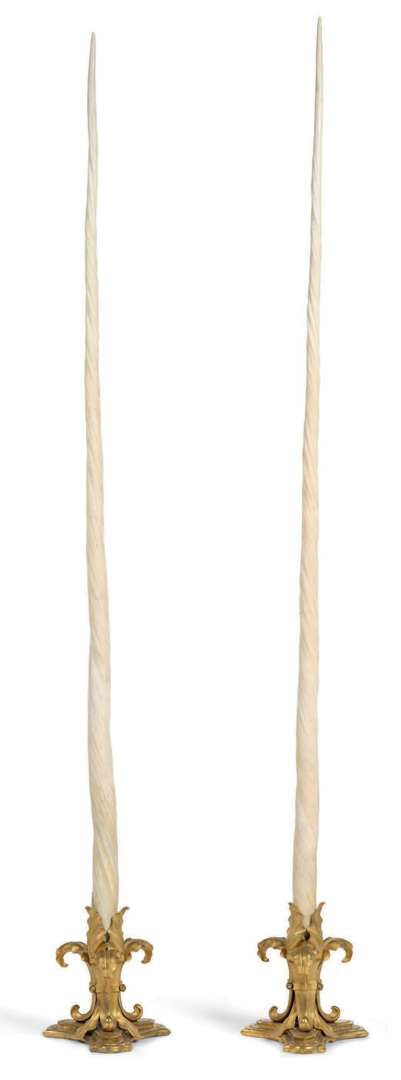
DEUX DENTS DE NARVAL
The item was sold for 78 000 €
Fees include commission and taxes.
DEUX DENTS DE NARVAL
~ each mounted on ormolu pedestals in the shape of a heraldic fleur-de-lys in full bloom. For the mounting: Rome, late 17th century, early 18th century.
Heights: 207 cm and 200 cm
Gross weight: 11 kg each
(One tooth cracked at the base)
Monodon monoceros - Intra-Community certificate issued on 28/11/2023
PROVENANCE
- Presumed property of the Farnese family in Rome.
- Adriano Ribolzi Collection
- Sold at Sotheby's on November 30, 2011, lot 12.
- Private collection.
The remarkable gilded bronze mounting in the shape of a fleur-de-lys surely refers to the heraldry of a powerful family for whom the fleur-de-lys is emblematic, such as the Farnese family, whose signature fleur-de-lys is omnipresent in the decoration of the Farnese palace in Rome.
The myth of the Unicorn
The narwhal's tooth was long considered the horn adorning the forehead of the legendary unicorn, the most important imaginary animal from the Middle Ages to the Renaissance. This straight, torso-shaped, pointed horn, most often found on the shores of England, Denmark or Iceland, was reputed to possess magical powers, including the ability to purify water of all poison and cure illness. As such, it figured prominently in all princely, royal and imperial curiosity cabinets, and even in cathedral treasuries, often set off by precious silver, gold or gilded bronze mounts.
Horns were traded for sums as extraordinary as they were extravagant, reaching their peak in the middle of the 16th century. It was during this same century, however, that their presumed provenance began to be questioned. In 1607, and again in 1645, the narwhal was identified as a marine animal and described in detail. In the 18th century, doubts were dispelled once and for all, and it was finally established that the famous unicorn horns were in fact narwhal tusks.
Nevertheless, they gained in scientific interest what they lost in symbolic or esoteric value, and remained just as valuable, particularly in the eyes of collectors and natural history enthusiasts, as witnessed by the rich mounts dedicated to some of them...
~ each mounted on ormolu pedestals in the shape of a heraldic fleur-de-lys in full bloom. For the mounting: Rome, late 17th century, early 18th century.
Heights: 207 cm and 200 cm
Gross weight: 11 kg each
(One tooth cracked at the base)
Monodon monoceros - Intra-Community certificate issued on 28/11/2023
PROVENANCE
- Presumed property of the Farnese family in Rome.
- Adriano Ribolzi Collection
- Sold at Sotheby's on November 30, 2011, lot 12.
- Private collection.
The remarkable gilded bronze mounting in the shape of a fleur-de-lys surely refers to the heraldry of a powerful family for whom the fleur-de-lys is emblematic, such as the Farnese family, whose signature fleur-de-lys is omnipresent in the decoration of the Farnese palace in Rome.
The myth of the Unicorn
The narwhal's tooth was long considered the horn adorning the forehead of the legendary unicorn, the most important imaginary animal from the Middle Ages to the Renaissance. This straight, torso-shaped, pointed horn, most often found on the shores of England, Denmark or Iceland, was reputed to possess magical powers, including the ability to purify water of all poison and cure illness. As such, it figured prominently in all princely, royal and imperial curiosity cabinets, and even in cathedral treasuries, often set off by precious silver, gold or gilded bronze mounts.
Horns were traded for sums as extraordinary as they were extravagant, reaching their peak in the middle of the 16th century. It was during this same century, however, that their presumed provenance began to be questioned. In 1607, and again in 1645, the narwhal was identified as a marine animal and described in detail. In the 18th century, doubts were dispelled once and for all, and it was finally established that the famous unicorn horns were in fact narwhal tusks.
Nevertheless, they gained in scientific interest what they lost in symbolic or esoteric value, and remained just as valuable, particularly in the eyes of collectors and natural history enthusiasts, as witnessed by the rich mounts dedicated to some of them...