
&w=3840&q=75)
&w=3840&q=75)
&w=3840&q=75)
&w=3840&q=75)
&w=3840&q=75)
&w=3840&q=75)
&w=3840&q=75)
&w=3840&q=75)


91
GRAND PLAT AU LANCIER OTTOMAN
The item was sold for 27 300 €
Fees include commission and taxes.
GRAND PLAT AU LANCIER OTTOMAN
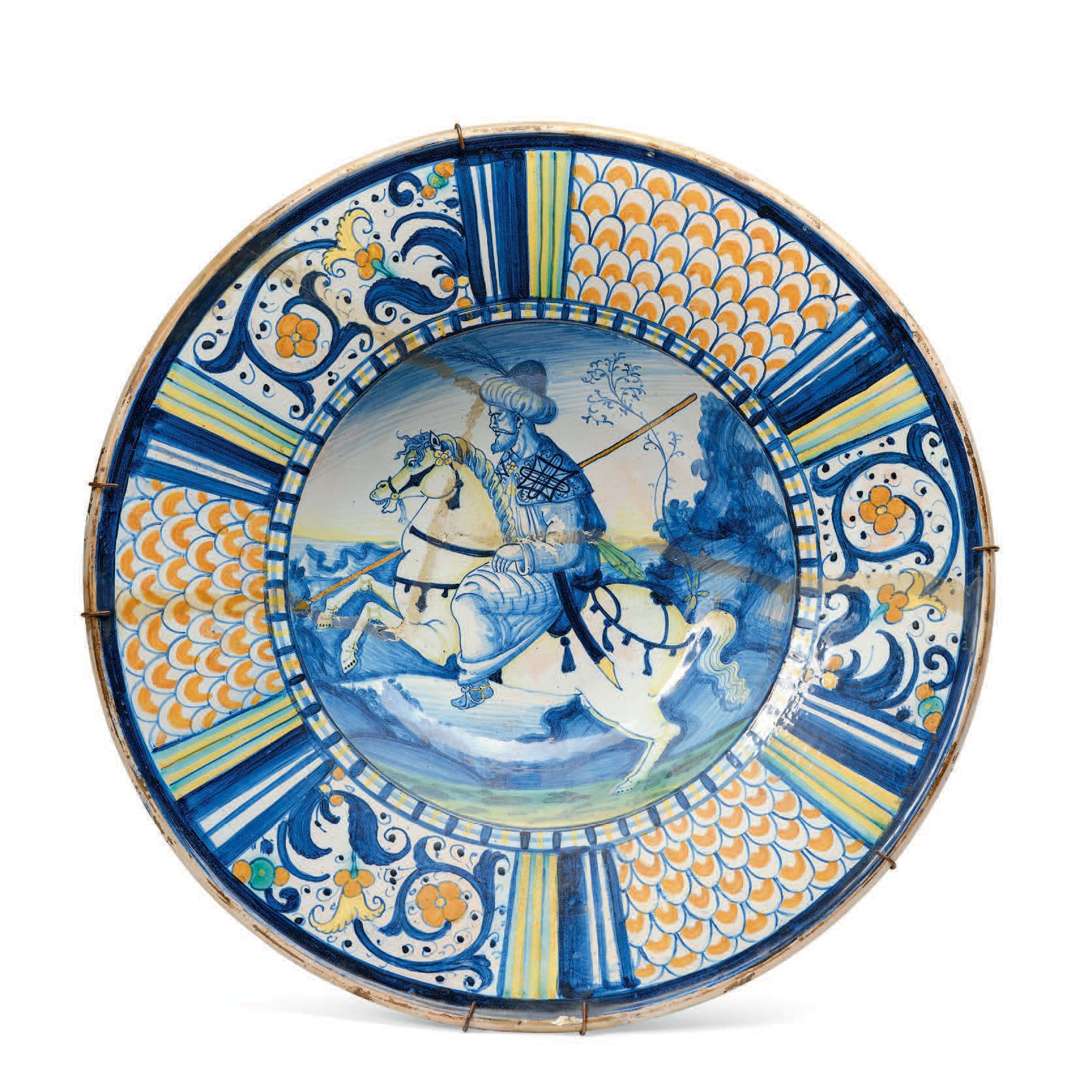
Round, hollow polychrome earthenware dish with blue cameo central decoration of a Turkish lancer rider, wearing a turban and carrying a scimitar at his side, standing on a prancing horse. The wing is decorated with alternating interlocking scales and arabesque foliage. Reverse with colorless glaze and snail motifs.
Italy, Deruta. Probably Mancini workshop. 16th century, circa 1530
Diameter: 43.5 cm
(Visible damage, visible restoration)
PROVENANCE
- Charles Damiron collection (1868 - 1964)
- his descendants to this day.
The Ottoman Empire is the largest and longest surviving empire in the Islamic world. Adherents to Sunni Islam, the Ottomans rapidly expanded their territories, seizing Constantinople in 1453. Selim I ("the sinister", r. 1512 - 20) retook Egypt and Syria from the Mamluks in 1517, and campaigns in Iran led to a major defeat of their Safavid rivals. Selim's successor, Suleiman I "The Magnificent", led the Ottoman forces to Vienna, where they were repulsed in 1529.
It was in this precise context that our majolica dish was produced: the representation of the galloping Ottoman horseman was an image as feared as it was admired in the West of the first half of the 16th century.
Dishes featuring the Ottoman lancer can be found in the British Museum [N°1855,0313. 3], the Fitzwilliam Museum [C. 100-1927] and the MAK (Museum für Angewandte Kunst) in Vienna.
Round, hollow polychrome earthenware dish with blue cameo central decoration of a Turkish lancer rider, wearing a turban and carrying a scimitar at his side, standing on a prancing horse. The wing is decorated with alternating interlocking scales and arabesque foliage. Reverse with colorless glaze and snail motifs.
Italy, Deruta. Probably Mancini workshop. 16th century, circa 1530
Diameter: 43.5 cm
(Visible damage, visible restoration)
PROVENANCE
- Charles Damiron collection (1868 - 1964)
- his descendants to this day.
The Ottoman Empire is the largest and longest surviving empire in the Islamic world. Adherents to Sunni Islam, the Ottomans rapidly expanded their territories, seizing Constantinople in 1453. Selim I ("the sinister", r. 1512 - 20) retook Egypt and Syria from the Mamluks in 1517, and campaigns in Iran led to a major defeat of their Safavid rivals. Selim's successor, Suleiman I "The Magnificent", led the Ottoman forces to Vienna, where they were repulsed in 1529.
It was in this precise context that our majolica dish was produced: the representation of the galloping Ottoman horseman was an image as feared as it was admired in the West of the first half of the 16th century.
Dishes featuring the Ottoman lancer can be found in the British Museum [N°1855,0313. 3], the Fitzwilliam Museum [C. 100-1927] and the MAK (Museum für Angewandte Kunst) in Vienna.