
&w=3840&q=75)
&w=3840&q=75)
&w=3840&q=75)
&w=3840&q=75)
&w=3840&q=75)
&w=3840&q=75)
&w=3840&q=75)
&w=3840&q=75)


198
JAPON, INOUE DE KYOTO ÉPOQUE MEIJI (1868 - 1912)
The item was sold for 11 050 €
Fees include commission and taxes.
JAPON, INOUE DE KYOTO ÉPOQUE MEIJI (1868 - 1912)
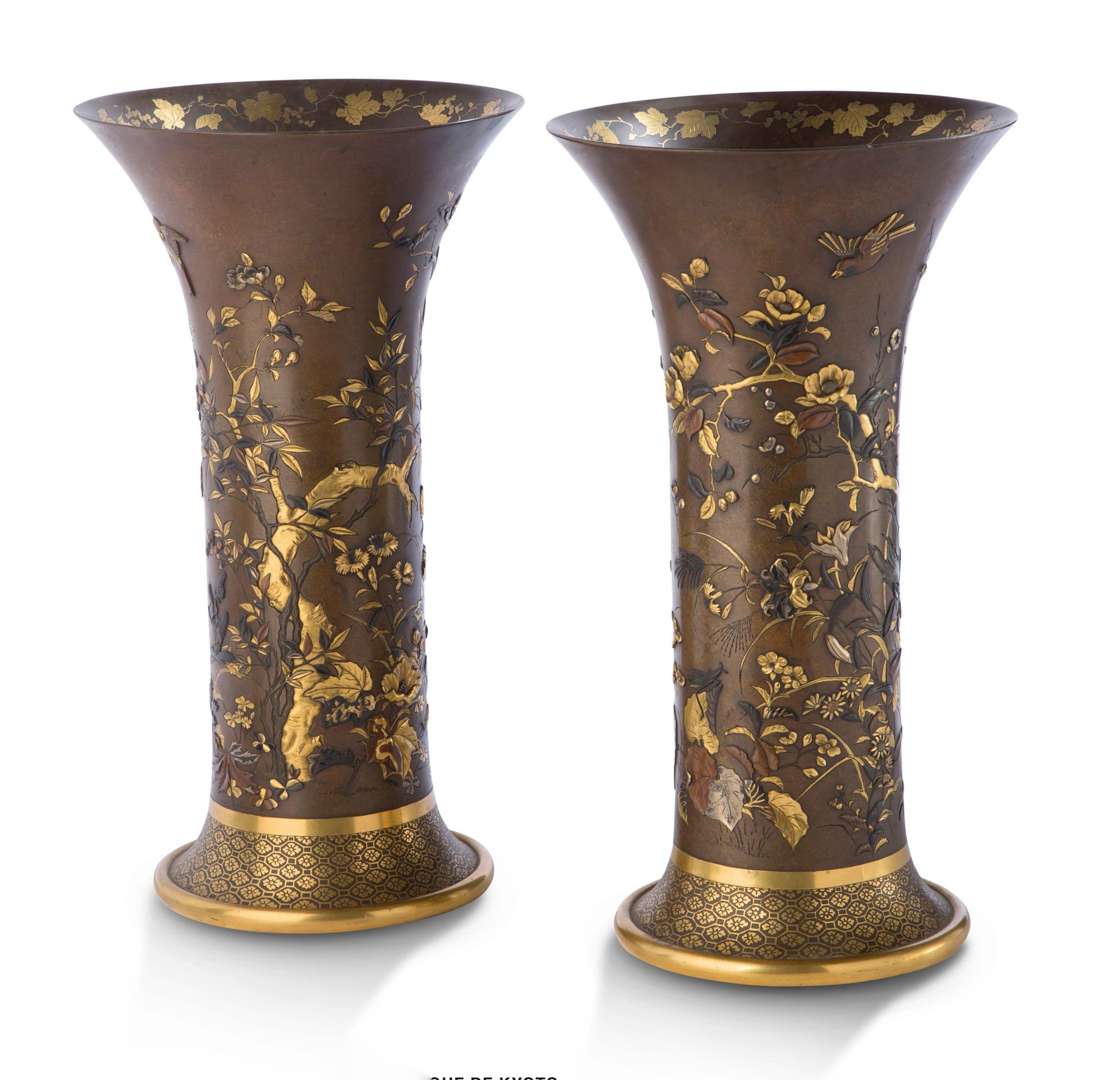
An important pair of sentoku bronze horn vases with a caramel-brown patina, the slightly flared base inlaid, in gold nunomezogan, with a net of stylized flowers, and framed by two gold bands. The body is freely decorated, in gold, silver, copper and shakudo kebori, katakiri and takazogan, with an abundance of lilies, wild orchids and susuki in the shade of an imposing prunus and tree peonies intertwining their branches.
The scene is filled with birds and insects.
The inside of the neck is adorned with vine shoots in gold nunomezogan. The base signed Saikyo
Inoue Sei ("Made by Inoue from the Western capital (Kyoto)").
H. 37.5 cm
NOTE
Metalworking is one of Japan's immemorial skills, traditionally patronized by the warrior elites who have ruled the country since the 12th century. However, from the
Edo period (1600-1868), the long decline of the warrior class led to the decline of the metal arts.
The Meiji period marked a real revival of artistic fields, under the impetus of imperial power. From then on, metal craftsmen had to reinvent themselves and move beyond traditional models. They turned to the decorative arts, perfecting traditional techniques and developing new decorative alloys to create spectacular objets d'art, such as the pair of vases presented here.
These horn vases were produced and signed by a Kyoto metal workshop, the Inoue workshop, about which little information has been gathered. It is assumed that this workshop, active in the second half of the 19th century, was linked to a certain Inoue
Kichibei, whose pieces were exhibited at various world fairs.
Other products from the Inoue workshop in Kyoto are illustrated in "The Nasser D. Khalili
Collection", Vol. II, Metalwork part 1 and 2, n°12 and 87.
An important pair of sentoku bronze horn vases with a caramel-brown patina, the slightly flared base inlaid, in gold nunomezogan, with a net of stylized flowers, and framed by two gold bands. The body is freely decorated, in gold, silver, copper and shakudo kebori, katakiri and takazogan, with an abundance of lilies, wild orchids and susuki in the shade of an imposing prunus and tree peonies intertwining their branches.
The scene is filled with birds and insects.
The inside of the neck is adorned with vine shoots in gold nunomezogan. The base signed Saikyo
Inoue Sei ("Made by Inoue from the Western capital (Kyoto)").
H. 37.5 cm
NOTE
Metalworking is one of Japan's immemorial skills, traditionally patronized by the warrior elites who have ruled the country since the 12th century. However, from the
Edo period (1600-1868), the long decline of the warrior class led to the decline of the metal arts.
The Meiji period marked a real revival of artistic fields, under the impetus of imperial power. From then on, metal craftsmen had to reinvent themselves and move beyond traditional models. They turned to the decorative arts, perfecting traditional techniques and developing new decorative alloys to create spectacular objets d'art, such as the pair of vases presented here.
These horn vases were produced and signed by a Kyoto metal workshop, the Inoue workshop, about which little information has been gathered. It is assumed that this workshop, active in the second half of the 19th century, was linked to a certain Inoue
Kichibei, whose pieces were exhibited at various world fairs.
Other products from the Inoue workshop in Kyoto are illustrated in "The Nasser D. Khalili
Collection", Vol. II, Metalwork part 1 and 2, n°12 and 87.