
&w=3840&q=75)
&w=3840&q=75)
&w=3840&q=75)
&w=3840&q=75)
&w=3840&q=75)
&w=3840&q=75)
&w=3840&q=75)
&w=3840&q=75)


174
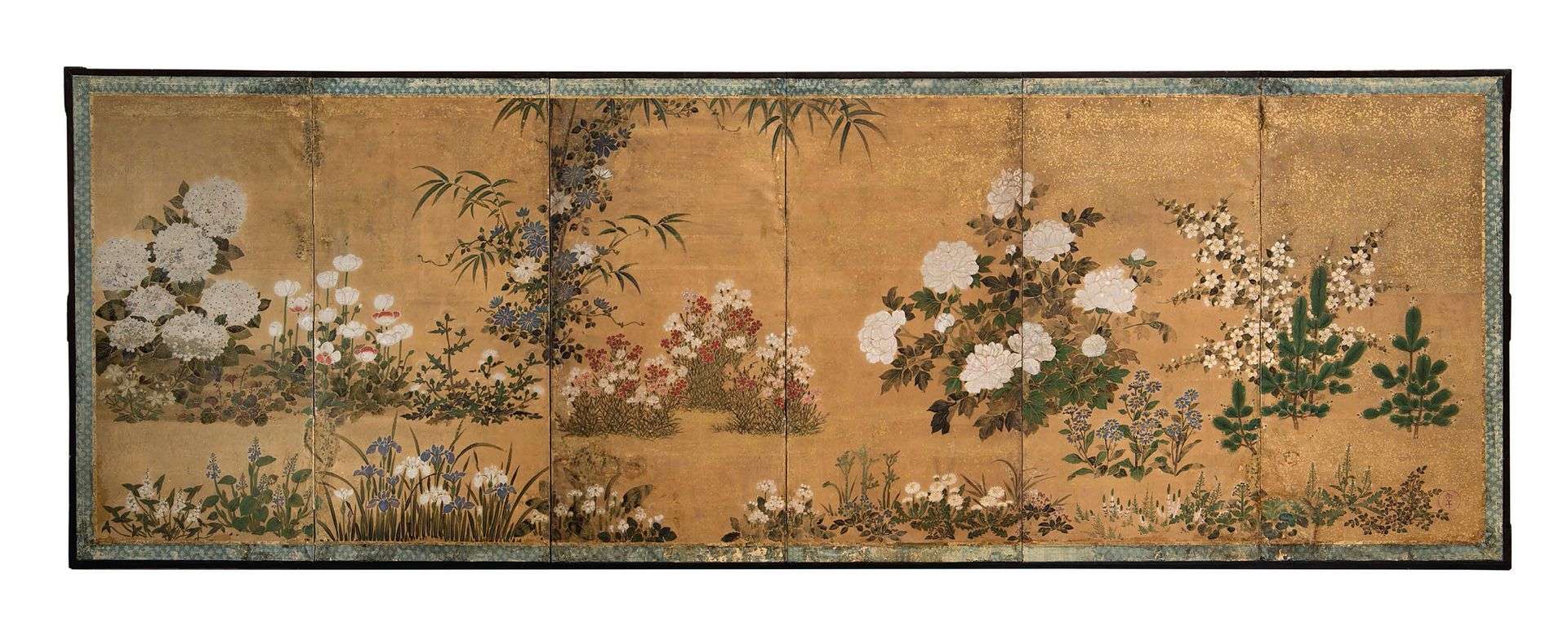
JAPON, ÉCOLE DE SOTATSU TAWARAYA ÉPOQUE ÉDO, XVIIe SIÈCLE
The item was sold for 9 226 €
Fees include commission and taxes.
JAPON, ÉCOLE DE SOTATSU TAWARAYA ÉPOQUE ÉDO, XVIIe SIÈCLE
Rinpa-style six-leaf folding screen, decorated in ink and colors on gold-flecked buff paper, depicting an imaginary garden with flowers from the four seasons: hydrangeas, poppies, dandelions, clematis, bamboos, carnations, peonies, young pine shoots, irises, trifoliate sagittaria... The elegant composition depicts each species in a dense bouquet of harmoniously intertwining flowers and leaves. On the lower right, the circular red "I'nen" seal.
H. 116 cm - L. tot. 337 cm
PROVENANCE
A copy of the certificate and invoice of purchase from the "Compagnie de la Chine et des Indes", Paris, in 1989, is attached.
NOTE
The Rinpa movement was born at the turn of the 17th century, from the collaboration of Tawaraya
Sotatsu and Hon'ami Koetsu, erudite aesthetes and multi-talented artists. Deeply influenced by the refinement and elegance of the Heian period (794 - 1185), considered the quintessence of Japanese artistic expression, they fused existing currents to invent a new decorative style, freed from the constraints of official court art. This new style was an unprecedented artistic upheaval, with a lasting influence on Japanese decorative arts.
Rinpa artists freely drew inspiration from the heritage of their predecessors, without direct transmission from master to disciple, giving rise to a multitude of original styles that shared a common trait of boldness and freedom in composition, a quest for aestheticism in everyday life through all the mediums of Japanese art (lacquer, ceramics, painting...) and a particular attachment to representations of nature.
Although a leading figure of the Rinpa movement and already recognized as an outstanding artist of his time, Tawaraya Sotatsu remains a mystery, as little is known about his life. He seems to have been active between 1600 and 1640 at the Tawaraya
Tawaraya workshop in Kyoto. This decorative workshop (eya), which brought together artists specialized in all kinds of painting-related disciplines (illumination, paper decoration, fan and screen painting, etc.), supplied the aristocracy of the Imperial Court as well as the new class of wealthy merchants.
The composition of the present screen, a rhythmic play of shapes and colors created by the arrangement of flowers in isolated bouquets, is in line with Sotatsu Tawaraya's scattered compositions of four-season flowers, a specialty of his workshop. In the lower right-hand corner, the circular red "I'nen" seal used by both the master and the Tawaraya workshop can be seen.
Rinpa-style six-leaf folding screen, decorated in ink and colors on gold-flecked buff paper, depicting an imaginary garden with flowers from the four seasons: hydrangeas, poppies, dandelions, clematis, bamboos, carnations, peonies, young pine shoots, irises, trifoliate sagittaria... The elegant composition depicts each species in a dense bouquet of harmoniously intertwining flowers and leaves. On the lower right, the circular red "I'nen" seal.
H. 116 cm - L. tot. 337 cm
PROVENANCE
A copy of the certificate and invoice of purchase from the "Compagnie de la Chine et des Indes", Paris, in 1989, is attached.
NOTE
The Rinpa movement was born at the turn of the 17th century, from the collaboration of Tawaraya
Sotatsu and Hon'ami Koetsu, erudite aesthetes and multi-talented artists. Deeply influenced by the refinement and elegance of the Heian period (794 - 1185), considered the quintessence of Japanese artistic expression, they fused existing currents to invent a new decorative style, freed from the constraints of official court art. This new style was an unprecedented artistic upheaval, with a lasting influence on Japanese decorative arts.
Rinpa artists freely drew inspiration from the heritage of their predecessors, without direct transmission from master to disciple, giving rise to a multitude of original styles that shared a common trait of boldness and freedom in composition, a quest for aestheticism in everyday life through all the mediums of Japanese art (lacquer, ceramics, painting...) and a particular attachment to representations of nature.
Although a leading figure of the Rinpa movement and already recognized as an outstanding artist of his time, Tawaraya Sotatsu remains a mystery, as little is known about his life. He seems to have been active between 1600 and 1640 at the Tawaraya
Tawaraya workshop in Kyoto. This decorative workshop (eya), which brought together artists specialized in all kinds of painting-related disciplines (illumination, paper decoration, fan and screen painting, etc.), supplied the aristocracy of the Imperial Court as well as the new class of wealthy merchants.
The composition of the present screen, a rhythmic play of shapes and colors created by the arrangement of flowers in isolated bouquets, is in line with Sotatsu Tawaraya's scattered compositions of four-season flowers, a specialty of his workshop. In the lower right-hand corner, the circular red "I'nen" seal used by both the master and the Tawaraya workshop can be seen.