
&w=3840&q=75)
&w=3840&q=75)
&w=3840&q=75)
&w=3840&q=75)
&w=3840&q=75)
&w=3840&q=75)
&w=3840&q=75)
&w=3840&q=75)


57
CHINE DYNASTIE QING, XIXe SIÈCLE
The item was sold for 19 111 €
Fees include commission and taxes.
CHINE DYNASTIE QING, XIXe SIÈCLE
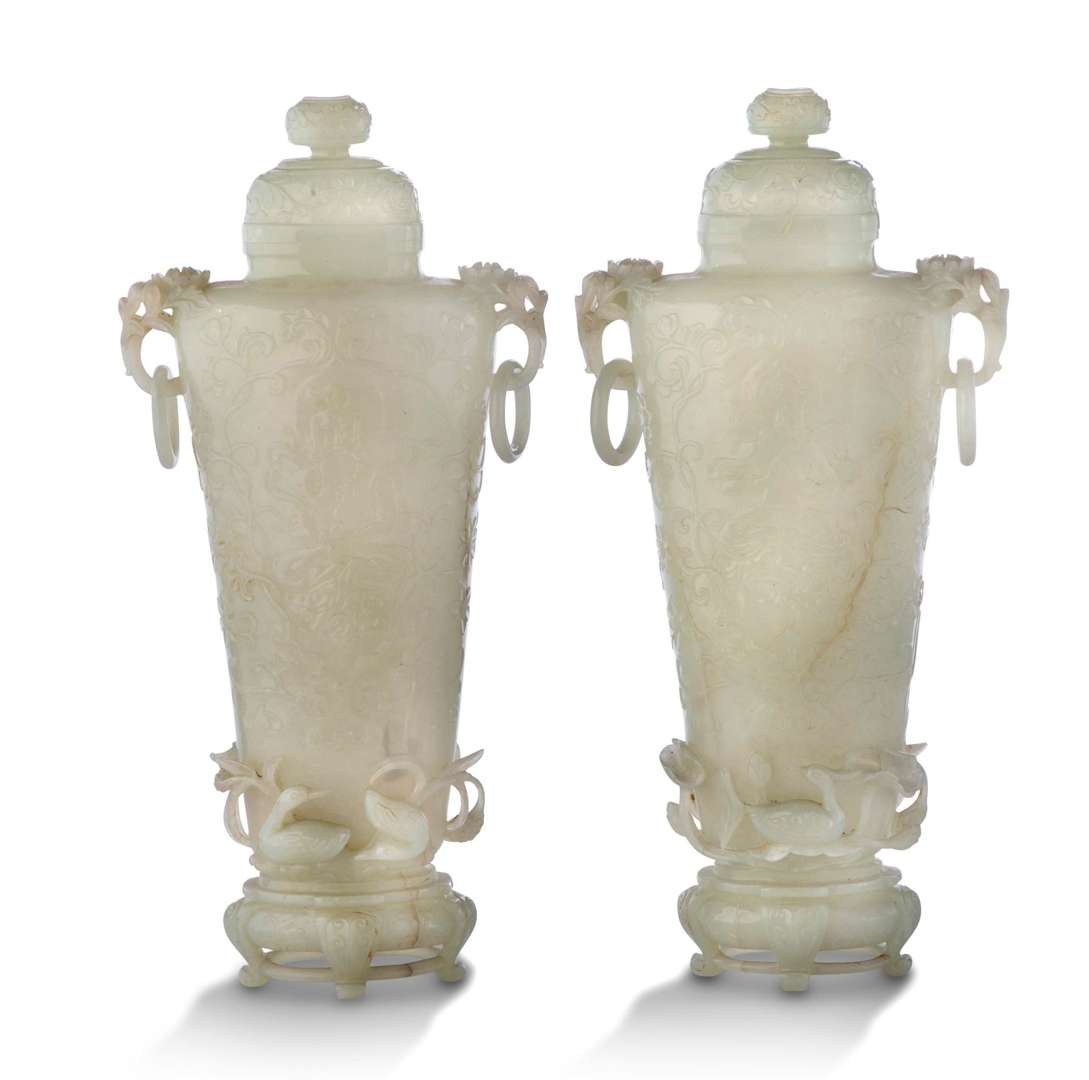
= Rare and important pair of celadon nephrite jade covered vases, of elongated form flaring to the shoulder, the base imitating a quadripod pedestal decorated with foliage and ruyi heads. The base is decorated with figures in relief representing three Mandarin ducks frolicking among lotuses and millet stalks. The body is decorated with a dense network of intertwining floral scrolls, and in the center are enthroned figures of bodhisattvas, seated on clouds, adorned with floating jewels and ribbons, their hands executing various mudras or holding various attributes. The shoulder is marked and flanked by two handles in the form of blossoming chrysanthemum stems holding mobile rings. The lid is carved with foliage scrolls, and the handle is delicately recessed.
H. tot. 24 cm
NOTE
Jade is the most important gem of Chinese civilization. A stone of immortality, it links the celestial and terrestrial worlds, and is both a ritual medium and a symbol of power and prestige.
Appreciated for its rarity, hardness and beauty, jade has been used since the Neolithic period, notably in the tombs of the Hongshang and Liangzhu cultures, in the form of ritual objects and ornaments. During the Warring Kingdoms (481 - 221 B.C.), it was even consumed by the Chinese elite, who hoped to attain eternal life.
Under the following dynasties, the taste for everyday jade objects gradually developed, and production diversified towards the decorative arts, particularly for scholarly objects such as brushholders, vases, water bowls, paintbrushes, armrests...
The archaizing style, inspired by models from Antiquity, coexisted harmoniously with the artistic tastes of each dynasty. Artists left more room for their creativity, innovating in the creation of exceptional pieces, and constantly pushing back technical limits, since working with jade is laborious and delicate. Craftsmen shape it with a rope and an abrasive, before it is sculpted and polished. The theme of the piece is chosen according to the stone's appearance, in order to achieve exceptional color and brilliance. The art of jade reached its apogee during the Qing dynasty, thanks not only to technical advances but also to the impetus of the emperor Qianlong, a great jade collector fascinated by this material with its infinite possibilities.
Our pair of celadon jade vases testify to the virtuosity of Chinese lapidary craftsmen.
The very thin, finely sculpted walls highlight the quality and transparency of the stone. The sculpture, which skilfully blends ronde-bosse and bas-relief, is also intended to be illusionistic, by adding a jade base to the vase.
The decoration is a harmonious blend of styles, juxtaposing archaic models, literate themes inspired by nature and Buddhist iconography through the bodhisattvas sculpted on either side. It is interesting to note that a set of incense burners and vases of very similar style and decoration are illustrated in
SCHNEEBERGER Pierre-F., "The Baur Collection Geneva, Chinese Jades and other hardstones", 1976, B.69, B.92, B.94 and B.96.
= Rare and important pair of celadon nephrite jade covered vases, of elongated form flaring to the shoulder, the base imitating a quadripod pedestal decorated with foliage and ruyi heads. The base is decorated with figures in relief representing three Mandarin ducks frolicking among lotuses and millet stalks. The body is decorated with a dense network of intertwining floral scrolls, and in the center are enthroned figures of bodhisattvas, seated on clouds, adorned with floating jewels and ribbons, their hands executing various mudras or holding various attributes. The shoulder is marked and flanked by two handles in the form of blossoming chrysanthemum stems holding mobile rings. The lid is carved with foliage scrolls, and the handle is delicately recessed.
H. tot. 24 cm
NOTE
Jade is the most important gem of Chinese civilization. A stone of immortality, it links the celestial and terrestrial worlds, and is both a ritual medium and a symbol of power and prestige.
Appreciated for its rarity, hardness and beauty, jade has been used since the Neolithic period, notably in the tombs of the Hongshang and Liangzhu cultures, in the form of ritual objects and ornaments. During the Warring Kingdoms (481 - 221 B.C.), it was even consumed by the Chinese elite, who hoped to attain eternal life.
Under the following dynasties, the taste for everyday jade objects gradually developed, and production diversified towards the decorative arts, particularly for scholarly objects such as brushholders, vases, water bowls, paintbrushes, armrests...
The archaizing style, inspired by models from Antiquity, coexisted harmoniously with the artistic tastes of each dynasty. Artists left more room for their creativity, innovating in the creation of exceptional pieces, and constantly pushing back technical limits, since working with jade is laborious and delicate. Craftsmen shape it with a rope and an abrasive, before it is sculpted and polished. The theme of the piece is chosen according to the stone's appearance, in order to achieve exceptional color and brilliance. The art of jade reached its apogee during the Qing dynasty, thanks not only to technical advances but also to the impetus of the emperor Qianlong, a great jade collector fascinated by this material with its infinite possibilities.
Our pair of celadon jade vases testify to the virtuosity of Chinese lapidary craftsmen.
The very thin, finely sculpted walls highlight the quality and transparency of the stone. The sculpture, which skilfully blends ronde-bosse and bas-relief, is also intended to be illusionistic, by adding a jade base to the vase.
The decoration is a harmonious blend of styles, juxtaposing archaic models, literate themes inspired by nature and Buddhist iconography through the bodhisattvas sculpted on either side. It is interesting to note that a set of incense burners and vases of very similar style and decoration are illustrated in
SCHNEEBERGER Pierre-F., "The Baur Collection Geneva, Chinese Jades and other hardstones", 1976, B.69, B.92, B.94 and B.96.