
&w=3840&q=75)
&w=3840&q=75)
&w=3840&q=75)
&w=3840&q=75)
&w=3840&q=75)
&w=3840&q=75)
&w=3840&q=75)
&w=3840&q=75)


141
LAMENNAIS Félicité de (1782-1854). MANUSCRIT autographe de notes de lectur
Estimate1 000 - 1 500 €
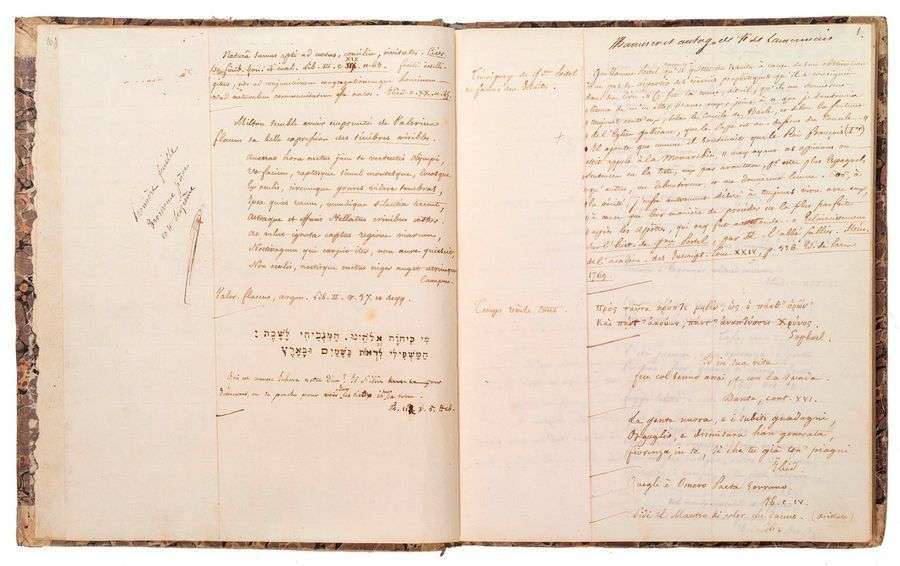
LAMENNAIS Félicité de (1782-1854). autograph manuscript of reading notes, [ca. 1836]| thick 65-page in-4 notebook (the rest blank), period parchment spine binding, slipcase.
Precious notebook testifying to the eclecticism of his readings, to his encyclopedic spirit, but also to his curiosity about Man.
Lamennais inscribed here abundant excerpts from ancient and modern authors, with some quotations in Latin, Greek, Hebrew, German or Italian. Lamennais must have used it until the end of 1836. The document, which bears a notary's inventory mark at the beginning and at the end, comes from the library of Paul-Émile FORGUES (1813-1883), a literary scholar charged by Lamennais to direct the edition of his complete works.
One finds in particular comparisons between Milton and Valerius Flaccus, between Sophocles and Dante| a testimony of Guillaume Postel in favor of the Jesuits and an opinion of the abbot Mignet on the angels| quotations or selected pieces of Schiller, Shakespeare, Voltaire, Maimonides, Saint Augustin, Aristotle, La Harpe, Saint-Simon, Machiavelli, Luther, L'Hospital| curious passages on foreign civilizations, philosophies, religions or institutions, by Abel Rémusat, the abbot Mignot, Dumont d'Urville, Herbelot, F.C. de Savigny, J.F. de La Harpe, Virey, le chevalier Chardin, Joseph de Maistre| biblical quotations (Psalms, Hebrews...), etc. Human nature, beliefs and law are Lamennais' favorite subjects in his notes.
Lamennais carefully indicates the source of his quotations and bears in the margin thematic headings: "Time reveals all", "Atheism", "Tolerance", "Confession" and "Confession among the Jews", "Materialism" and "Consequences of materialism", "Pre-eminence of the Rom. ", "Power of Popes over Kings", "Spirit in Politics", "Abolition of Slavery", "The City is an Association of Free Men", "Future Life", "Creatures as an Expression of God", "Christianity is but the Primitive Law perfected", etc., etc.
A typed analysis of the history and contents of this booklet is bound at the end.
Precious notebook testifying to the eclecticism of his readings, to his encyclopedic spirit, but also to his curiosity about Man.
Lamennais inscribed here abundant excerpts from ancient and modern authors, with some quotations in Latin, Greek, Hebrew, German or Italian. Lamennais must have used it until the end of 1836. The document, which bears a notary's inventory mark at the beginning and at the end, comes from the library of Paul-Émile FORGUES (1813-1883), a literary scholar charged by Lamennais to direct the edition of his complete works.
One finds in particular comparisons between Milton and Valerius Flaccus, between Sophocles and Dante| a testimony of Guillaume Postel in favor of the Jesuits and an opinion of the abbot Mignet on the angels| quotations or selected pieces of Schiller, Shakespeare, Voltaire, Maimonides, Saint Augustin, Aristotle, La Harpe, Saint-Simon, Machiavelli, Luther, L'Hospital| curious passages on foreign civilizations, philosophies, religions or institutions, by Abel Rémusat, the abbot Mignot, Dumont d'Urville, Herbelot, F.C. de Savigny, J.F. de La Harpe, Virey, le chevalier Chardin, Joseph de Maistre| biblical quotations (Psalms, Hebrews...), etc. Human nature, beliefs and law are Lamennais' favorite subjects in his notes.
Lamennais carefully indicates the source of his quotations and bears in the margin thematic headings: "Time reveals all", "Atheism", "Tolerance", "Confession" and "Confession among the Jews", "Materialism" and "Consequences of materialism", "Pre-eminence of the Rom. ", "Power of Popes over Kings", "Spirit in Politics", "Abolition of Slavery", "The City is an Association of Free Men", "Future Life", "Creatures as an Expression of God", "Christianity is but the Primitive Law perfected", etc., etc.
A typed analysis of the history and contents of this booklet is bound at the end.