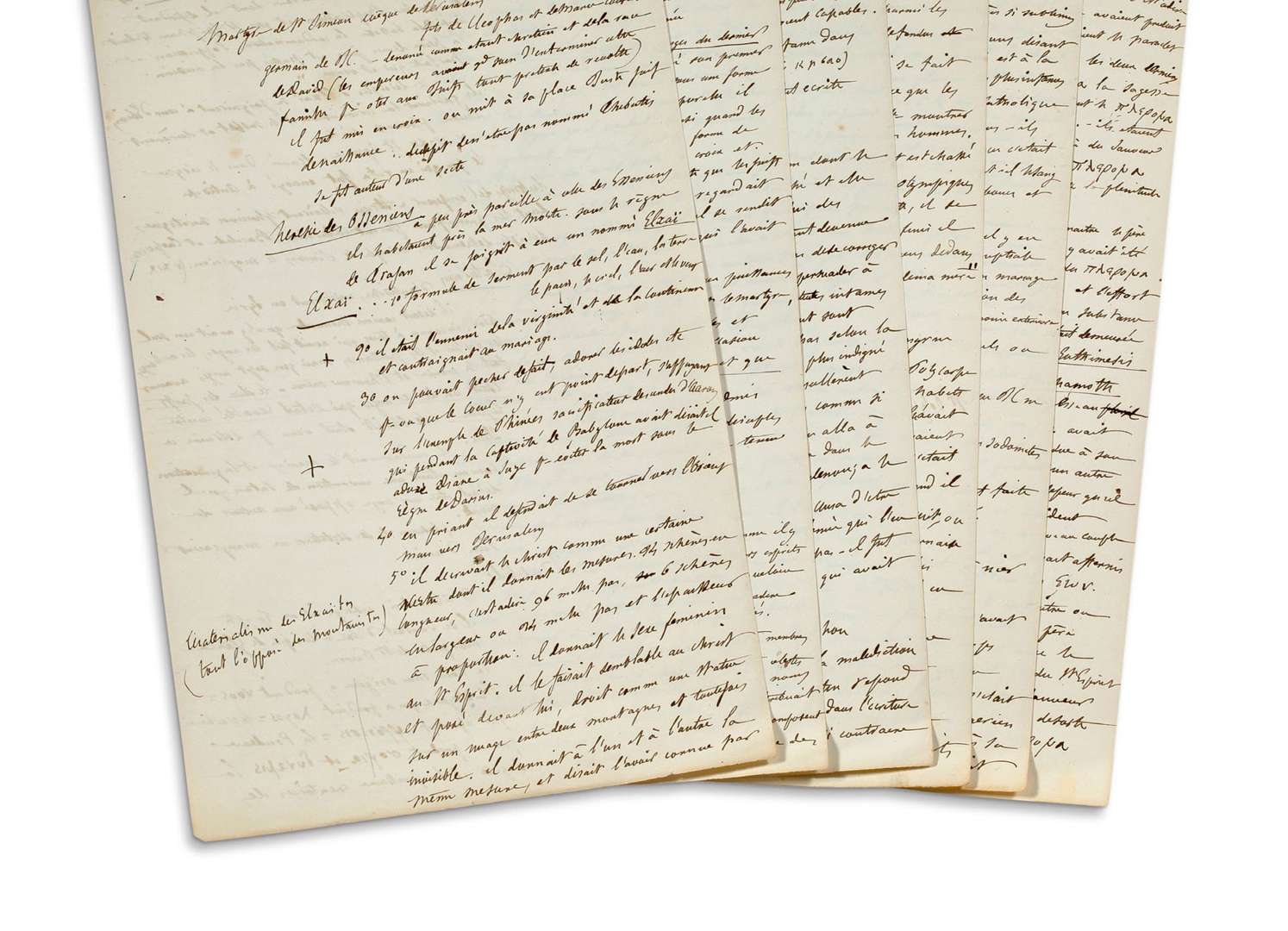
FLAUBERT Gustave (1821-1880). autograph manuscript, [ca. 1869]| 12 pages on 6 folios (30 x 19 cm).
Preparatory work for the third version of The Temptation of Saint Anthony. For Flaubert, The Temptation of Saint Anthony is "the work of his entire life, since the first idea came to him in 1845, in Genoa, in front of a painting by Brueghel, and since that time, he has not stopped thinking about it and reading about it," as he indicates in a letter of 1872. In fact, in 1849, he completed a first version (which remained in manuscript and was published posthumously), returned to it in 1856, and then, finally, in 1874, transformed the old work to form a completely different one. The present manuscript resembles a documentary memento of which Flaubert was accustomed, that is to say, notes from one of his "related readings", most probably a history of the early Church (at the top of the page the mention "Book III"). These notes concern the heresiarchs and the first Christians. They were probably written around 1869, when Flaubert began to recast his book, since the names mentioned in the manuscript, absent from the first and second versions, appear in the fourth part of the final version of the text. This manuscript is a perfect example of the way Flaubert mixes erudition and invention, documentary passion and style. It is presented as a list of biographical and theoretical information on the doctrine and martyrdoms of the first Christians and heretics of the first centuries of the Christian era. Flaubert mentions the "Martyrdom of St. Simeon, bishop of Jerusalem", the "Heresy of the Ossenians, which is similar to that of the Essenians", "Saturninus of Antioch, teacher in Syria", "Basilides of Alexandria", "Carporas", the "Gnostics", "the son of Carporas, Epiphanius, who continued his doctrine", the "Heresy of Valentine" (he details it at length on 2 pages using names written in Greek), the other Valentinians "the Sethians", "the Cainites", "the Ophites", the "Heresy of Marcion and Apelles", the martyrs of St. Justin and St. Polycarp, and finally "Peregrin". From the verso of the fifth leaf, the notes end with a series of quotations of varying length from the Second Apology of St. Justin concerning the justification of "Christian doctrine," "the Martyrdom of Ptolemy," and a "dialogue of St. Justin with Triphon...

&w=3840&q=75)
&w=3840&q=75)
&w=3840&q=75)
&w=3840&q=75)
&w=3840&q=75)
&w=3840&q=75)
&w=3840&q=75)
&w=3840&q=75)