
&w=3840&q=75)
&w=3840&q=75)
&w=3840&q=75)
&w=3840&q=75)
&w=3840&q=75)
&w=3840&q=75)
&w=3840&q=75)
&w=3840&q=75)


87
BOILEAU-DESPRÉAUX Nicolas (1636-1711). L.A.S. « Despreaux », Paris 10 nove
Estimate7 000 - 8 000 €
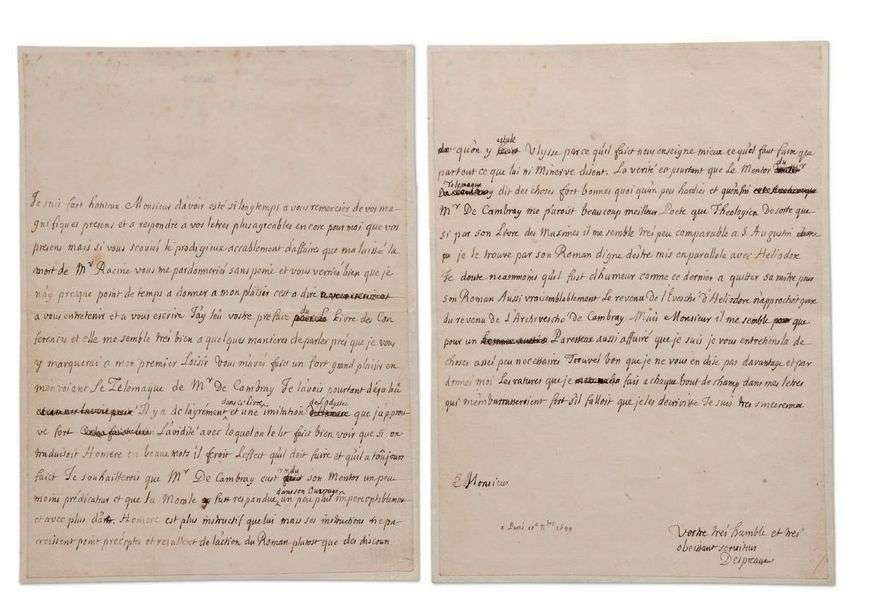
BOILEAU-DESPRÉAUX Nicolas (1636-1711). L.A.S. " Despreaux ", Paris November 10, 1699, to his friend Claude BROSSETTE| 2 pages in-4, mounted on strong paper.
Superb letter on the death of RACINE and the Télémaque of FÉNELON.
He is very ashamed to have been late in thanking him for his magnificent gifts and his even more pleasant letters, "but if you know the prodigious burden of business that the death of Mr. RACINE has left me, you will forgive me without difficulty and you will see that I have almost no time to give to my pleasure, that is to say, to talk to you and to write to you"... He congratulates Brossette on his preface to the book of the Conferences, then says his pleasure to receive " Le Télemaque de Mr De Cambray [FÉNELON]. I had already read it. There is pleasure in this book, and an imitation of the Odyssey which I approve of. The eagerness with which it is read makes it clear that if Homer were translated into fine words he would do what he should do and has always done. I would wish that Mr. De Cambray had made his Mentor a little less preachy and that morality had been spread in his work a little more imperceptibly and with more art. HOMERE is more instructive than he is, but his instructions do not seem to be precepts and result from the action of the novel rather than from the speeches that are given in it. Ulysses, by what he does, teaches us better what to do than anything he or Minerva says. The truth is however that the Mentor of Telemachus says some very good things even though they are a bit bold and that finally Mr. De Cambray seems to me to be a much better Poet than Theologian so that if by his book of Maxims he seems to me to be very little comparable to S. Augustine I find him by his Novel to be a very good poet. Augustine, I find him worthy of being compared with Heliodorus in his novel. I doubt, however, that he was in the same mood as the latter to leave his mitre for his novel. Oeuvres complètes, Bibl. de la Pléiade, p. 638. A handwritten document from 1640 in the name of Agostino Centurione, governor general of Corsica, is attached.
Superb letter on the death of RACINE and the Télémaque of FÉNELON.
He is very ashamed to have been late in thanking him for his magnificent gifts and his even more pleasant letters, "but if you know the prodigious burden of business that the death of Mr. RACINE has left me, you will forgive me without difficulty and you will see that I have almost no time to give to my pleasure, that is to say, to talk to you and to write to you"... He congratulates Brossette on his preface to the book of the Conferences, then says his pleasure to receive " Le Télemaque de Mr De Cambray [FÉNELON]. I had already read it. There is pleasure in this book, and an imitation of the Odyssey which I approve of. The eagerness with which it is read makes it clear that if Homer were translated into fine words he would do what he should do and has always done. I would wish that Mr. De Cambray had made his Mentor a little less preachy and that morality had been spread in his work a little more imperceptibly and with more art. HOMERE is more instructive than he is, but his instructions do not seem to be precepts and result from the action of the novel rather than from the speeches that are given in it. Ulysses, by what he does, teaches us better what to do than anything he or Minerva says. The truth is however that the Mentor of Telemachus says some very good things even though they are a bit bold and that finally Mr. De Cambray seems to me to be a much better Poet than Theologian so that if by his book of Maxims he seems to me to be very little comparable to S. Augustine I find him by his Novel to be a very good poet. Augustine, I find him worthy of being compared with Heliodorus in his novel. I doubt, however, that he was in the same mood as the latter to leave his mitre for his novel. Oeuvres complètes, Bibl. de la Pléiade, p. 638. A handwritten document from 1640 in the name of Agostino Centurione, governor general of Corsica, is attached.