
&w=3840&q=75)
&w=3840&q=75)
&w=3840&q=75)
&w=3840&q=75)
&w=3840&q=75)
&w=3840&q=75)
&w=3840&q=75)
&w=3840&q=75)

214
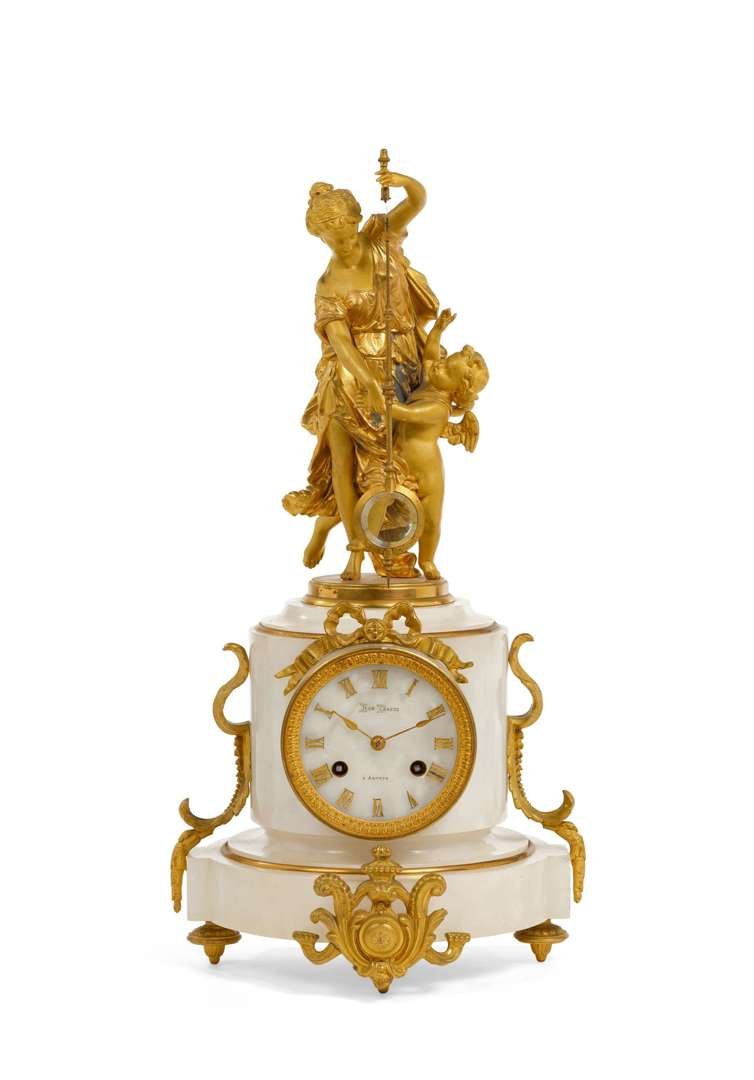
RARE PENDULE MYSTÉRIEUSE DITE «DE GUILMET» en marbre blanc et bronze doré,
The item was sold for 2 470 €
Fees include commission and taxes.
RARE MYSTERIOUS "DE GUILMET" CLOCK in white marble and gilt bronze, surmounted by a figure of Venus holding the oscillating pendulum and a child in love. White marble dial signed Jean Craeye in Antwerp. Plate signed GLT breveté. Second half of the 19th century.
Height: 57 cm-Width: 30 cm-Depth: 22 cm (Very good condition)
Andre Romain Guilmet (1827-1892), inventor of the mysterious principle of our pendulum, is one of the French clockmakers, like Robert Houdin, who responded to the 19th-century Parisian passion for magic and prestidigitation by designing a clock of an intrinsically mysterious nature. The mechanism he designed was intended to give the impression that the pendulum, held in place by the figurative surmount, seemed to swing without impulse. To achieve this, the figure is placed on a post that pivots on a pinpoint at the base, allowing the figure itself to oscillate imperceptibly from side to side. With this post connected to the specially designed escapement, the pendulum impulse is ingeniously transferred through the figure. Guilmet obtained a patent for his invention in 1867, which was modified in 1872. The apparent popularity of his "pendule à marche mystérieuse" model is due in part to the presentation of these clocks at the various international exhibitions held in Paris and elsewhere in the last quarter of the 19th century.
Height: 57 cm-Width: 30 cm-Depth: 22 cm (Very good condition)
Andre Romain Guilmet (1827-1892), inventor of the mysterious principle of our pendulum, is one of the French clockmakers, like Robert Houdin, who responded to the 19th-century Parisian passion for magic and prestidigitation by designing a clock of an intrinsically mysterious nature. The mechanism he designed was intended to give the impression that the pendulum, held in place by the figurative surmount, seemed to swing without impulse. To achieve this, the figure is placed on a post that pivots on a pinpoint at the base, allowing the figure itself to oscillate imperceptibly from side to side. With this post connected to the specially designed escapement, the pendulum impulse is ingeniously transferred through the figure. Guilmet obtained a patent for his invention in 1867, which was modified in 1872. The apparent popularity of his "pendule à marche mystérieuse" model is due in part to the presentation of these clocks at the various international exhibitions held in Paris and elsewhere in the last quarter of the 19th century.