
&w=3840&q=75)
&w=3840&q=75)
&w=3840&q=75)
&w=3840&q=75)
&w=3840&q=75)
&w=3840&q=75)
&w=3840&q=75)
&w=3840&q=75)


160
HUBERT SARTON (1748-1828)
The item was sold for 22 100 €
Fees include commission and taxes.
HUBERT SARTON (1748-1828)
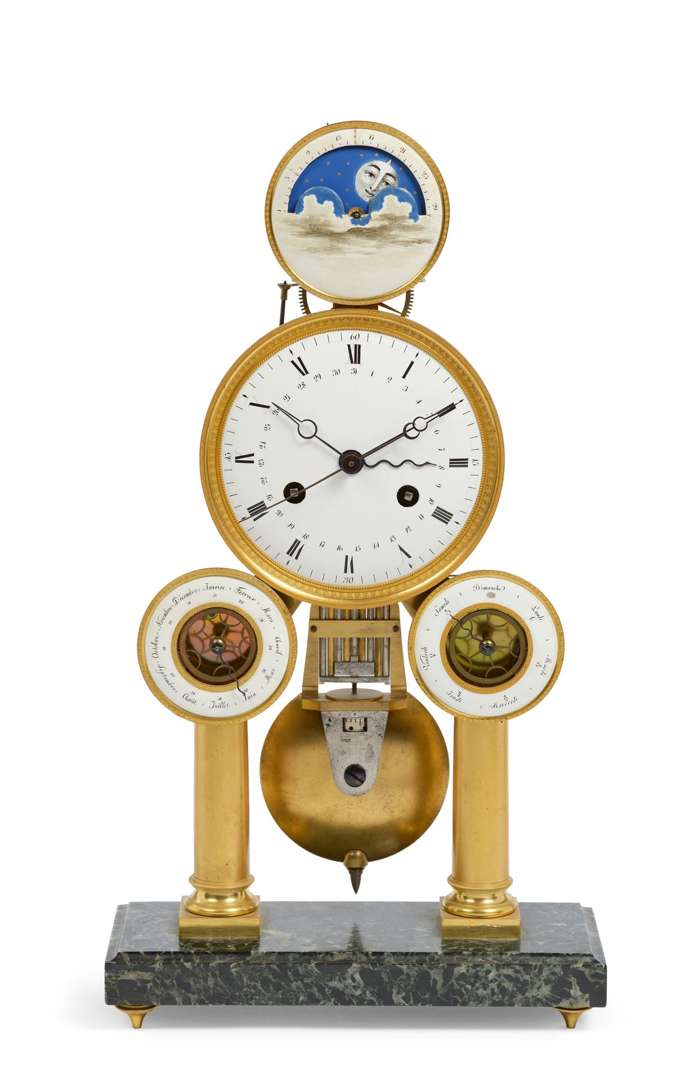
Astronomical skeleton clock with date and moon phase indications. The central part rests on two gilded brass columns, supporting two auxiliary skeleton dials with white enamelled circles and a double frieze in chased and gilded bronze, one for the indication of the months in 30, 31 or 28 days and the other for the days of the week and astronomical signs. At the top is the enamelled main dial in a chased ormolu frame, with Roman numerals for the hours and Arabic numerals for the minutes, an external railway scale, a central second hand for the seconds beat, a serpentine hand for the date and two winding squares for the clockwork and striking mechanism. At the top, a white and polychrome enamel dial indicates the phases of the moon on a rotating disc. The whole rests on a marble plate with tapered feet at each end. Movement with compensated "gril" balance, knife-edge blade attachment, pin escapement, gong chime with counting wheel for the hours and half-hours on a gong hammer, engraved signature on the back plate for the moon phases. Liège, late 18th century.
Height: 50 cm
PROVENANCE
- Sotheby's London sale, May 30, 1991, lot 248.
- Guy Dierckx Collection (1937-2022).
BIBLIOGRAPHY
Our clock is described in Jacques Nève's reference work, Les pendules d'Hubert Sarton : 1748-1828-Horloger, Mécanicien, Inventeur.
Astronomical skeleton clock with date and moon phase indications. The central part rests on two gilded brass columns, supporting two auxiliary skeleton dials with white enamelled circles and a double frieze in chased and gilded bronze, one for the indication of the months in 30, 31 or 28 days and the other for the days of the week and astronomical signs. At the top is the enamelled main dial in a chased ormolu frame, with Roman numerals for the hours and Arabic numerals for the minutes, an external railway scale, a central second hand for the seconds beat, a serpentine hand for the date and two winding squares for the clockwork and striking mechanism. At the top, a white and polychrome enamel dial indicates the phases of the moon on a rotating disc. The whole rests on a marble plate with tapered feet at each end. Movement with compensated "gril" balance, knife-edge blade attachment, pin escapement, gong chime with counting wheel for the hours and half-hours on a gong hammer, engraved signature on the back plate for the moon phases. Liège, late 18th century.
Height: 50 cm
PROVENANCE
- Sotheby's London sale, May 30, 1991, lot 248.
- Guy Dierckx Collection (1937-2022).
BIBLIOGRAPHY
Our clock is described in Jacques Nève's reference work, Les pendules d'Hubert Sarton : 1748-1828-Horloger, Mécanicien, Inventeur.