
&w=3840&q=75)
&w=3840&q=75)
&w=3840&q=75)
&w=3840&q=75)
&w=3840&q=75)
&w=3840&q=75)
&w=3840&q=75)
&w=3840&q=75)

102
TIBET XVe - XVIe SIÈCLE
The item was sold for 23 400 €
Fees include commission and taxes.
TIBET XVe - XVIe SIÈCLE
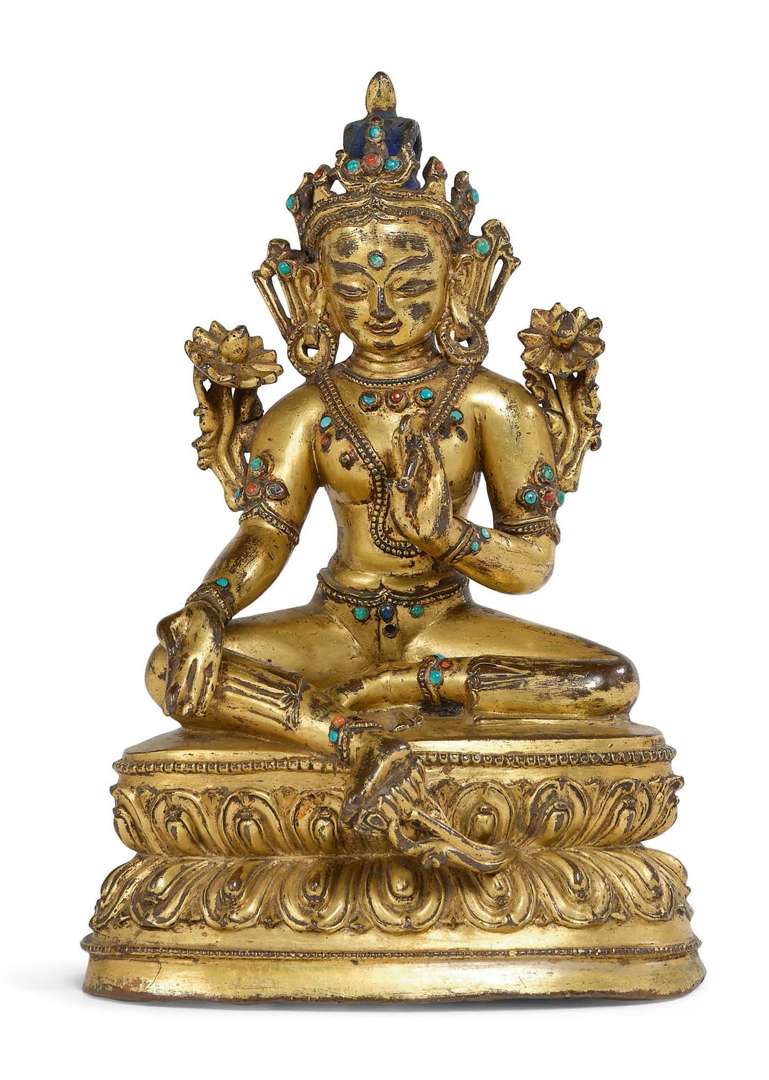
= Statuette in gilded copper alloy and inlaid hard stones representing Shyama Tara, seated in lalitasana on a double lotiform base, her left foot resting on a lotus flower, her left hand in varada mudra and her right hand in refuge mudra, each hand holding a lotus stem blooming on her shoulders.
She is dressed in a fine dhoti, adorned with numerous jewels, her hair tied in a high bun, her head girded with a five-flowered crown.
The face is round and small, the eyebrows marked on top of two stretched out eyes. The base sealed with red lacquer.
H. 16 cm
PROVENANCE
Purchased in February 1997 from the Kubera gallery, Nice.
Collection of Mr. and Mrs. R.
NOTE
Tara (literally "The Liberator") is, along with Avalokiteshvara, the most popular deity of Tibet. She is a female bodhisattva, the tutelary deity of the country and the embodiment of compassion, the "mother" who protects against all dangers and difficulties of life. She was born from the tears of Avalokiteshvara in front of the suffering of the beings trapped in the cycle of reincarnations. Shyama Tara ("Green Tara") is the original Tara, the one from which the twenty-one other forms derive, because green can represent all other colors.
She is the embodiment of active compassion and is shown with her right leg half unfolded because she is ready to stand up and help beings.
This representation of Shyama Tara takes its inspiration from the Newar style of the Khatmandu valley, notably the graceful posture, the round barrel of the deity as well as the important work of inlaying hard stones.
CONDITION REPORT
Wear to the gilt, some inlays are missing, scratches, traces of blue pigment in the hair
= Statuette in gilded copper alloy and inlaid hard stones representing Shyama Tara, seated in lalitasana on a double lotiform base, her left foot resting on a lotus flower, her left hand in varada mudra and her right hand in refuge mudra, each hand holding a lotus stem blooming on her shoulders.
She is dressed in a fine dhoti, adorned with numerous jewels, her hair tied in a high bun, her head girded with a five-flowered crown.
The face is round and small, the eyebrows marked on top of two stretched out eyes. The base sealed with red lacquer.
H. 16 cm
PROVENANCE
Purchased in February 1997 from the Kubera gallery, Nice.
Collection of Mr. and Mrs. R.
NOTE
Tara (literally "The Liberator") is, along with Avalokiteshvara, the most popular deity of Tibet. She is a female bodhisattva, the tutelary deity of the country and the embodiment of compassion, the "mother" who protects against all dangers and difficulties of life. She was born from the tears of Avalokiteshvara in front of the suffering of the beings trapped in the cycle of reincarnations. Shyama Tara ("Green Tara") is the original Tara, the one from which the twenty-one other forms derive, because green can represent all other colors.
She is the embodiment of active compassion and is shown with her right leg half unfolded because she is ready to stand up and help beings.
This representation of Shyama Tara takes its inspiration from the Newar style of the Khatmandu valley, notably the graceful posture, the round barrel of the deity as well as the important work of inlaying hard stones.
CONDITION REPORT
Wear to the gilt, some inlays are missing, scratches, traces of blue pigment in the hair