
&w=3840&q=75)
&w=3840&q=75)
&w=3840&q=75)
&w=3840&q=75)
&w=3840&q=75)
&w=3840&q=75)
&w=3840&q=75)
&w=3840&q=75)


76
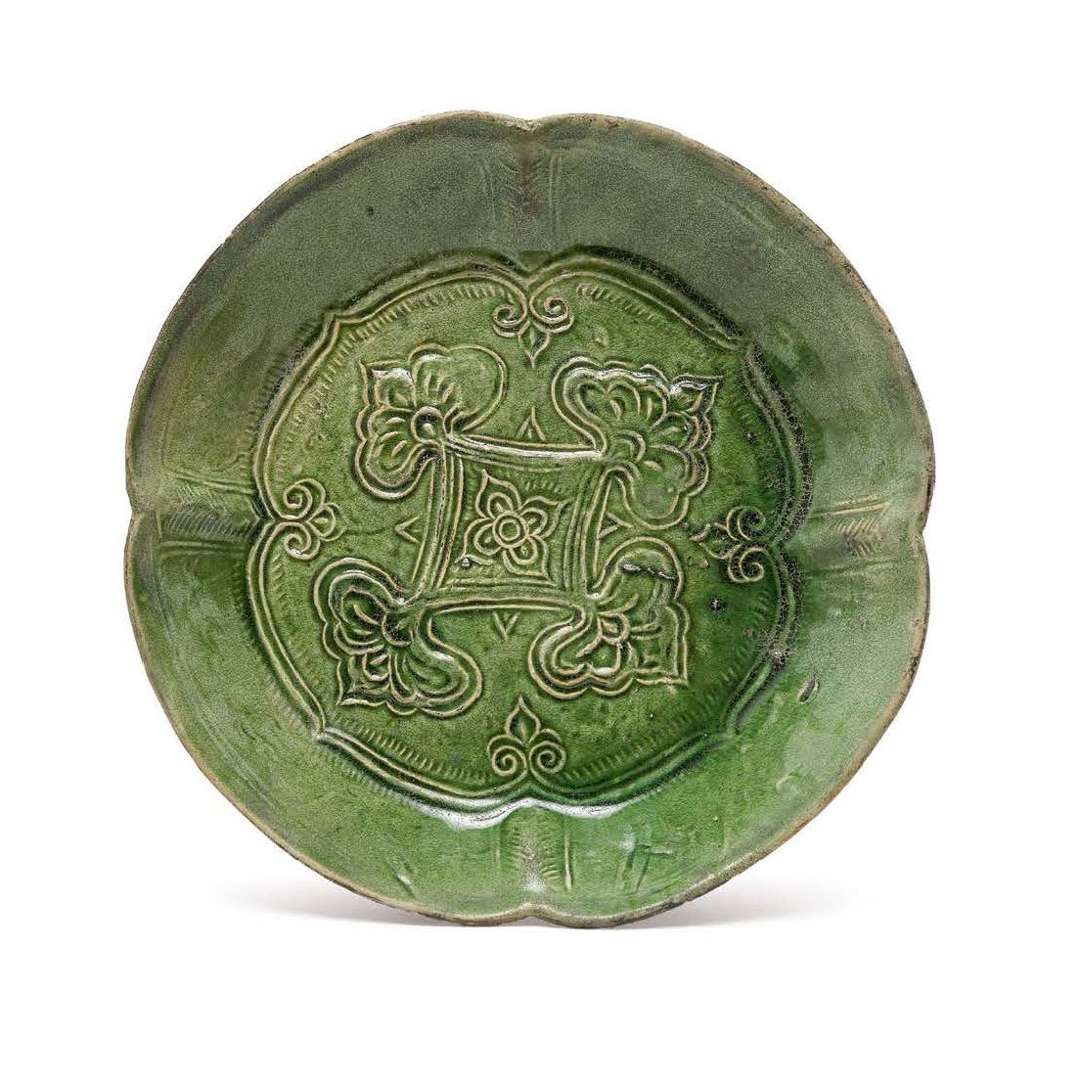
CHINE, HEBEI — DYNASTIE TANG, IXe SIÈCLE
The item was sold for 3 999 €
Fees include commission and taxes.
CHINE, HEBEI — DYNASTIE TANG, IXe SIÈCLE
= Rare small stoneware dish with green glaze, four-lobed shape, the interior molded with motifs imitating Middle Eastern silverware of the period. The piece is fully glazed in a beautiful bright green hue.
Label " bao tàng lich su - 1979 - TP. Hô Chi
Minh" on the reverse.
D. 14,5 cm
PROVENANCE
Wreck of Ba Ria, 2019.
A copy of the dating certificate of the cup (TVT 04), signed by Dr. Hoang Anh Tuan, director of the Museum of History of Ho Chi Minh City, dated and made in Ho Chi Minh City on January 26, 2021, will be given to the purchaser.
NOTE
The coins from the Ba Ria wreck (2019) have very strong similarities with those excavated during the excavation of the Jingxing kilns in Hebei.
This type of piece was intended for the local market but also for export to the Middle East and Southeast Asia.
East and Southeast Asia.
During the Tang Dynasty (618 - 907), China experienced an unprecedented cultural, military, artistic and commercial development.
The Silk Roads experienced a revival through the expansion of maritime trade routes in particular. This major axis of trade linked the cities of southern China (Guangzhou, etc.) to Southeast Asia, then to the Indian subcontinent and finally to the maritime routes of the Middle East (Persian Gulf, Red Sea, etc.). This intensification of exchanges pushes the Tang dynasty to engage in a
Tang Dynasty to engage in mass production, especially of the very famous Chinese ceramics, for export abroad.
It is in this context that many merchant ships that sank in the waters of Southeast Asia became exceptional sources of information for the knowledge of the Maritime Silk Roads.
The wreck of Ba Ria (Ba Ria province-
Vung Tau) was discovered in 2019 in
South of Vietnam. Its cargo, mainly composed of ceramics, is very similar to that of the famous Belitung wreck (discovered in 1998 in Indonesia).
It contains high quality white ceramics from the North China kilns, pieces from the Changsha kilns, green glazed ceramics and some celadons from the Yue kilns.
The few pieces from this wreck that we present are an exceptional testimony of this Tang "golden age".
= Rare small stoneware dish with green glaze, four-lobed shape, the interior molded with motifs imitating Middle Eastern silverware of the period. The piece is fully glazed in a beautiful bright green hue.
Label " bao tàng lich su - 1979 - TP. Hô Chi
Minh" on the reverse.
D. 14,5 cm
PROVENANCE
Wreck of Ba Ria, 2019.
A copy of the dating certificate of the cup (TVT 04), signed by Dr. Hoang Anh Tuan, director of the Museum of History of Ho Chi Minh City, dated and made in Ho Chi Minh City on January 26, 2021, will be given to the purchaser.
NOTE
The coins from the Ba Ria wreck (2019) have very strong similarities with those excavated during the excavation of the Jingxing kilns in Hebei.
This type of piece was intended for the local market but also for export to the Middle East and Southeast Asia.
East and Southeast Asia.
During the Tang Dynasty (618 - 907), China experienced an unprecedented cultural, military, artistic and commercial development.
The Silk Roads experienced a revival through the expansion of maritime trade routes in particular. This major axis of trade linked the cities of southern China (Guangzhou, etc.) to Southeast Asia, then to the Indian subcontinent and finally to the maritime routes of the Middle East (Persian Gulf, Red Sea, etc.). This intensification of exchanges pushes the Tang dynasty to engage in a
Tang Dynasty to engage in mass production, especially of the very famous Chinese ceramics, for export abroad.
It is in this context that many merchant ships that sank in the waters of Southeast Asia became exceptional sources of information for the knowledge of the Maritime Silk Roads.
The wreck of Ba Ria (Ba Ria province-
Vung Tau) was discovered in 2019 in
South of Vietnam. Its cargo, mainly composed of ceramics, is very similar to that of the famous Belitung wreck (discovered in 1998 in Indonesia).
It contains high quality white ceramics from the North China kilns, pieces from the Changsha kilns, green glazed ceramics and some celadons from the Yue kilns.
The few pieces from this wreck that we present are an exceptional testimony of this Tang "golden age".