
&w=3840&q=75)
&w=3840&q=75)
&w=3840&q=75)
&w=3840&q=75)
&w=3840&q=75)
&w=3840&q=75)
&w=3840&q=75)
&w=3840&q=75)

26
JAPON — PÉRIODE MEIJI (1868 - 1912)
The item was sold for 16 900 €
Fees include commission and taxes.
JAPON — PÉRIODE MEIJI (1868 - 1912)
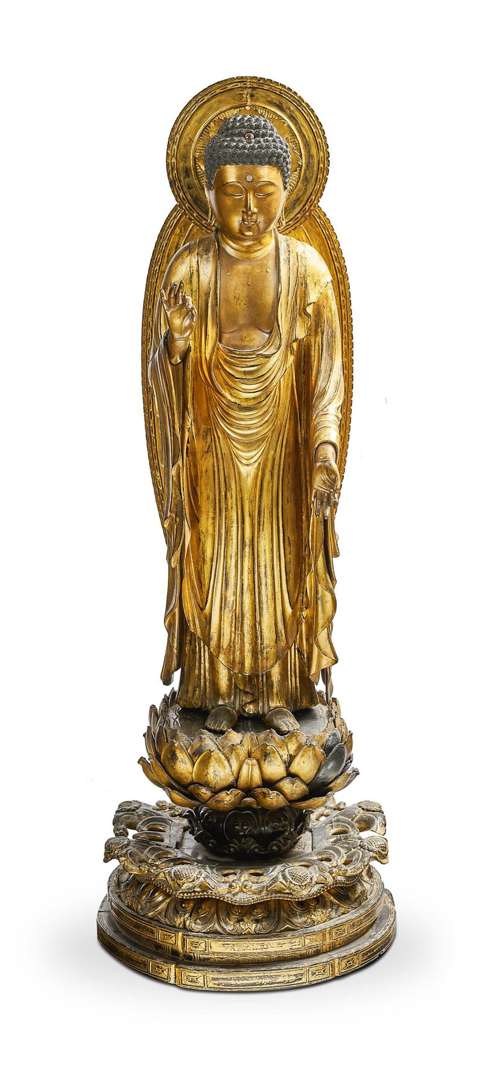
Important gilded lacquered wood sculpture of Amida Buddha in "Raigô-ryuzô" (literally "Who comes to welcome"), standing on two lotus flowers, themselves resting on a circular openwork base.
The Buddha stands before a large mandorla outlining his silhouette, a lotus flower blooming behind his head. He is dressed in a long, finely pleated monastic robe revealing his torso. Both hands are in the preaching mudra (seppô-in), fingers curved, thumb and index finger forming a circle, the right hand raised to shoulder height, the left hand lowered.
The face is round, the eyes half-closed, the mouth small, underlined by a thin painted moustache, the expression benevolent.
Total height : 145 cm
(Misses, cracks, jumps of lacquer)
NOTE
This iconography is the most common one given to Amida Buddha in Japanese Buddhism of non-esoteric tradition. This is the attitude in which Amida Buddha appears when he comes to welcome the faithful who are to be reborn in his Pure Land. Also the position of his hands is called "Seal of Welcome" (raigô-in).
Important gilded lacquered wood sculpture of Amida Buddha in "Raigô-ryuzô" (literally "Who comes to welcome"), standing on two lotus flowers, themselves resting on a circular openwork base.
The Buddha stands before a large mandorla outlining his silhouette, a lotus flower blooming behind his head. He is dressed in a long, finely pleated monastic robe revealing his torso. Both hands are in the preaching mudra (seppô-in), fingers curved, thumb and index finger forming a circle, the right hand raised to shoulder height, the left hand lowered.
The face is round, the eyes half-closed, the mouth small, underlined by a thin painted moustache, the expression benevolent.
Total height : 145 cm
(Misses, cracks, jumps of lacquer)
NOTE
This iconography is the most common one given to Amida Buddha in Japanese Buddhism of non-esoteric tradition. This is the attitude in which Amida Buddha appears when he comes to welcome the faithful who are to be reborn in his Pure Land. Also the position of his hands is called "Seal of Welcome" (raigô-in).