
&w=3840&q=75)
&w=3840&q=75)
&w=3840&q=75)
&w=3840&q=75)
&w=3840&q=75)
&w=3840&q=75)
&w=3840&q=75)
&w=3840&q=75)


177
STAËL Germaine Necker, baronne de (1766 - 1817)
The item was sold for 2 636 €
Fees include commission and taxes.
STAËL Germaine Necker, baronne de (1766 - 1817)
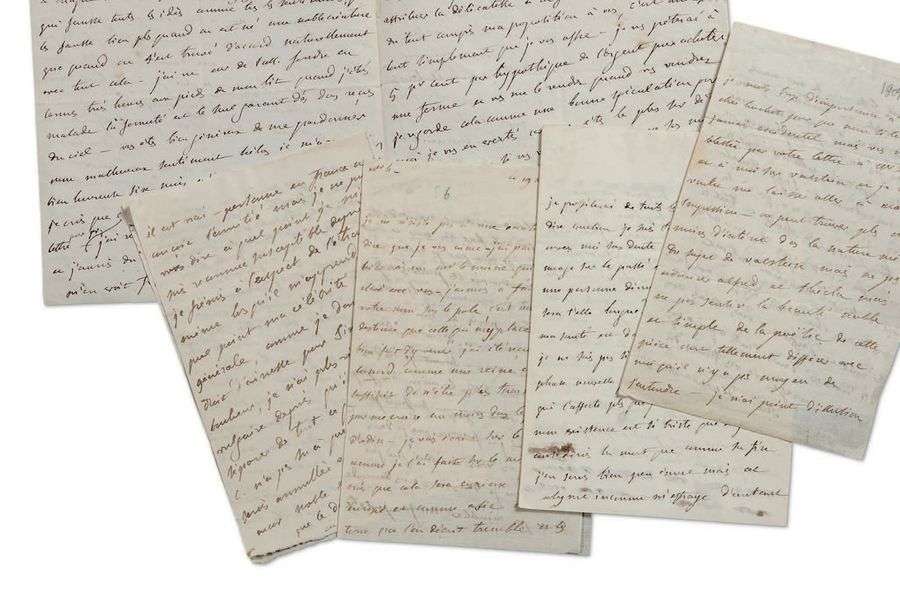
5 L.A., 1803 - 1812, to Claude HOCHET| 16 pages in-8 and 4 pages in-4 (the bottom of the 2nd leaf of the 3rd letter has been cut, and 3 lines and 6 words of the 4th have been crossed out).
Very interesting correspondence to his faithful friend and confidant
Claude Hochet.
[Claude HOCHET (1772 - 1857), journalist at the Publiciste de Suard, met in 1796 in Suard's salon Benjamin Constant and Mme de Staël, whose friend and faithful correspondent he remained until his death. He will gradually abandon literature for an administrative career, but will remain for Mme de Staël and Constant a devoted confidant and friend, playing between them the role of liaison officer and also serving as an intermediary and informant].
Metz November 7 [1803]. Departure from France for Germany after having received her order of exile. She received and burned his letter "which contained such noble proofs of your friendship I wish you never to speak of it, certain that the memory of it will be found in my heart, but there are moments when one must extinguish everything, it is almost to die in one's lifetime. I wanted to say with my metaphysical literature that I would write to Mr. Su[ard] what I would observe in Germany [...] No, in truth I don't want to print anything, I don't know when I will regain my faculties, I have suffered so horribly that I am not sure I will come out of it again - at least in spirit. This departure from France gives me back all the pains of the one in Bondy for the imagination, it is a terrible thing that a border and a great test for the heart that goodbyes. [...] What folly to present a trip as pleasant I have no curiosity and each new object shakes the pain and makes it better felt". She did not know that Mme SUARD had written to her father: "I am attached to her and to her husband who has redoubled in me a feeling that is almost painful as it is true. No one in France conceives friendship but I cannot tell you how susceptible I have become to it since I shudder at the sight of the foreigner, even when he tells me how general my fame is, as I would give this birthright for six months of happiness, I have nothing left but vulgarity since it is necessary to separate myself from all that I love, the 1st C[onsul] did not know to what extent I would have been annulled with pleasure"...
[Rouen] this Monday [3 or 10 November 1806]. On her love for Prosper de BARANTE: "I give you my word of honor, my friend, that you will not be named in Pr. on this matter of money"| she is going to pay her debts: "we are completely free of mutual embarrassment in this respect. What I would like very much is for him to try to get himself sent back to Paris - and that is not a problem.
Paris - and it's not for my feeling alone, it's for his dignity that I wish it, he's a man who can fall as well as rise, his mobility and his father are fighting against his pride and against me". Then about the 17th Bulletin of the Grand Army: "The Queen of Prussia is the most respectable woman in the world and Hullin [General HULIN had presided over the military commission of the Duke of Enghien] to command in
Berlin! You speak of happiness in can it exist when such a dear object [Barante] is in the middle of all that. Ah, I fear every moment that he is going down a road that distorts all ideas as well as all feelings, that distorts them much more when one is born a noble creature than when one has found oneself naturally in agreement with all this.
I saw Mr. de Tall. [TALLEYRAND] burst into tears for three hours at the foot of my bed when I was ill. Firmness is the only guarantee of the gifts received from heaven. You are very generous to forgive me my unfortunate feeling, alas, it has made me very happy, six months, will it be worth more? She noticed [in the Publicist] the extract from the story
Auguste : "I should have recognized you there since the courage had struck me. If this goes on for another ten years, people in France will no longer know what honesty is| it will be called the drivel of old men. As long as we are still young, at least they cannot attribute delicacy to weakness". She explains to Hochet that she wishes to lend him "money to buy a farm [...] I consider it a good speculation for me I warn you because you are the surest of all debtors"... As for the date of publication of her novel [Corinne], she would like "that this war was finished I find it indecent to show oneself on subjects of pleasure in the middle of the tears of Europe", and it is necessary to arrange "the business of the censorship". She is in the process of buying "a land [Acosta] two leagues nearer to Paris than Mantes| we must see if they will let me stay there"...
[Geneva] this 26th of March [1809]. On the tragedy Wallstein by Benjamin
Constant, and on De l'Allemagne.
"One can find more or less interest in the very nature of Valstein's subject but not admire Alfred and Thécla but not feel the noble and simple beauty of the play.
5 L.A., 1803 - 1812, to Claude HOCHET| 16 pages in-8 and 4 pages in-4 (the bottom of the 2nd leaf of the 3rd letter has been cut, and 3 lines and 6 words of the 4th have been crossed out).
Very interesting correspondence to his faithful friend and confidant
Claude Hochet.
[Claude HOCHET (1772 - 1857), journalist at the Publiciste de Suard, met in 1796 in Suard's salon Benjamin Constant and Mme de Staël, whose friend and faithful correspondent he remained until his death. He will gradually abandon literature for an administrative career, but will remain for Mme de Staël and Constant a devoted confidant and friend, playing between them the role of liaison officer and also serving as an intermediary and informant].
Metz November 7 [1803]. Departure from France for Germany after having received her order of exile. She received and burned his letter "which contained such noble proofs of your friendship I wish you never to speak of it, certain that the memory of it will be found in my heart, but there are moments when one must extinguish everything, it is almost to die in one's lifetime. I wanted to say with my metaphysical literature that I would write to Mr. Su[ard] what I would observe in Germany [...] No, in truth I don't want to print anything, I don't know when I will regain my faculties, I have suffered so horribly that I am not sure I will come out of it again - at least in spirit. This departure from France gives me back all the pains of the one in Bondy for the imagination, it is a terrible thing that a border and a great test for the heart that goodbyes. [...] What folly to present a trip as pleasant I have no curiosity and each new object shakes the pain and makes it better felt". She did not know that Mme SUARD had written to her father: "I am attached to her and to her husband who has redoubled in me a feeling that is almost painful as it is true. No one in France conceives friendship but I cannot tell you how susceptible I have become to it since I shudder at the sight of the foreigner, even when he tells me how general my fame is, as I would give this birthright for six months of happiness, I have nothing left but vulgarity since it is necessary to separate myself from all that I love, the 1st C[onsul] did not know to what extent I would have been annulled with pleasure"...
[Rouen] this Monday [3 or 10 November 1806]. On her love for Prosper de BARANTE: "I give you my word of honor, my friend, that you will not be named in Pr. on this matter of money"| she is going to pay her debts: "we are completely free of mutual embarrassment in this respect. What I would like very much is for him to try to get himself sent back to Paris - and that is not a problem.
Paris - and it's not for my feeling alone, it's for his dignity that I wish it, he's a man who can fall as well as rise, his mobility and his father are fighting against his pride and against me". Then about the 17th Bulletin of the Grand Army: "The Queen of Prussia is the most respectable woman in the world and Hullin [General HULIN had presided over the military commission of the Duke of Enghien] to command in
Berlin! You speak of happiness in can it exist when such a dear object [Barante] is in the middle of all that. Ah, I fear every moment that he is going down a road that distorts all ideas as well as all feelings, that distorts them much more when one is born a noble creature than when one has found oneself naturally in agreement with all this.
I saw Mr. de Tall. [TALLEYRAND] burst into tears for three hours at the foot of my bed when I was ill. Firmness is the only guarantee of the gifts received from heaven. You are very generous to forgive me my unfortunate feeling, alas, it has made me very happy, six months, will it be worth more? She noticed [in the Publicist] the extract from the story
Auguste : "I should have recognized you there since the courage had struck me. If this goes on for another ten years, people in France will no longer know what honesty is| it will be called the drivel of old men. As long as we are still young, at least they cannot attribute delicacy to weakness". She explains to Hochet that she wishes to lend him "money to buy a farm [...] I consider it a good speculation for me I warn you because you are the surest of all debtors"... As for the date of publication of her novel [Corinne], she would like "that this war was finished I find it indecent to show oneself on subjects of pleasure in the middle of the tears of Europe", and it is necessary to arrange "the business of the censorship". She is in the process of buying "a land [Acosta] two leagues nearer to Paris than Mantes| we must see if they will let me stay there"...
[Geneva] this 26th of March [1809]. On the tragedy Wallstein by Benjamin
Constant, and on De l'Allemagne.
"One can find more or less interest in the very nature of Valstein's subject but not admire Alfred and Thécla but not feel the noble and simple beauty of the play.