
&w=3840&q=75)
&w=3840&q=75)
&w=3840&q=75)
&w=3840&q=75)
&w=3840&q=75)
&w=3840&q=75)
&w=3840&q=75)
&w=3840&q=75)


107
72155 COCTEAU Jean (1889-1963). MANUSCRIT autographe signé « Jean Cocteau
The item was sold for 2 340 €
Fees include commission and taxes.
COCTEAU Jean (1889 - 1963)
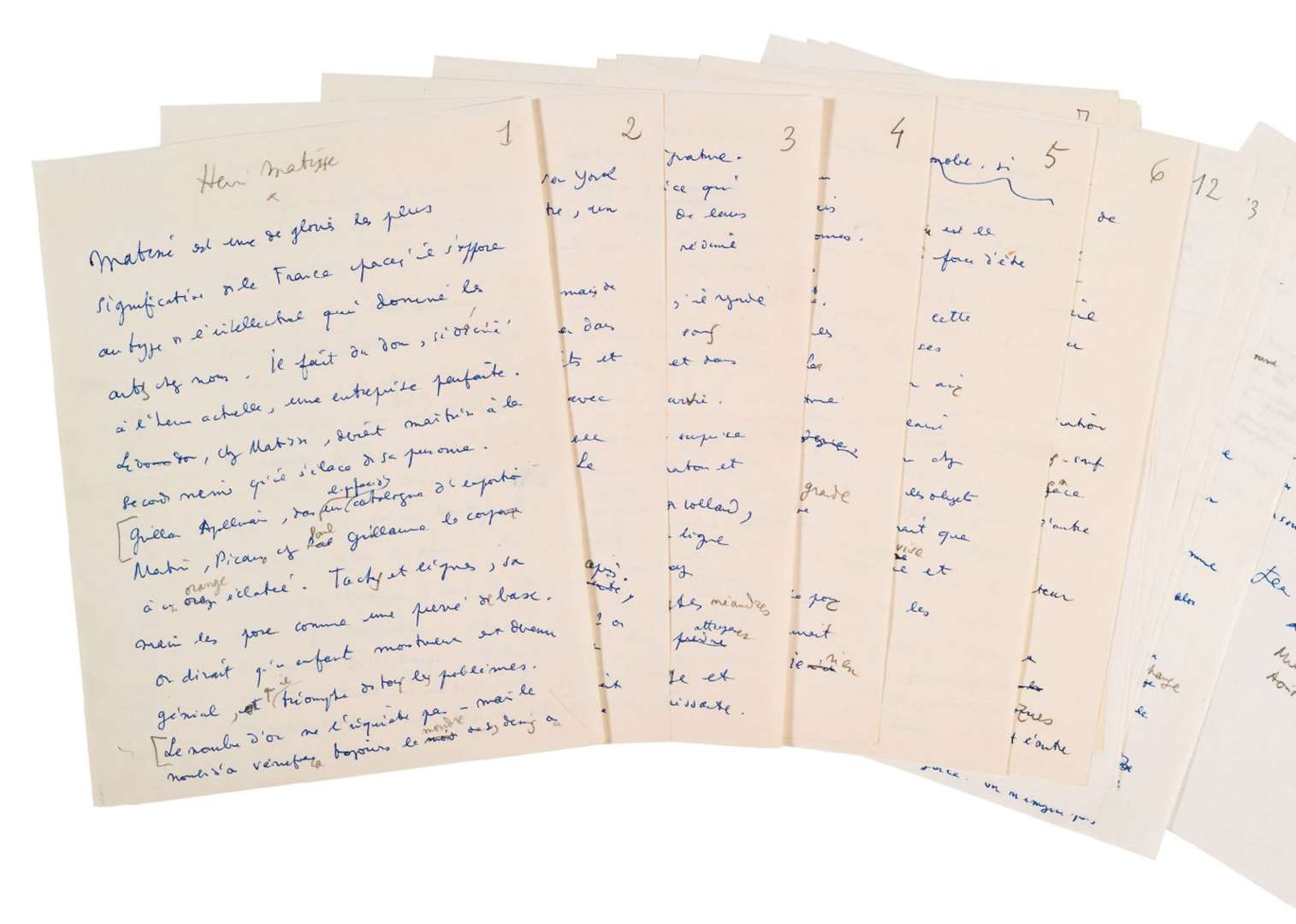
MANUSCRIT autograph signed "Jean Cocteau", Henri Matisse, Milly August 1949| 16 pages in-4.
Beautiful tribute to Matisse.
This text on Matisse, written in August 1949, does not seem to have been published at the time| a shorter version appeared in the journal Livres de France in October 1955. The text was recently published in Écrits sur l'art (Gallimard, 2022, pp. 245-250).
The manuscript is written in blue ballpoint pen (except for page 12 added in pencil), with numerous erasures, corrections and additions in pencil| it has several unpublished paragraphs, and variants from the edited text.
"MATISSE is one of the most significant glories of France because he opposes the type of intellectual that dominates the arts here. He makes the gift, so decried at the present time, a perfect enterprise". Cocteau refers to Guillaume APOLLINAIRE who, "in the preface to the exhibition catalog Matisse, Picasso at Paul Guillaume's compares him to a burst orange. Stains and lines, his hand lies like a base stone. [...] Matisse, according to Picasso's beautiful phrase, first finds and then seeks, that is his great marvel. [...] Never was a freer hand put at the service of such a young mind. Never has such wealth fallen into more thrifty hands. Never will you have a more striking example of the immediate control of instinct." Cocteau evokes the decor for STRAWINSKY's Le Rossignol at Diaghilev's: "One could have expected a jungle of colors. It was nothing of the sort. The curtain rose on a pale blue void organized by that taste which is the opposite of good taste and which astonishes by dint of being simple.
Cocteau reiterates his deep admiration for Matisse and Picasso: "they paint at the antipodes - except in what concerns the stripping and the total absence of silliness. One projects seeds, the other combines grafts. One disrupts traffic without malice. The other is a traffic disruptor and meditates on its accidents."
Matisse's genius is evident and "Matisse, like all geniuses, is a killer. He is surrounded by the nimbus with which assassins halo themselves. He reigns by divine grace, by who knows what privilege of the soul" as "the gold that no one imitates and which exercises a mysterious domination". About the color: "It seems that Matisse waters a canvas and that the colors grow there. The sun finishes the work. It could be that in a set of works of Matisse, the rooms of exhibition embaumententent". Cocteau tries to define the abstract painting: "It seems inconceivable since the abstraction ceases to be it at the minute when it and represented. [...] At the antipodes of each other, Matisse and Picasso push realism to the point where abstraction cannot be questioned". He does not dare to tackle the technical side which seems to him to be a fight against the inert object: "I suppose that Matisse enters into a struggle with the materials he uses to paint [...] The genius consists in erasing the traces of this struggle the second it breaks out". He shows again the differences between Picasso and Matisse in their representation of the couple and concludes: "Few men have had the same determination to put themselves in the forefront, to expose themselves, to commit themselves to the limit of possibility. There remains only the failure to counterbalance too much success and cross the zone of shade where the heroes bathe, become invulnerable and ensure immortality".
MANUSCRIT autograph signed "Jean Cocteau", Henri Matisse, Milly August 1949| 16 pages in-4.
Beautiful tribute to Matisse.
This text on Matisse, written in August 1949, does not seem to have been published at the time| a shorter version appeared in the journal Livres de France in October 1955. The text was recently published in Écrits sur l'art (Gallimard, 2022, pp. 245-250).
The manuscript is written in blue ballpoint pen (except for page 12 added in pencil), with numerous erasures, corrections and additions in pencil| it has several unpublished paragraphs, and variants from the edited text.
"MATISSE is one of the most significant glories of France because he opposes the type of intellectual that dominates the arts here. He makes the gift, so decried at the present time, a perfect enterprise". Cocteau refers to Guillaume APOLLINAIRE who, "in the preface to the exhibition catalog Matisse, Picasso at Paul Guillaume's compares him to a burst orange. Stains and lines, his hand lies like a base stone. [...] Matisse, according to Picasso's beautiful phrase, first finds and then seeks, that is his great marvel. [...] Never was a freer hand put at the service of such a young mind. Never has such wealth fallen into more thrifty hands. Never will you have a more striking example of the immediate control of instinct." Cocteau evokes the decor for STRAWINSKY's Le Rossignol at Diaghilev's: "One could have expected a jungle of colors. It was nothing of the sort. The curtain rose on a pale blue void organized by that taste which is the opposite of good taste and which astonishes by dint of being simple.
Cocteau reiterates his deep admiration for Matisse and Picasso: "they paint at the antipodes - except in what concerns the stripping and the total absence of silliness. One projects seeds, the other combines grafts. One disrupts traffic without malice. The other is a traffic disruptor and meditates on its accidents."
Matisse's genius is evident and "Matisse, like all geniuses, is a killer. He is surrounded by the nimbus with which assassins halo themselves. He reigns by divine grace, by who knows what privilege of the soul" as "the gold that no one imitates and which exercises a mysterious domination". About the color: "It seems that Matisse waters a canvas and that the colors grow there. The sun finishes the work. It could be that in a set of works of Matisse, the rooms of exhibition embaumententent". Cocteau tries to define the abstract painting: "It seems inconceivable since the abstraction ceases to be it at the minute when it and represented. [...] At the antipodes of each other, Matisse and Picasso push realism to the point where abstraction cannot be questioned". He does not dare to tackle the technical side which seems to him to be a fight against the inert object: "I suppose that Matisse enters into a struggle with the materials he uses to paint [...] The genius consists in erasing the traces of this struggle the second it breaks out". He shows again the differences between Picasso and Matisse in their representation of the couple and concludes: "Few men have had the same determination to put themselves in the forefront, to expose themselves, to commit themselves to the limit of possibility. There remains only the failure to counterbalance too much success and cross the zone of shade where the heroes bathe, become invulnerable and ensure immortality".