
&w=3840&q=75)
&w=3840&q=75)
&w=3840&q=75)
&w=3840&q=75)
&w=3840&q=75)
&w=3840&q=75)
&w=3840&q=75)
&w=3840&q=75)


143
EINSTEIN Albert (1879-1955)
The item was sold for 22 100 €
Fees include commission and taxes.
EINSTEIN Albert (1879-1955)
L.A. S. "A. E.", [15 July 1950], to Ernst Gabor STRAUS| 2 pages in-4| in German.
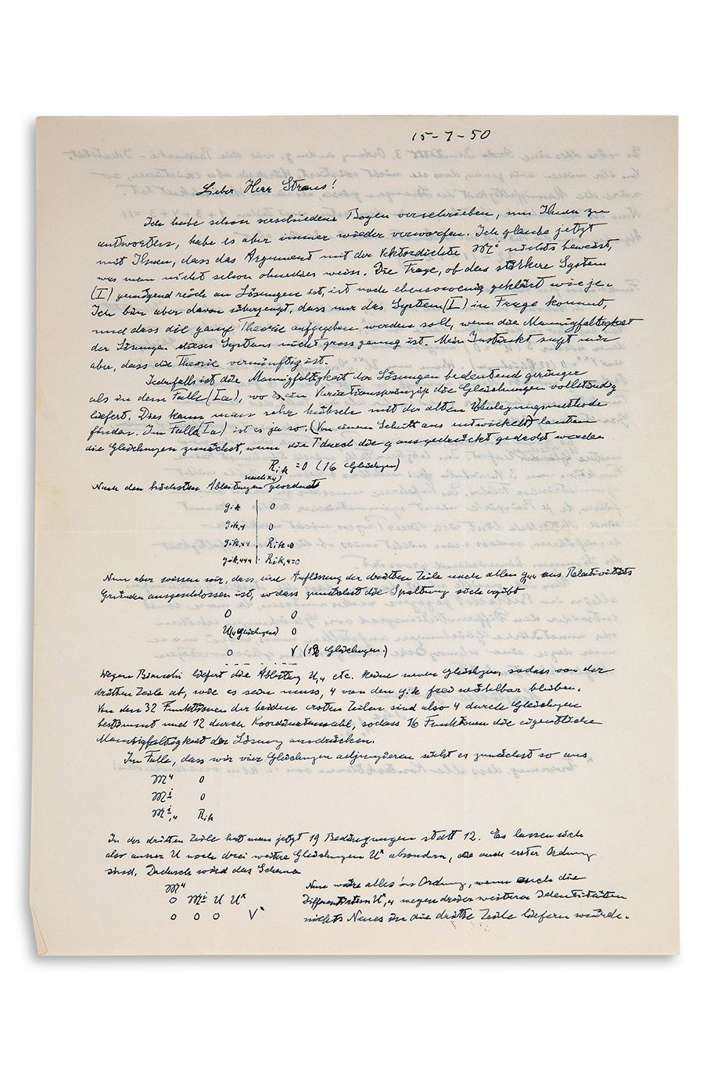
Scientific discussion of the Theory, with calculations and tables. "Ich habe schon verschiedene Bogen verschrieben, um Ihnen zu antworten, habe es aber immer wieder verworfen. Ich glaube jetzt mit Ihnen, dass das Argument mit der Vektordichte nichts beweist, was man nicht schon ohnedies weiss. Die Frage, ob das stärkere System (I) genügend reich an Lösungen ist, ist noch ebensowenig geklärt wie je. Ich bin aber davon überzeugt, dass nur das System (I) in Frage kommt, und dass die ganze Theorie aufgegeben werden soll, wenn die Mannigfaltigkeit der Lösungen dieses Systems nicht gross genug ist. Mein Instinkt sagt mir aber, dass die Theorie vernünftig ist. Jedenfalls ist die Mannigfaltigkeit der Lösungen bedeutend geringer als in dem Falle (Ia), wo ein Variationsprinzip die Gleichungen vollständig liefert. Dies kann man sehr hübsch mit der alten Überlegungsmethode finden. Im Falle (Ia) ist es ja so. [...] Wegen Bianchi liefert die Ableitung U,4 etc. keine neuen Gleichungen, sodass von der dritten Zeile ab, wie es sein muss, 4 von den Gik frei wählbar bleiben. Von den 32 Funktionen der beiden ersten Zeilen sind also 4 durch Gleichungen bestimmt und 12 durch Koordinatenwahl, sodass 16 Funktionen die eigentliche Mannigfaltigkeit der Lösung ausdrücken ".... Etc. Einstein now agrees with Straus that the vector density argument proves nothing that is not already known. The question whether the strongest system (I) is sufficiently rich in solutions is still unanswered. He is convinced, however, that only system (I) can be considered and that the whole theory should be abandoned if the range of solutions for this system is not wide enough. But his instinct tells him that the theory is reasonable. In any case, the variety of solutions is much less than in case (Ia), where a principle of variation completely supplies the equations. This can be found very well with the old method of reasoning. In case (Ia) it is so. And Einstein develops various calculations...
For Bianchi, the derivation U,4 etc. does not provide new equations, so from the third line, as it should, 4 remain freely selectable by Gik. Of the 32 functions in the first two lines, 4 are determined by equations and 12 by coordinate selection, so that 16 functions express the real diversity of the solution... Etc. In conclusion: "Es kann aber sein, dass dieser Prozess auch dabei nicht abgeschlossen ist sondern noch eine oder zwei weitere U-Gleichungen liefert. Im letzteren Falle würde überhaupt keine Funktion von 3 Variabeln frei wählbar bleiben im Falle nicht symmetrischer Felder. This procedure should, however, lead to an end, because the parts that are not symmetrical to each other have been identified. Natürlich lässt sich dieser Prozess nicht wirklich durchführen, sodass man nicht weiss, ob die Mannigfaltigkeit der Lösungen hinreichend gross ist. Aber ich zweifle nicht daran, dass die starken Gleichungen allein in Betracht gezogen werden müssen, da man sonst entweder den Differentiationgrad von Gleichungen erhöhen oder unnatürliche Gleichungen aufstellen muss, wobei man noch dazu eine schmerzliche Wahl zwischen gleichwertigen Möglichkeiten hätte "... However, it is possible that this process is not yet complete, but also provides one or two additional U-equations. In the latter case, no function of 3 variables would remain freely selectable in the case of non-symmetric fields. However, the procedure must end, because examples of non-symmetric fields are known. Of course, this process cannot really be done, so it is not known whether the variety of solutions is large enough. But I have no doubt that the strong equations must be considered alone, because otherwise one would either have to increase the degree of differentiation of the equations, or set up unnatural equations...
L.A. S. "A. E.", [15 July 1950], to Ernst Gabor STRAUS| 2 pages in-4| in German.
Scientific discussion of the Theory, with calculations and tables. "Ich habe schon verschiedene Bogen verschrieben, um Ihnen zu antworten, habe es aber immer wieder verworfen. Ich glaube jetzt mit Ihnen, dass das Argument mit der Vektordichte nichts beweist, was man nicht schon ohnedies weiss. Die Frage, ob das stärkere System (I) genügend reich an Lösungen ist, ist noch ebensowenig geklärt wie je. Ich bin aber davon überzeugt, dass nur das System (I) in Frage kommt, und dass die ganze Theorie aufgegeben werden soll, wenn die Mannigfaltigkeit der Lösungen dieses Systems nicht gross genug ist. Mein Instinkt sagt mir aber, dass die Theorie vernünftig ist. Jedenfalls ist die Mannigfaltigkeit der Lösungen bedeutend geringer als in dem Falle (Ia), wo ein Variationsprinzip die Gleichungen vollständig liefert. Dies kann man sehr hübsch mit der alten Überlegungsmethode finden. Im Falle (Ia) ist es ja so. [...] Wegen Bianchi liefert die Ableitung U,4 etc. keine neuen Gleichungen, sodass von der dritten Zeile ab, wie es sein muss, 4 von den Gik frei wählbar bleiben. Von den 32 Funktionen der beiden ersten Zeilen sind also 4 durch Gleichungen bestimmt und 12 durch Koordinatenwahl, sodass 16 Funktionen die eigentliche Mannigfaltigkeit der Lösung ausdrücken ".... Etc. Einstein now agrees with Straus that the vector density argument proves nothing that is not already known. The question whether the strongest system (I) is sufficiently rich in solutions is still unanswered. He is convinced, however, that only system (I) can be considered and that the whole theory should be abandoned if the range of solutions for this system is not wide enough. But his instinct tells him that the theory is reasonable. In any case, the variety of solutions is much less than in case (Ia), where a principle of variation completely supplies the equations. This can be found very well with the old method of reasoning. In case (Ia) it is so. And Einstein develops various calculations...
For Bianchi, the derivation U,4 etc. does not provide new equations, so from the third line, as it should, 4 remain freely selectable by Gik. Of the 32 functions in the first two lines, 4 are determined by equations and 12 by coordinate selection, so that 16 functions express the real diversity of the solution... Etc. In conclusion: "Es kann aber sein, dass dieser Prozess auch dabei nicht abgeschlossen ist sondern noch eine oder zwei weitere U-Gleichungen liefert. Im letzteren Falle würde überhaupt keine Funktion von 3 Variabeln frei wählbar bleiben im Falle nicht symmetrischer Felder. This procedure should, however, lead to an end, because the parts that are not symmetrical to each other have been identified. Natürlich lässt sich dieser Prozess nicht wirklich durchführen, sodass man nicht weiss, ob die Mannigfaltigkeit der Lösungen hinreichend gross ist. Aber ich zweifle nicht daran, dass die starken Gleichungen allein in Betracht gezogen werden müssen, da man sonst entweder den Differentiationgrad von Gleichungen erhöhen oder unnatürliche Gleichungen aufstellen muss, wobei man noch dazu eine schmerzliche Wahl zwischen gleichwertigen Möglichkeiten hätte "... However, it is possible that this process is not yet complete, but also provides one or two additional U-equations. In the latter case, no function of 3 variables would remain freely selectable in the case of non-symmetric fields. However, the procedure must end, because examples of non-symmetric fields are known. Of course, this process cannot really be done, so it is not known whether the variety of solutions is large enough. But I have no doubt that the strong equations must be considered alone, because otherwise one would either have to increase the degree of differentiation of the equations, or set up unnatural equations...