
&w=3840&q=75)
&w=3840&q=75)
&w=3840&q=75)
&w=3840&q=75)
&w=3840&q=75)
&w=3840&q=75)
&w=3840&q=75)
&w=3840&q=75)


137
EINSTEIN Albert (1879-1955)
The item was sold for 48 100 €
Fees include commission and taxes.
EINSTEIN Albert (1879-1955)
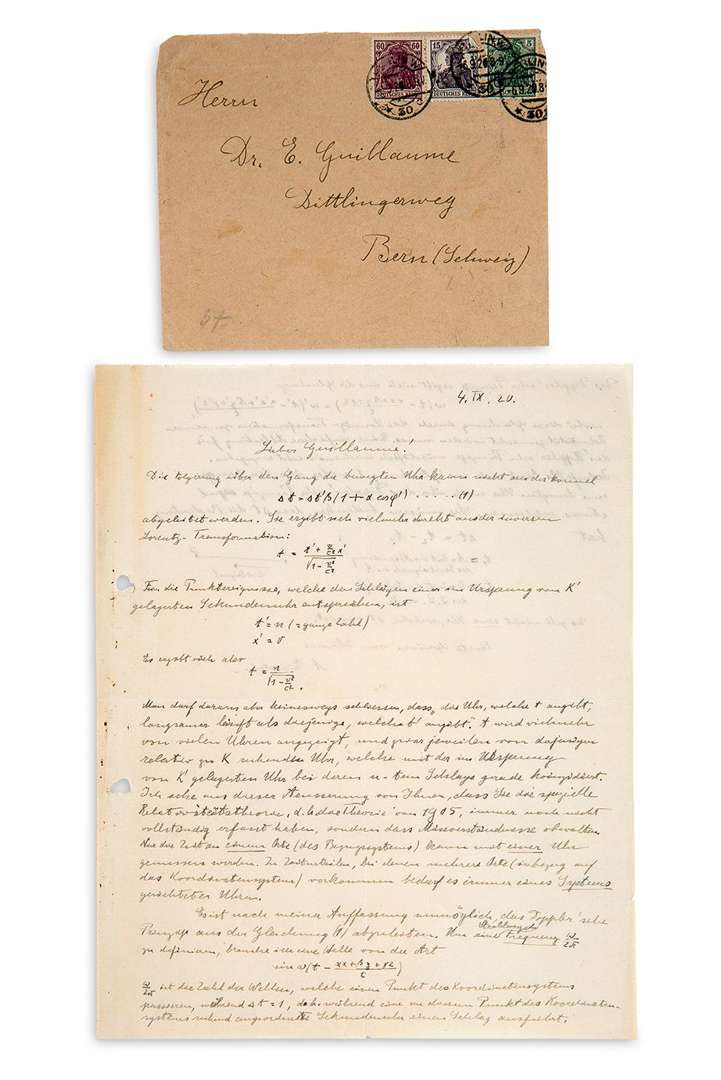
L.A.S. "A. Einstein ", 4.IX.[19]20, to Édouard GUILLAUME| 1 page and a half in-4, envelope (binder holes)| in German
Important scientific letter, with calculations and equations, on the measurement of time and relativity. [Henri Poincaré's editor, the physicist Édouard GUILLAUME (1881-1959), cousin of the Nobel Prize winner in physics Charles-Édouard Guillaume, was Einstein's colleague in Bern at the Intellectual Property Office. His conceptions of universal time went against Einstein's theory of relativity, and led him to engage in a long and virulent polemic with Einstein and Marcel Grossmann, beginning with his articles in the Revue de Métaphysique et de Morale on "La théorie de la relativité et le temps universel" (1918) and "La théorie de la relativité et sa signification" (1920)]. In this letter, Einstein gives new explanations to Edouard Guillaume. Although still decried by a part of the scientific community, Einstein's theories were proven in 1919. Arthur Eddington realized the measurement of the deviation that the light of a star undergoes near the sun. This is a direct consequence of the theory of gravitation. But Guillaume persisted in proving the contrary. He tried to combine the theories of Christian Andreas Doppler (1803-1853) who had worked on the real shift of the light frequency and those of Hendrik Antoon Lorentz whose work served as a basis for the theory of Einstein. Doppler's calculations were wrong and Guillaume's use of Lorentz's theories cannot be applied to the theory of relativity.
"Die Folgerung über den Gang die bewegten Uhr kann nicht aus der Formel Δt = Δt'β(1+αcosφ')..... (1) abgeleitet werden. Sie ergibt sich vielmehr direkt aus der inversen Lorentz-Transformation: [formal] Für die Punktereignisse, welche den Schlägen einer im Ursprung von K' gelagerten Sekundenuhr entsprechen, ist [formal] Es ergibt sich also [formal] Man darf daraus aber keineswegs schliessen, dass "die Uhr, welche t angibt, langsamer läuft als diejenige, welche t' angibt." t wird vielmehr von vielen Uhren angezeigt, und zwar jeweilen von derjenigen relativ zu K ruhenden Uhr, welche mit der im Ursprung von gelagerten Uhr bei deren n-tem Schlage gerade koinzidiert. Ich sehe aus dieser Aeusserung von Ihnen, dass Sie die spezielle Relativitäts-theorie, d. h. die Theorie von 1905, immer noch nicht vollständig erfasst haben, sondern dass Missverständnisse obwalten. Nur die Zeit an einem Orte (des Bezugssystems) kann mit einer Uhr gemessen werden. In Zeiturteilen, bei denen mehr Orte (inbezug auf das Koordinatensystem) vorkommen bedarf es immer eines Systems gerichteter Uhren. Es ist nach meiner Auffassung unmöglich, das Doppler'sche Prinzip aus der Gleichung (1) abzuleiten. Um eine Strahlung als Frequenz ω/2π zu definieren, brauche ich eine Welle von der Art [formel] ω/2π ist die Zahl der Wellen, welche einen Punkt des Koordinatensystems passieren, während Δ t = 1, d. h. während eine an diesem Punkt des Koordinatensystems ruhend angeordnete Sekundenuhr einen Schlage ausführt, das Doppler'sche Prinzip ergibt sich aus der Gleichung [formula], wobei diese Gleichung durch die Lorentz-Transformation zu einer Identität gemacht werden muss. Eine einfachere Ableitung für das Doppler'sche Prinzip wüsste ich durchaus nicht anzugeben. Jedenfalls lässt sich aus Gleichung 1 weder über den Gang einer bewegten Uhr noch über das Doppler'sche Prinzip irgend etwas schliessen. Sie müssen bedenken, dass Δ t die Bedeutung hat Δ t = t 2 - t 1 A.----------.B t 1 = A = Zeit der Absendung des Lichtsignals in A t 2 = B = Zeit der Ankunft des L. S. in B. Es gibt nicht eine Uhr, welche Δt anzeigt "...
L.A.S. "A. Einstein ", 4.IX.[19]20, to Édouard GUILLAUME| 1 page and a half in-4, envelope (binder holes)| in German
Important scientific letter, with calculations and equations, on the measurement of time and relativity. [Henri Poincaré's editor, the physicist Édouard GUILLAUME (1881-1959), cousin of the Nobel Prize winner in physics Charles-Édouard Guillaume, was Einstein's colleague in Bern at the Intellectual Property Office. His conceptions of universal time went against Einstein's theory of relativity, and led him to engage in a long and virulent polemic with Einstein and Marcel Grossmann, beginning with his articles in the Revue de Métaphysique et de Morale on "La théorie de la relativité et le temps universel" (1918) and "La théorie de la relativité et sa signification" (1920)]. In this letter, Einstein gives new explanations to Edouard Guillaume. Although still decried by a part of the scientific community, Einstein's theories were proven in 1919. Arthur Eddington realized the measurement of the deviation that the light of a star undergoes near the sun. This is a direct consequence of the theory of gravitation. But Guillaume persisted in proving the contrary. He tried to combine the theories of Christian Andreas Doppler (1803-1853) who had worked on the real shift of the light frequency and those of Hendrik Antoon Lorentz whose work served as a basis for the theory of Einstein. Doppler's calculations were wrong and Guillaume's use of Lorentz's theories cannot be applied to the theory of relativity.
"Die Folgerung über den Gang die bewegten Uhr kann nicht aus der Formel Δt = Δt'β(1+αcosφ')..... (1) abgeleitet werden. Sie ergibt sich vielmehr direkt aus der inversen Lorentz-Transformation: [formal] Für die Punktereignisse, welche den Schlägen einer im Ursprung von K' gelagerten Sekundenuhr entsprechen, ist [formal] Es ergibt sich also [formal] Man darf daraus aber keineswegs schliessen, dass "die Uhr, welche t angibt, langsamer läuft als diejenige, welche t' angibt." t wird vielmehr von vielen Uhren angezeigt, und zwar jeweilen von derjenigen relativ zu K ruhenden Uhr, welche mit der im Ursprung von gelagerten Uhr bei deren n-tem Schlage gerade koinzidiert. Ich sehe aus dieser Aeusserung von Ihnen, dass Sie die spezielle Relativitäts-theorie, d. h. die Theorie von 1905, immer noch nicht vollständig erfasst haben, sondern dass Missverständnisse obwalten. Nur die Zeit an einem Orte (des Bezugssystems) kann mit einer Uhr gemessen werden. In Zeiturteilen, bei denen mehr Orte (inbezug auf das Koordinatensystem) vorkommen bedarf es immer eines Systems gerichteter Uhren. Es ist nach meiner Auffassung unmöglich, das Doppler'sche Prinzip aus der Gleichung (1) abzuleiten. Um eine Strahlung als Frequenz ω/2π zu definieren, brauche ich eine Welle von der Art [formel] ω/2π ist die Zahl der Wellen, welche einen Punkt des Koordinatensystems passieren, während Δ t = 1, d. h. während eine an diesem Punkt des Koordinatensystems ruhend angeordnete Sekundenuhr einen Schlage ausführt, das Doppler'sche Prinzip ergibt sich aus der Gleichung [formula], wobei diese Gleichung durch die Lorentz-Transformation zu einer Identität gemacht werden muss. Eine einfachere Ableitung für das Doppler'sche Prinzip wüsste ich durchaus nicht anzugeben. Jedenfalls lässt sich aus Gleichung 1 weder über den Gang einer bewegten Uhr noch über das Doppler'sche Prinzip irgend etwas schliessen. Sie müssen bedenken, dass Δ t die Bedeutung hat Δ t = t 2 - t 1 A.----------.B t 1 = A = Zeit der Absendung des Lichtsignals in A t 2 = B = Zeit der Ankunft des L. S. in B. Es gibt nicht eine Uhr, welche Δt anzeigt "...