
&w=3840&q=75)
&w=3840&q=75)
&w=3840&q=75)
&w=3840&q=75)
&w=3840&q=75)
&w=3840&q=75)
&w=3840&q=75)
&w=3840&q=75)


SARTRE Jean-Paul (1905-1980)
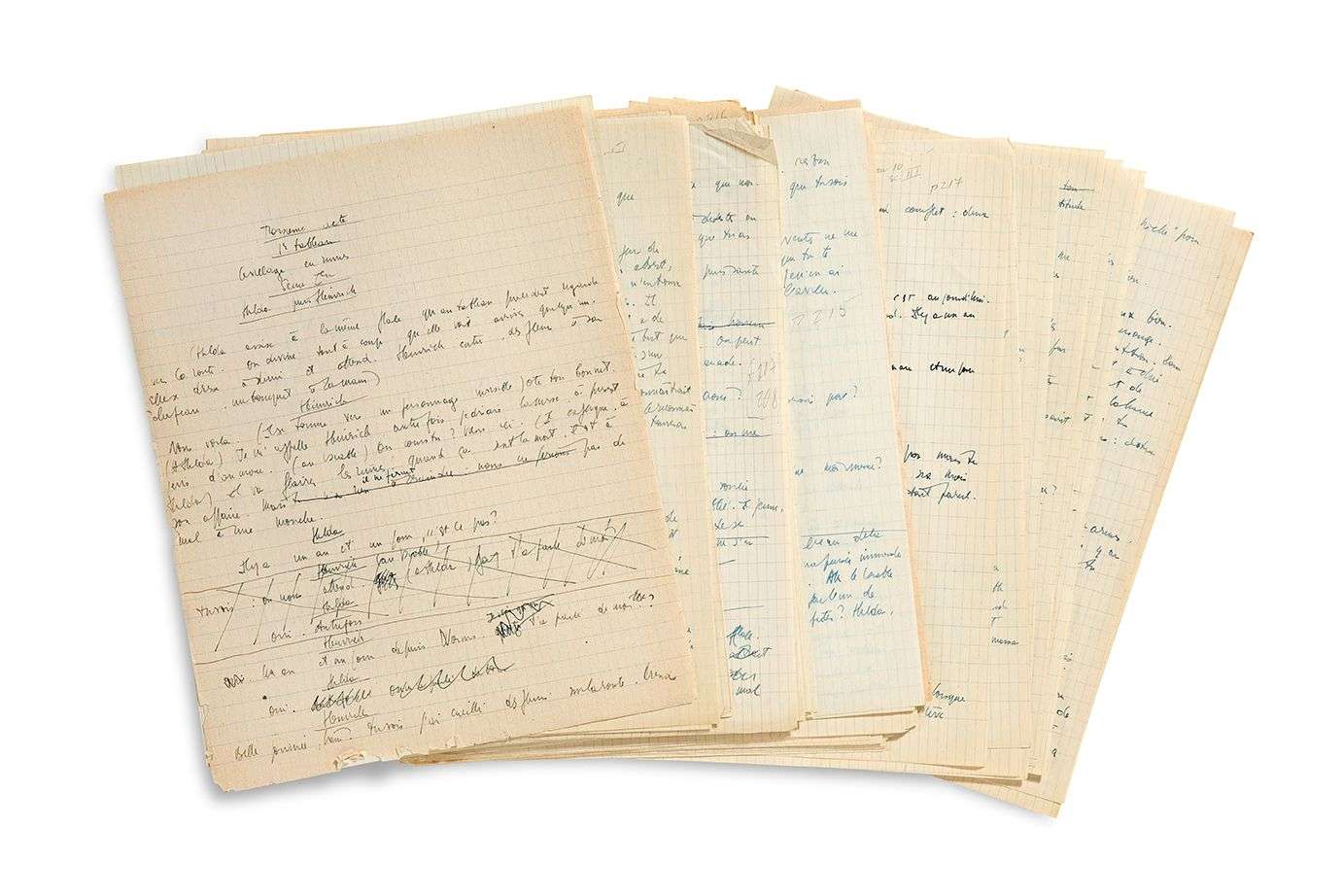
AUTOGRAPHIC MANUSCRIPT for Le Diable et le Bon Dieu, [1951]| 91 pages on 85 ff. in-4 (27 x 21 cm) in a Moirans paper block cover.
First draft and working manuscripts for his play Le Diable et le Bon Dieu. Begun in early 1951, the play was first performed at the Théâtre Antoine on June 7, 1951 in a production by Louis Jouvet (with Pierre Brasseur, Jean Vilar, Maria Casarès...), and published in Les Temps modernes of June, July and August 1951, and in volume at Gallimard in October 1951. The manuscript, in blue-black ink on sheets of squared paper written on the front (6 are also written on the back) and sometimes partially filled, sometimes presents several versions of the same text, Sartre not liking to erase and preferring to take again his text on a new sheet| some however present erasures and corrections, and passages crossed out. These work sheets present a version sometimes very different from the printed text. We have here almost the whole of the tenth scene in act III (with the exception of the short scene v and last), in the ruined village: scene i with Hilda and then Heinrich, scene ii between Hilda and Goetz, scene iii with the same and Heinrich, and the long scene iv of confrontation between the former warrior Goetz and the priest Heinrich. We can only give here a brief overview of the interest of this manuscript. Thus, in scene i, we note a long tirade by Hilda (taken up again on another sheet in a shortened version) of which only a three-sentence reply will remain in the final version: "The one who offended you is no more. I thought he was waiting for you, that he had dressed up to receive you, that he was going to challenge you and prove his victory. This is what excited your anger. Well, you see: your anger will be disappointed, it will meet only emptiness. He no longer cares about you or your bet. He is always absent, attentive to himself| he looks for his temptations and if he doesn't find any he invents them to punish himself for having had them. He fights against hunger, against thirst, against the desire he has for me| he youths, prays, scourges himself. Whatever evil you want to do to him you cannot torture him more than he tortures himself, whatever hatred you have for him, you cannot hate him more than he hates himself. Go away, let him do your work for you: he grows weaker every day. If I wasn't here to take care of him - when he wants me to take care of him - I think he would be dead already. He wouldn't even recognize you if he saw you and you wouldn't be able to recognize him. What's the point of being obstinate? Let us quote again, in scene iii, this line from Goetz, which disappeared from the final version: "Well, we are complete: you, me, the Devil and the Good Lord. Let's start.
AUTOGRAPHIC MANUSCRIPT for Le Diable et le Bon Dieu, [1951]| 91 pages on 85 ff. in-4 (27 x 21 cm) in a Moirans paper block cover.
First draft and working manuscripts for his play Le Diable et le Bon Dieu. Begun in early 1951, the play was first performed at the Théâtre Antoine on June 7, 1951 in a production by Louis Jouvet (with Pierre Brasseur, Jean Vilar, Maria Casarès...), and published in Les Temps modernes of June, July and August 1951, and in volume at Gallimard in October 1951. The manuscript, in blue-black ink on sheets of squared paper written on the front (6 are also written on the back) and sometimes partially filled, sometimes presents several versions of the same text, Sartre not liking to erase and preferring to take again his text on a new sheet| some however present erasures and corrections, and passages crossed out. These work sheets present a version sometimes very different from the printed text. We have here almost the whole of the tenth scene in act III (with the exception of the short scene v and last), in the ruined village: scene i with Hilda and then Heinrich, scene ii between Hilda and Goetz, scene iii with the same and Heinrich, and the long scene iv of confrontation between the former warrior Goetz and the priest Heinrich. We can only give here a brief overview of the interest of this manuscript. Thus, in scene i, we note a long tirade by Hilda (taken up again on another sheet in a shortened version) of which only a three-sentence reply will remain in the final version: "The one who offended you is no more. I thought he was waiting for you, that he had dressed up to receive you, that he was going to challenge you and prove his victory. This is what excited your anger. Well, you see: your anger will be disappointed, it will meet only emptiness. He no longer cares about you or your bet. He is always absent, attentive to himself| he looks for his temptations and if he doesn't find any he invents them to punish himself for having had them. He fights against hunger, against thirst, against the desire he has for me| he youths, prays, scourges himself. Whatever evil you want to do to him you cannot torture him more than he tortures himself, whatever hatred you have for him, you cannot hate him more than he hates himself. Go away, let him do your work for you: he grows weaker every day. If I wasn't here to take care of him - when he wants me to take care of him - I think he would be dead already. He wouldn't even recognize you if he saw you and you wouldn't be able to recognize him. What's the point of being obstinate? Let us quote again, in scene iii, this line from Goetz, which disappeared from the final version: "Well, we are complete: you, me, the Devil and the Good Lord. Let's start.