
&w=3840&q=75)
&w=3840&q=75)
&w=3840&q=75)
&w=3840&q=75)
&w=3840&q=75)
&w=3840&q=75)
&w=3840&q=75)
&w=3840&q=75)

107
ROUSSEAU Jean-Jacques (1712-1778)
The item was sold for 12 350 €
Fees include commission and taxes.
ROUSSEAU Jean-Jacques (1712-1778)
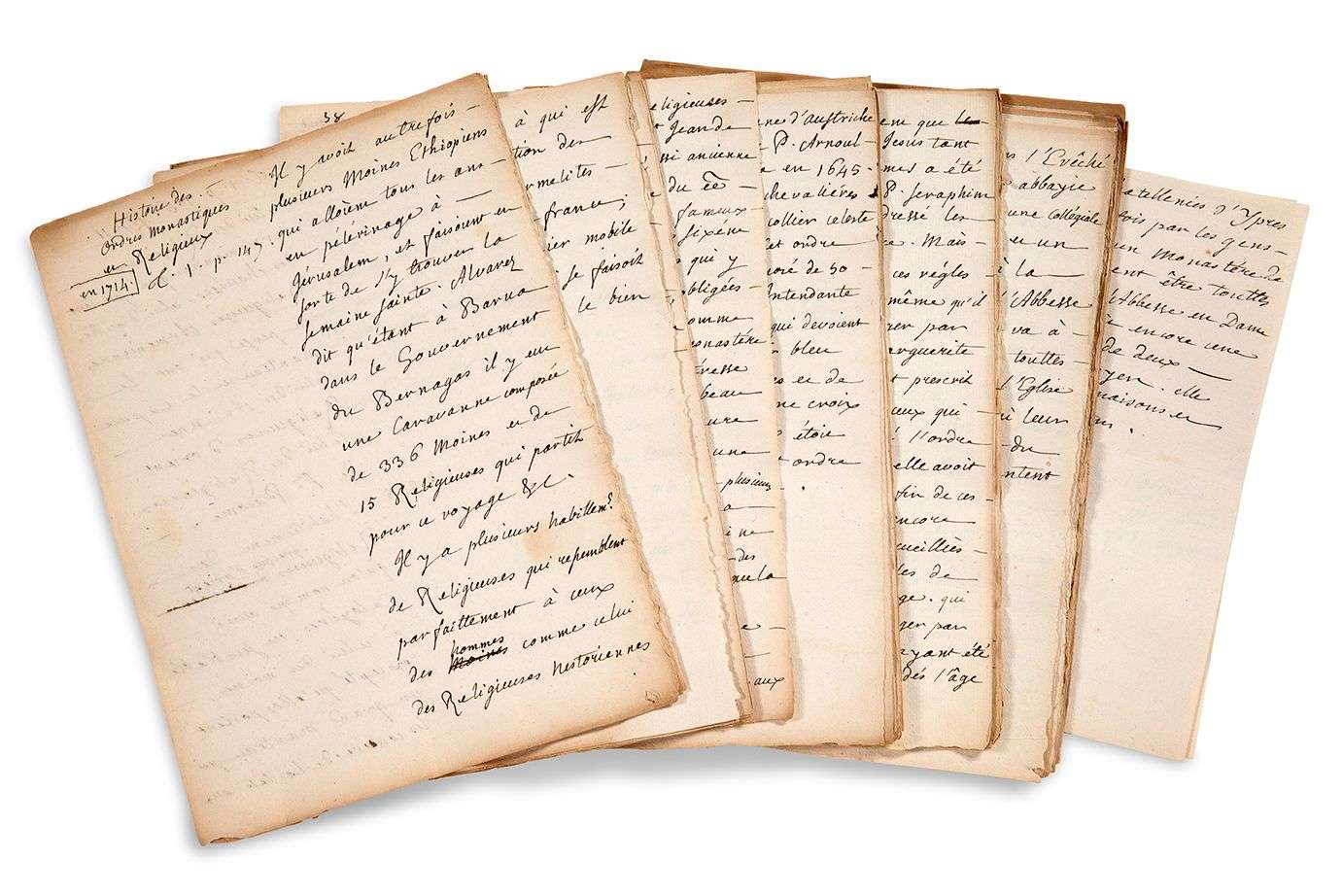
Autograph manuscript, Extraits de l'Histoire des Ordres Religieux et Monastiques| about 40 pages on 38 leaves in4, in folder with autograph title.
Interesting notes on the place of women in religious orders.
From the Histoire des ordres monastiques, religieux et militaires, et des congrégations seculières de l'un et de l'autre sexe, qui ont été établis jusqu'à présent (1714-1721), an important work in 5 volumes by the great Franciscan historian, Father Pierre Hippolyte HÉLYOT (1660-1716). This fundamental work constitutes the great repertory of the history of religious orders, giving even the costumes and habits of the different congregations. These notes are related to the work on women that Rousseau began in 1746 and continued until 1751 for his patroness Madame DUPIN, and which never saw the light of day. Rousseau is particularly interested in the originality of the morals of certain orders of nuns since the late Middle Ages, as well as in the particularity of their dress (certain nuns from the East and Armenia who wear the same clothes as monks, those who do not wear veils, those who do not wear shoes), of their ceremony of dress, etc., as well as in the originality of their practices. He thus notes certain discriminations of which the female orders in the Church were victims compared to the male orders, and is closely interested in the various military orders of nuns, nuns-knights (St. Brigid, Order of the Amaranth founded by Queen Christine| institution of the Religious Hospitallers of St. John of Jerusalem who prove themselves as knights| Anne of Austria's project to create an order of knights under the name of the "celestial necklace or Daughters of the Rosary", etc.). He notes information on mixed military orders (Crowned Knights of the Order of St. James in Germany, 1493)| on the nuns of the order founded by St. Caesarius, where they studied the Humanities| on the considerable powers and rights of certain communities such as the Benedictine nuns of Angers| on the evolution of ceremonies, such as the disappearance of the old custom of blessing and consecration of the Carthusian nuns, etc.
Here is an example: "The institution of the Religious Hospitallers of St. John of Jerusalem is as old as that of the Chers of the same order. Their most famous convent is in Sixene in Spain. The girls who are received there are obliged to prove themselves like the Knights. This monastery is like a fortress where there is a very beautiful palace for the prioress who is served with great pomp and has several titled officials. There are office maids who do not take any vows and those who are given only the half-cross. They perform the divine service with great pomp and majesty. On double feasts they wear fine cloth rochets and hold a silver scepter in their hands. They have ten priests and a prior, to whom they give the habit of the order. The Prioress provides for the vaquans benefits, and gives the habit of obedience to the priests who serve her. Four leaves have notes in the margin in the hand of Mrs. DUPIN, who also wrote the last two leaves of this file entirely.
Autograph manuscript, Extraits de l'Histoire des Ordres Religieux et Monastiques| about 40 pages on 38 leaves in4, in folder with autograph title.
Interesting notes on the place of women in religious orders.
From the Histoire des ordres monastiques, religieux et militaires, et des congrégations seculières de l'un et de l'autre sexe, qui ont été établis jusqu'à présent (1714-1721), an important work in 5 volumes by the great Franciscan historian, Father Pierre Hippolyte HÉLYOT (1660-1716). This fundamental work constitutes the great repertory of the history of religious orders, giving even the costumes and habits of the different congregations. These notes are related to the work on women that Rousseau began in 1746 and continued until 1751 for his patroness Madame DUPIN, and which never saw the light of day. Rousseau is particularly interested in the originality of the morals of certain orders of nuns since the late Middle Ages, as well as in the particularity of their dress (certain nuns from the East and Armenia who wear the same clothes as monks, those who do not wear veils, those who do not wear shoes), of their ceremony of dress, etc., as well as in the originality of their practices. He thus notes certain discriminations of which the female orders in the Church were victims compared to the male orders, and is closely interested in the various military orders of nuns, nuns-knights (St. Brigid, Order of the Amaranth founded by Queen Christine| institution of the Religious Hospitallers of St. John of Jerusalem who prove themselves as knights| Anne of Austria's project to create an order of knights under the name of the "celestial necklace or Daughters of the Rosary", etc.). He notes information on mixed military orders (Crowned Knights of the Order of St. James in Germany, 1493)| on the nuns of the order founded by St. Caesarius, where they studied the Humanities| on the considerable powers and rights of certain communities such as the Benedictine nuns of Angers| on the evolution of ceremonies, such as the disappearance of the old custom of blessing and consecration of the Carthusian nuns, etc.
Here is an example: "The institution of the Religious Hospitallers of St. John of Jerusalem is as old as that of the Chers of the same order. Their most famous convent is in Sixene in Spain. The girls who are received there are obliged to prove themselves like the Knights. This monastery is like a fortress where there is a very beautiful palace for the prioress who is served with great pomp and has several titled officials. There are office maids who do not take any vows and those who are given only the half-cross. They perform the divine service with great pomp and majesty. On double feasts they wear fine cloth rochets and hold a silver scepter in their hands. They have ten priests and a prior, to whom they give the habit of the order. The Prioress provides for the vaquans benefits, and gives the habit of obedience to the priests who serve her. Four leaves have notes in the margin in the hand of Mrs. DUPIN, who also wrote the last two leaves of this file entirely.