
&w=3840&q=75)
&w=3840&q=75)
&w=3840&q=75)
&w=3840&q=75)
&w=3840&q=75)
&w=3840&q=75)
&w=3840&q=75)
&w=3840&q=75)


QUENEAU RAYMOND (1903-1976)
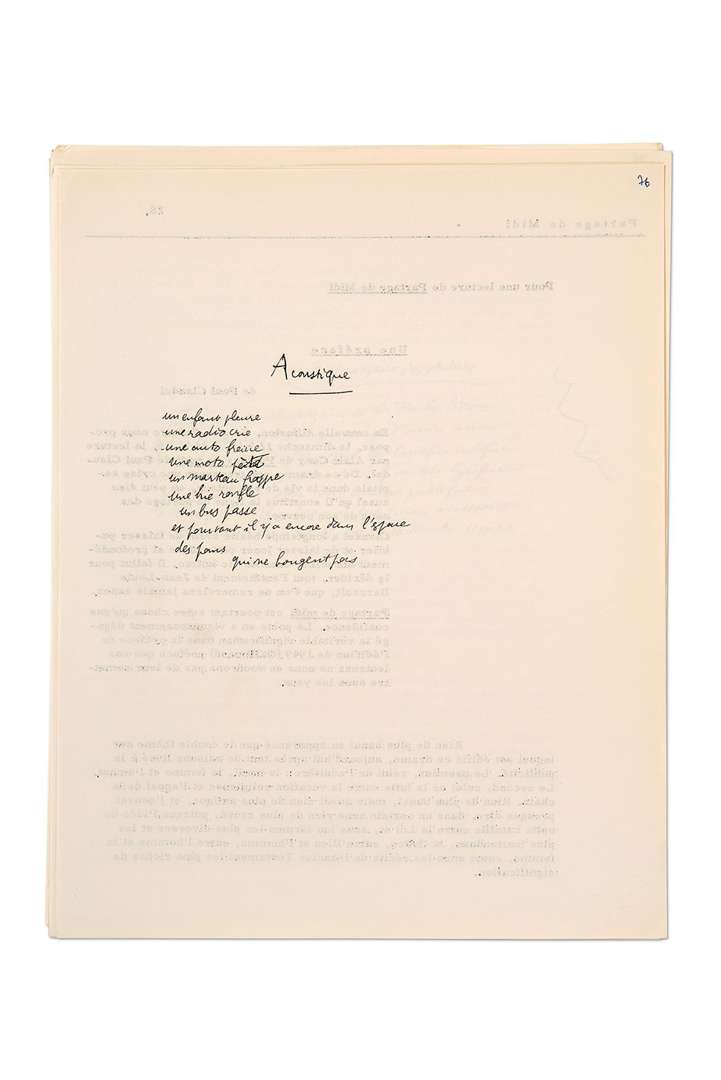
MANUSCRIT autograph signed "Raymond Queneau", Courir les rues, [1966]| 169 pages in-4 (21 x 27 cm).
Complete manuscript of the poetic collection Courir les rues, inspired by Paris.
Courir les rues was published in February 1967 by Gallimard in the collection Blanche. It is the first part of a trilogy completed by Battre la campagne (1968) and Fendre les flots (1969).
The first idea for this collection dates back to October 1960, but Queneau began working on it in 1966. In 1936-1938, he had written a column "Do you know Paris?" in L'Intransigeant. "This is not a collection of poems," wrote Queneau in the prayer of insertion, "but the account of comings and goings in a Paris that is neither the 'mysterious Paris' nor the 'unknown Paris' of specialists. It is only about small daily facts, pigeons, street names, lost tourists: a kind of ideal walk in a Paris that is not ideal, a walk that would begin at Pentecost and end at All Saints' Day, with the dead leaves. Among these marvelous exercises in urban poetry is Les Colombins, in which Queneau hijacks a song by Charles Trénet: "Long long long long after the pigeons have disappeared we will still see their droppings in the streets also in my poems and people will wonder what importance it had the pigeons what it was something in the genre of the aurochs or the pterodactyl of the coelacanth or of the dodo but nobody will read my poems anymore"
This quasi-definitive manuscript, cleaned up, presents the whole of the poems, with a few variants, crossed out verses and numerous corrections. One counts indeed nearly 150 autograph corrections, among which erasures with modifications, as well as additions and 25 verses entirely crossed out. It remained unknown to Claude Debon for the edition of the Pléiade.
The manuscript of the 154 poems is in black ink, on versos of sheets of various origins: printed reading notes, literary advertisements, typed letters, circulars from Gallimard or the Oulipo... One side presents a draft of a poem that has been crossed out, and two others present calculations of probability.
It is paginated from 1 to 169, and includes the title page: "Courir les rues / Raymond Queneau", page 2 with the epigraph of Heraclitus in Greek, 165 autographed pages and 2 typed pages.
All the poems follow in the order of the printed collection, except for three of them: La Ronde, Vaugelas bouquiniste and Zoo familier, which are in the manuscript towards the end of the collection.
3 handwritten poems and the typed poem do not appear in the published collection: ORTF (p. 61), Baptêmes (p. 72), and the very short poem composed of only one long line: Une expression toute faite (p. 166). These three poems are accompanied here by their printed and corrected proofs, as well as that of the poem Pour les cinquante ans de Mario Prassinos (pp. 92-93) in typescript with autograph title.
Some poems are very corrected, for example the large poem Hotel Hilton (pp. 56-57), which also has a crossed-out "Appendix" of 8 lines, which has not been published yet: "Whether it rains or snows or thunders / How nice it is to be at the Hilton Hotel / You don't hear gongs / You don't think about the Vietcong / Everything is air-conditioned / Everything is made to charm you / Whether it rains or snows or thunders / How nice it is to be at the Hilton Hotel" (p.57). The poem Le Diable à Paris (p. 85) also presents several corrections.
Three titles will be modified in the edition: Le Petit peuple des statues bis (p. 78) will become Luxembourg| Maladresse is entitled here Hugolesque and Juvénalien, and Passés futurs is here Dites-moi zoù (bis).
Among the main variants of text, the poem Rue de l'Ancienne-Comédie (p. 69) presents a different version of its last two lines: "under which sat one day innocently François Mauriac / to speak with friends ab hoc et ab hac".
OEuvres complètes, Bibliothèque de la Pléiade, tome I, edition established by Claude Debon, 1989 (p. 349-431, and notice p. 1326-1329).
MANUSCRIT autograph signed "Raymond Queneau", Courir les rues, [1966]| 169 pages in-4 (21 x 27 cm).
Complete manuscript of the poetic collection Courir les rues, inspired by Paris.
Courir les rues was published in February 1967 by Gallimard in the collection Blanche. It is the first part of a trilogy completed by Battre la campagne (1968) and Fendre les flots (1969).
The first idea for this collection dates back to October 1960, but Queneau began working on it in 1966. In 1936-1938, he had written a column "Do you know Paris?" in L'Intransigeant. "This is not a collection of poems," wrote Queneau in the prayer of insertion, "but the account of comings and goings in a Paris that is neither the 'mysterious Paris' nor the 'unknown Paris' of specialists. It is only about small daily facts, pigeons, street names, lost tourists: a kind of ideal walk in a Paris that is not ideal, a walk that would begin at Pentecost and end at All Saints' Day, with the dead leaves. Among these marvelous exercises in urban poetry is Les Colombins, in which Queneau hijacks a song by Charles Trénet: "Long long long long after the pigeons have disappeared we will still see their droppings in the streets also in my poems and people will wonder what importance it had the pigeons what it was something in the genre of the aurochs or the pterodactyl of the coelacanth or of the dodo but nobody will read my poems anymore"
This quasi-definitive manuscript, cleaned up, presents the whole of the poems, with a few variants, crossed out verses and numerous corrections. One counts indeed nearly 150 autograph corrections, among which erasures with modifications, as well as additions and 25 verses entirely crossed out. It remained unknown to Claude Debon for the edition of the Pléiade.
The manuscript of the 154 poems is in black ink, on versos of sheets of various origins: printed reading notes, literary advertisements, typed letters, circulars from Gallimard or the Oulipo... One side presents a draft of a poem that has been crossed out, and two others present calculations of probability.
It is paginated from 1 to 169, and includes the title page: "Courir les rues / Raymond Queneau", page 2 with the epigraph of Heraclitus in Greek, 165 autographed pages and 2 typed pages.
All the poems follow in the order of the printed collection, except for three of them: La Ronde, Vaugelas bouquiniste and Zoo familier, which are in the manuscript towards the end of the collection.
3 handwritten poems and the typed poem do not appear in the published collection: ORTF (p. 61), Baptêmes (p. 72), and the very short poem composed of only one long line: Une expression toute faite (p. 166). These three poems are accompanied here by their printed and corrected proofs, as well as that of the poem Pour les cinquante ans de Mario Prassinos (pp. 92-93) in typescript with autograph title.
Some poems are very corrected, for example the large poem Hotel Hilton (pp. 56-57), which also has a crossed-out "Appendix" of 8 lines, which has not been published yet: "Whether it rains or snows or thunders / How nice it is to be at the Hilton Hotel / You don't hear gongs / You don't think about the Vietcong / Everything is air-conditioned / Everything is made to charm you / Whether it rains or snows or thunders / How nice it is to be at the Hilton Hotel" (p.57). The poem Le Diable à Paris (p. 85) also presents several corrections.
Three titles will be modified in the edition: Le Petit peuple des statues bis (p. 78) will become Luxembourg| Maladresse is entitled here Hugolesque and Juvénalien, and Passés futurs is here Dites-moi zoù (bis).
Among the main variants of text, the poem Rue de l'Ancienne-Comédie (p. 69) presents a different version of its last two lines: "under which sat one day innocently François Mauriac / to speak with friends ab hoc et ab hac".
OEuvres complètes, Bibliothèque de la Pléiade, tome I, edition established by Claude Debon, 1989 (p. 349-431, and notice p. 1326-1329).