
&w=3840&q=75)
&w=3840&q=75)
&w=3840&q=75)
&w=3840&q=75)
&w=3840&q=75)
&w=3840&q=75)
&w=3840&q=75)
&w=3840&q=75)


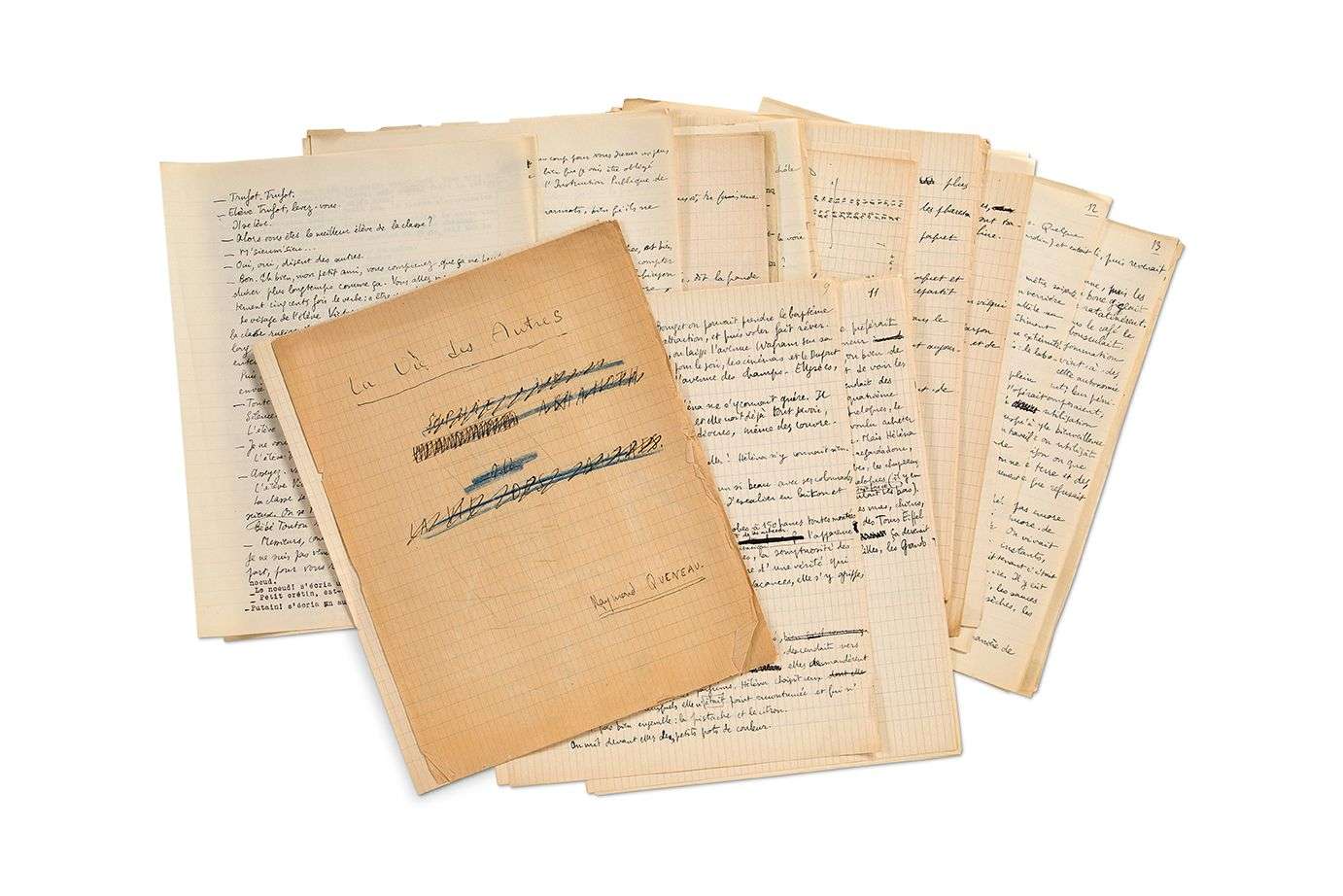
QUENEAU Raymond (1903-1976).
Autograph MANUSCRIT and autograph NOTES, Les Enfants du limon, [1936]| over 400 mostly in-4 leaves.
Important set of preparatory notes and the only known first draft manuscript of Queneau's fifth novel, Les Enfants du limon.
The composition of this ambitious novel spans eight years, from 1930 to 1938| it was published by Gallimard in July 1938. The manuscript of this first state, and the only one known for this novel, was written between February 13 and early October 1936.
Attached to the tradition of the social novel, with a large autobiographical part (several characters embody different facets of the novelist), this novel with its permanent humor and incredibly rich language is both encyclopedic and enigmatic. It concentrates in him all the world of Queneau: passion of mathematics, research on the language and the madness, Rabelaisian aim of the fabulous allegory and Flaubertian conception of the critical novel without message. "Extraordinary novel, as Madeleine Velguth writes, Les Enfants du limon forces the limits of the genre. [...] His first intention was to create a fiction on the theme of the "crab" - of a man who would live his life in reverse - to integrate into it a criticism of Catholicism and of the society of his time, and, finally, to add the madmen and, through their writings, to criticize the sciences. To this was added, in filigree, the autobiographical design and metaphysical concerns. All these elements are present in the novel, except for the initial idea of the "crab". But the novelist created Chambernac and Purpulan, an unforgettable couple who allowed the integration of the work on madmen into the plot. Indeed, this novel incorporates many fragments of Queneau's study on literary madmen, entitled Aux confins des ténèbres, which Gallimard and Denoël had refused to publish in 1934. It was in December 1935 that Queneau decided to make it the raw material of a new novel and to attribute its authorship to one of his main characters, Chambernac (first called Chambornac), under the title Encyclopédies des sciences inexactes.
This manuscript is studied at length by Madeleine Velguth in Volume II of the Complete Works of Raymond Queneau in the Bibliothèque de la Pléiade: "The first pages of Les Enfants du limon date from February 13, 1936, but it was not until July 14, during a stay in Ibiza with Michel Leiris, that the writing really began. [...] On September 20, he had already written two hundred and ten pages. [...] But on October 3 he notes "Stopped! Stopped! Stuck! Cold!", and abandons his work for the first time. This incomplete manuscript, which has come down to us, gives a novel in two parts: the first one made up of twelve chapters [...] and the second one, made up of six chapters and the beginning of a seventh [...] contains most of the novelistic material of the present first, second and sixth books, with the exception of everything that has to do with Chambernac,
Purpulan and the literary madmen. [...] Although the characters and the plot of the manuscript are in their broad outlines those of Les Enfants du limon, there are however differences in detail. [...] But what distinguishes perhaps the most this primitive state of the novelistic matter from the final novel is a difference of tone: this one will be light and playful whereas that one is heavy and grating. There will be a distancing that will allow a tender and amused irony to replace the strong sarcasm of the first state. [During the autumn and winter of 1936-1937, the diary of the novel testifies to Queneau's dissatisfaction with what he had written the previous summer. [...] Trying on October 3 to "take it all back", he immediately gives up. A severe self-critic, he notes on February 11, 1937: "All that is well out of order! [...] He found his project in April, and in July he noted that he intended to "join the two", that is, what he had already written and a fragment entitled "Helena". Queneau will proceed with this recasting during the summer of 1937. [Raymond Queneau finished writing Les Enfants du limon on April 21, 1938.
This manuscript includes three distinct sets, forming more than 400 autograph sheets:
A. Notes on various papers, of very different sizes and types (including leaflets, pocket notebook sheets, and an envelope bearing Queneau's name and address in Henry Miller's handwriting), forming 100 sheets, mostly written on the front only, with a few small drawings (heads and characters).
B. Autograph manuscript with very abundant corrections, reworkings, passages crossed out, left in draft form in places, untitled, comprising 249 leaves in-4 (mostly 27 x 21 cm), in black ink on checked or simply lined paper, mostly written on one side only, with 11 typewritten leaves
Autograph MANUSCRIT and autograph NOTES, Les Enfants du limon, [1936]| over 400 mostly in-4 leaves.
Important set of preparatory notes and the only known first draft manuscript of Queneau's fifth novel, Les Enfants du limon.
The composition of this ambitious novel spans eight years, from 1930 to 1938| it was published by Gallimard in July 1938. The manuscript of this first state, and the only one known for this novel, was written between February 13 and early October 1936.
Attached to the tradition of the social novel, with a large autobiographical part (several characters embody different facets of the novelist), this novel with its permanent humor and incredibly rich language is both encyclopedic and enigmatic. It concentrates in him all the world of Queneau: passion of mathematics, research on the language and the madness, Rabelaisian aim of the fabulous allegory and Flaubertian conception of the critical novel without message. "Extraordinary novel, as Madeleine Velguth writes, Les Enfants du limon forces the limits of the genre. [...] His first intention was to create a fiction on the theme of the "crab" - of a man who would live his life in reverse - to integrate into it a criticism of Catholicism and of the society of his time, and, finally, to add the madmen and, through their writings, to criticize the sciences. To this was added, in filigree, the autobiographical design and metaphysical concerns. All these elements are present in the novel, except for the initial idea of the "crab". But the novelist created Chambernac and Purpulan, an unforgettable couple who allowed the integration of the work on madmen into the plot. Indeed, this novel incorporates many fragments of Queneau's study on literary madmen, entitled Aux confins des ténèbres, which Gallimard and Denoël had refused to publish in 1934. It was in December 1935 that Queneau decided to make it the raw material of a new novel and to attribute its authorship to one of his main characters, Chambernac (first called Chambornac), under the title Encyclopédies des sciences inexactes.
This manuscript is studied at length by Madeleine Velguth in Volume II of the Complete Works of Raymond Queneau in the Bibliothèque de la Pléiade: "The first pages of Les Enfants du limon date from February 13, 1936, but it was not until July 14, during a stay in Ibiza with Michel Leiris, that the writing really began. [...] On September 20, he had already written two hundred and ten pages. [...] But on October 3 he notes "Stopped! Stopped! Stuck! Cold!", and abandons his work for the first time. This incomplete manuscript, which has come down to us, gives a novel in two parts: the first one made up of twelve chapters [...] and the second one, made up of six chapters and the beginning of a seventh [...] contains most of the novelistic material of the present first, second and sixth books, with the exception of everything that has to do with Chambernac,
Purpulan and the literary madmen. [...] Although the characters and the plot of the manuscript are in their broad outlines those of Les Enfants du limon, there are however differences in detail. [...] But what distinguishes perhaps the most this primitive state of the novelistic matter from the final novel is a difference of tone: this one will be light and playful whereas that one is heavy and grating. There will be a distancing that will allow a tender and amused irony to replace the strong sarcasm of the first state. [During the autumn and winter of 1936-1937, the diary of the novel testifies to Queneau's dissatisfaction with what he had written the previous summer. [...] Trying on October 3 to "take it all back", he immediately gives up. A severe self-critic, he notes on February 11, 1937: "All that is well out of order! [...] He found his project in April, and in July he noted that he intended to "join the two", that is, what he had already written and a fragment entitled "Helena". Queneau will proceed with this recasting during the summer of 1937. [Raymond Queneau finished writing Les Enfants du limon on April 21, 1938.
This manuscript includes three distinct sets, forming more than 400 autograph sheets:
A. Notes on various papers, of very different sizes and types (including leaflets, pocket notebook sheets, and an envelope bearing Queneau's name and address in Henry Miller's handwriting), forming 100 sheets, mostly written on the front only, with a few small drawings (heads and characters).
B. Autograph manuscript with very abundant corrections, reworkings, passages crossed out, left in draft form in places, untitled, comprising 249 leaves in-4 (mostly 27 x 21 cm), in black ink on checked or simply lined paper, mostly written on one side only, with 11 typewritten leaves