
&w=3840&q=75)
&w=3840&q=75)
&w=3840&q=75)
&w=3840&q=75)
&w=3840&q=75)
&w=3840&q=75)
&w=3840&q=75)
&w=3840&q=75)


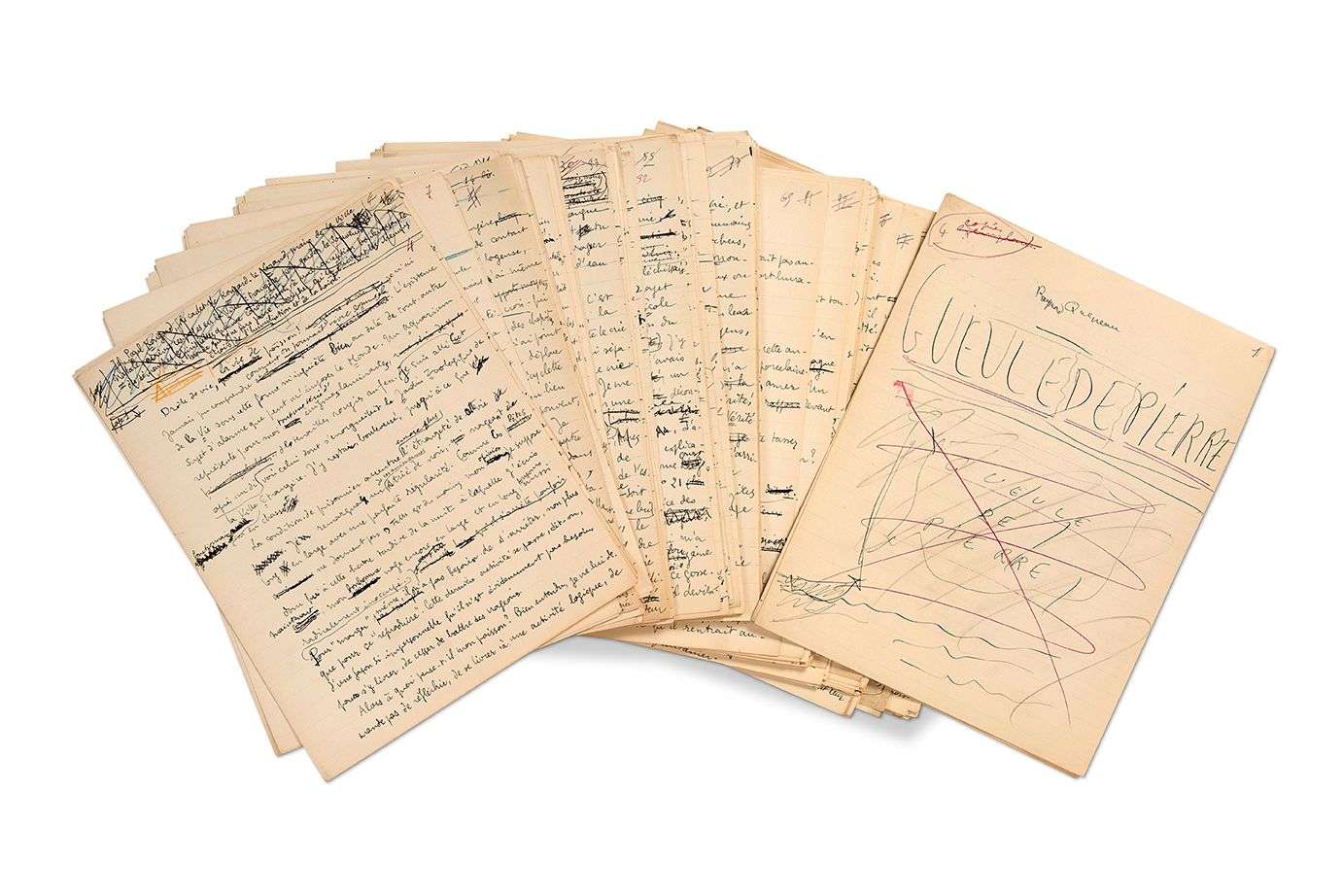
QUENEAU RAYMOND (1903-1976)
autograph manuscript signed "Raymond Queneau", Gueule de pierre, [1933-1934]| 166 ff. in-4| plus autograph preparatory notes and drafts, 77 ff. miscellaneous and 103 p. in-4| the autograph manuscript of Histoire d'une pétrification, 28 p. in-4| and the corrected TAPUSCRIT, 121 p. in-4
Complete autograph manuscript of Queneau's second novel, accompanied by the important file of his pretexts and the diary of its genesis.
Raymond Queneau's second novel, Gueule de pierre was begun in August 1933 and the writing continued until May 18, 1934| it was published by Gallimard in September 1934. The prayer of insertion summarizes the plot as follows: "A father had three sons, he sent Pierre abroad to complete his studies, he kept Paul close to him to support him in his strength, he let Jean wander where he wanted. The eldest returned from his trip with such unusual ideas that his father was very angry: he chased him out of his presence and treated him ignominiously... But his two other sons had discovered such a secret that he had to flee. Pursued into the mountains, he died there. Peter went back down to the city, John did not return, and Paul had always stayed there. As for the father, he became a gigantic stone"... The novel has three parts, each corresponding to one of the sons and to one of the natural kingdoms: the first (animal kingdom) is a monologue, the second (vegetable kingdom) takes the form of a narrative, and the third (vegetable kingdom) is a series of twelve prose poems, each placed under a sign of the Zodiac. In 1948, Queneau will integrate Gueule de pierre in Saint Glinglin.
The set includes:
A. File of notes, plans, drafts, lists of characters, sketches and tables. A pad labeled "Gueule de Pierre Parerga 1933-1934" comprising 25 ff in-4 detached from the lined pad (including 3 written and erased on the verso), 10 ff. scattered and 9 ff. torn from a notebook-12. There are numerous plans, preparatory notes, false beginnings, organizational diagrams of the novel, some of them in the form of tables, a drawn plan of the Ville Natale (dated September 27, 1933), a list of Cornish village names dated September 28 with their transformation into character names (Kuggar becoming Kougard, Poldowrian Pol Dovrian...), a table of the signs of the Zodiac (with their symbols in red ink, the Greek and Roman names of the deities attached to them, and the organs of the body concerned), draft titles (A Man Becomes a Stone, Totem and Taboo, A Father Had 3 Sons, Saint-Glin, The Origins of Totemism, etc.), a draft of a "Note liminaire et même, on peut dire, préliminaire", lists of characters (one with the "names modified on 28.4.34"), a "Etat du roman le 23 sept.", etc.
B. Fragments of the first state of Part 2 (33 ff. from a lined block), discontinuously paginated, in black ink (plus 4 ff. reused on verso for manuscript, 2 pp. in-8, and a few torn pages.)
C. Intermediate version of sections VIII to XI of part 2 and first state of part 3, in 7 school notebooks (22.5 x 17 cm) amounting to 103 pages in all (plus 8 scattered pages).
D. Complete manuscript: 166 numbered ff. from a lined block in-4 (22,5 x 17,5 cm), in black ink r| it is extensively crossed out and corrected. On the back of many leaves, one finds erased drafts. Thus, on the back of the title page one can read a primitive title| "Midi le juste ou Il est midi ". It presents innumerable variants and corrections compared to the final text, starting with the titles of the parts, which were originally "The Foreign City", "The Saint-Glinling" and "The Arid Mountain". We also see that the novel opened with a proclamation of the hero, which Queneau later deleted: "I, Pierre Kougard, eldest son of Kougard-le-Grand, mayor of the Ville Natale, wrote these pages in the Ville Étrangère to keep the Memory of the [spiritual steps strikethrough] concerns that led me [to a shattering conception of the world that I strikethrough] to elaborate a new doctrine that I could only make triumph after following the narrow paths of humiliation and hatred." At the same time, and in a burlesque mode, the second part begins with another apostrophe, this time attributing the authorship of the pages to Raymond Queneau: "You, Raymond Queneau, wrote these pages in Coverack (Duchy of Cornwall) and in Paris (Department of the Seine) in order to preserve the memory of the G. F. (Future Generations). F. (Future generations) the memory of what happened in the City of birth on the day of the Saint-Glingin XX34 ". Each page of the manuscript is covered with corrections| one also notes annotations such as "taken again in Paris in April 34", "unsuccessful attempts", "impossible to write". The last page bears the word "Fin" and the date "18.5.34 14 h.20". On the back of the sheets, one can discover a first verse
autograph manuscript signed "Raymond Queneau", Gueule de pierre, [1933-1934]| 166 ff. in-4| plus autograph preparatory notes and drafts, 77 ff. miscellaneous and 103 p. in-4| the autograph manuscript of Histoire d'une pétrification, 28 p. in-4| and the corrected TAPUSCRIT, 121 p. in-4
Complete autograph manuscript of Queneau's second novel, accompanied by the important file of his pretexts and the diary of its genesis.
Raymond Queneau's second novel, Gueule de pierre was begun in August 1933 and the writing continued until May 18, 1934| it was published by Gallimard in September 1934. The prayer of insertion summarizes the plot as follows: "A father had three sons, he sent Pierre abroad to complete his studies, he kept Paul close to him to support him in his strength, he let Jean wander where he wanted. The eldest returned from his trip with such unusual ideas that his father was very angry: he chased him out of his presence and treated him ignominiously... But his two other sons had discovered such a secret that he had to flee. Pursued into the mountains, he died there. Peter went back down to the city, John did not return, and Paul had always stayed there. As for the father, he became a gigantic stone"... The novel has three parts, each corresponding to one of the sons and to one of the natural kingdoms: the first (animal kingdom) is a monologue, the second (vegetable kingdom) takes the form of a narrative, and the third (vegetable kingdom) is a series of twelve prose poems, each placed under a sign of the Zodiac. In 1948, Queneau will integrate Gueule de pierre in Saint Glinglin.
The set includes:
A. File of notes, plans, drafts, lists of characters, sketches and tables. A pad labeled "Gueule de Pierre Parerga 1933-1934" comprising 25 ff in-4 detached from the lined pad (including 3 written and erased on the verso), 10 ff. scattered and 9 ff. torn from a notebook-12. There are numerous plans, preparatory notes, false beginnings, organizational diagrams of the novel, some of them in the form of tables, a drawn plan of the Ville Natale (dated September 27, 1933), a list of Cornish village names dated September 28 with their transformation into character names (Kuggar becoming Kougard, Poldowrian Pol Dovrian...), a table of the signs of the Zodiac (with their symbols in red ink, the Greek and Roman names of the deities attached to them, and the organs of the body concerned), draft titles (A Man Becomes a Stone, Totem and Taboo, A Father Had 3 Sons, Saint-Glin, The Origins of Totemism, etc.), a draft of a "Note liminaire et même, on peut dire, préliminaire", lists of characters (one with the "names modified on 28.4.34"), a "Etat du roman le 23 sept.", etc.
B. Fragments of the first state of Part 2 (33 ff. from a lined block), discontinuously paginated, in black ink (plus 4 ff. reused on verso for manuscript, 2 pp. in-8, and a few torn pages.)
C. Intermediate version of sections VIII to XI of part 2 and first state of part 3, in 7 school notebooks (22.5 x 17 cm) amounting to 103 pages in all (plus 8 scattered pages).
D. Complete manuscript: 166 numbered ff. from a lined block in-4 (22,5 x 17,5 cm), in black ink r| it is extensively crossed out and corrected. On the back of many leaves, one finds erased drafts. Thus, on the back of the title page one can read a primitive title| "Midi le juste ou Il est midi ". It presents innumerable variants and corrections compared to the final text, starting with the titles of the parts, which were originally "The Foreign City", "The Saint-Glinling" and "The Arid Mountain". We also see that the novel opened with a proclamation of the hero, which Queneau later deleted: "I, Pierre Kougard, eldest son of Kougard-le-Grand, mayor of the Ville Natale, wrote these pages in the Ville Étrangère to keep the Memory of the [spiritual steps strikethrough] concerns that led me [to a shattering conception of the world that I strikethrough] to elaborate a new doctrine that I could only make triumph after following the narrow paths of humiliation and hatred." At the same time, and in a burlesque mode, the second part begins with another apostrophe, this time attributing the authorship of the pages to Raymond Queneau: "You, Raymond Queneau, wrote these pages in Coverack (Duchy of Cornwall) and in Paris (Department of the Seine) in order to preserve the memory of the G. F. (Future Generations). F. (Future generations) the memory of what happened in the City of birth on the day of the Saint-Glingin XX34 ". Each page of the manuscript is covered with corrections| one also notes annotations such as "taken again in Paris in April 34", "unsuccessful attempts", "impossible to write". The last page bears the word "Fin" and the date "18.5.34 14 h.20". On the back of the sheets, one can discover a first verse