
&w=3840&q=75)
&w=3840&q=75)
&w=3840&q=75)
&w=3840&q=75)
&w=3840&q=75)
&w=3840&q=75)
&w=3840&q=75)
&w=3840&q=75)


94
MARAT Jean-Paul (1743-1793) Médecin et physicien, conventionnel (Paris),jo
The item was sold for 84 500 €
Fees include commission and taxes.
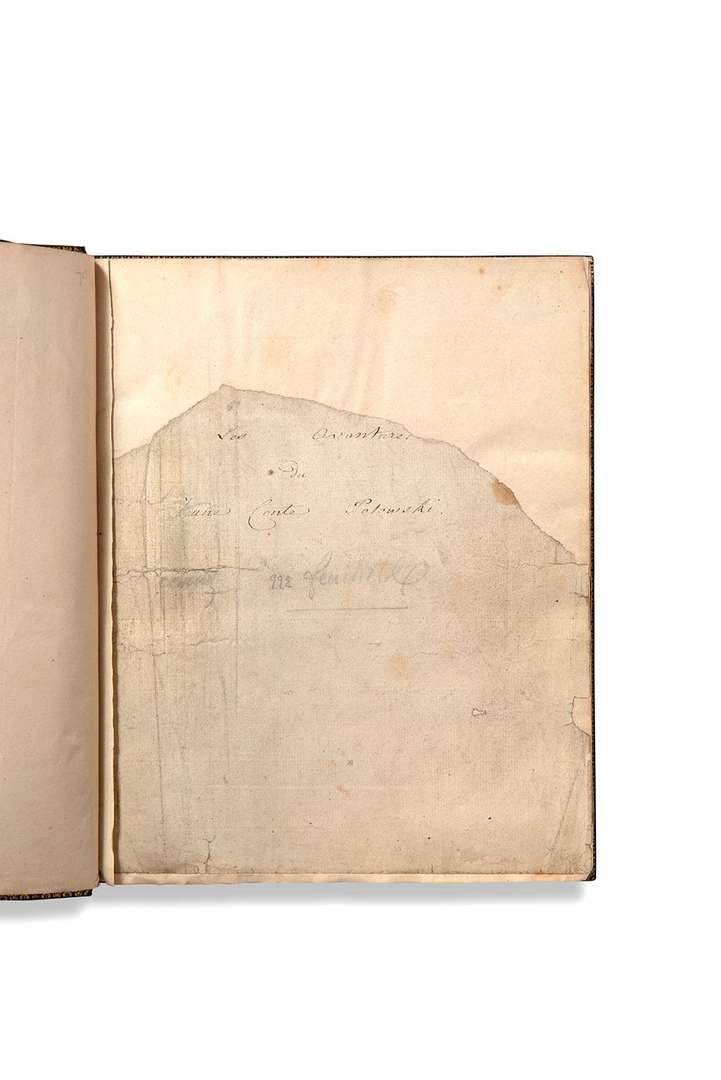
MARAT Jean-Paul (1743-1793) Médecin et physicien, conventionnel (Paris),journaliste et pamphlétaire, assassiné par Charlotte Corday
Autograph manuscript, Les Avantures du Jeune Conte Potowski| one volume in-4 (23 x 19 cm) of 222 leaves or 442 pages| 19th century binding full blue-black morocco, triple cold fillet framing the boards, ribbed spine, cold boxes, gilt title, gilt inner border, combed linings and endpapers, untrimmed, gilt head [Niédrée]| in a modern half-maroquin midnight slipcase, gilt title.
Important and exceptional manuscript of the only novel written by Marat, long unknown, where he claims, thirty years before his revolutionary pamphlets, the freedom of the people and the overthrow of tyrants.
Written around 1770-1771 in England, where Marat found a position as a veterinary doctor in Newcastle, and at the same time he was completing his philosophical work Essay on the Human Soul, the novel was not published until 1847. This epistolary and sentimental novel, modeled on Rousseau's The New Heloise, traces the thwarted loves of two young Polish aristocrats in the crisis-ridden Poland of the 1770s: Gustave Potowski, who has "a mouth drawn by love, ebony-black hair, a leg made with a lathe, and a soft, white, chubby hand," passionately loves the lovely Lucile Sobieska, who has "a complexion of lilies and roses," the daughter of a friend of his father, and they are about to celebrate their marriage when civil war breaks out and divides the nation into the Russian and patriot parties. The lovers are then separated, the two families become mortal enemies, and the events caused by the pain of the lovers, the vicissitudes of war, the perfidy of a countess secretly in love with the young man, follow one another, before the final reconciliation and the union of Lucile and Gustav. The action takes place, from 1769 to 1771, in a Poland shaken by the civil war| thus, the sentimental intrigue leaves place to the political concerns, Marat taking obviously side for the patriots who fight for "peace, the union, the freedom", against the despotic CATHERINE II, indulging, twenty years before his revolutionary pamphlets, in a violent indictment against the monarchic authority and the tyrants, who devour "our rest, our freedom, our blood". He already calls the patriots to the revolt...
The political heart of the novel is found in the long letter LII, a real political dialogue between Gustave Potowski and a Frenchman (whose adventures in Turkey form a small novel within the novel), obviously the spokesman of Marat. Here is how he presents Catherine II: "by a suitte of vanity and of the imitative instinct natural to her sex, she has made some small undertakings| but which are of no consequence for the public happiness. For example, she has established schools of French literature for a hundred or so young men who hold court: but has she established public schools, where the fear of the Gods, the rights of humanity, the love of the fatherland are taught? She encouraged some luxury arts, and a little animated the trade: but did she abolish the onerous taxes, and leave to the ploughmen the means to better cultivate their lands? Far from having sought to enrich her states, she has only worked to ruin them, by depopulating the countryside of farmers by forced enrolments [...] She has created a new code: but has she thought of making the laws triumph? Is she not still all powerful against them? And is this new code even based on equity? Is the punishment proportionate to the offense? Are not terrible torments always the punishment for the smallest faults? Has it made regulations to purify morals, to prevent crimes, to protect the weak against the strong? Has it established courts to enforce the laws and to defend individuals against government attacks? She has freed her subjects from the yoke of the nobles: but this is only to increase her own empire. Are they not still her slaves? Does she not always push them by terror?
A little further on, the Frenchman draws a severe picture of the situation in Poland, and harshly criticizes these monstrous laws "which, for the advantage of a handful of individuals, deprive so many millions of men of the natural right to be free [...] In Poland, there are only Tyrants and Slaves: the Fatherland has therefore no children to defend it. [...] Those powers which, under the pretext of restoring peace in your desolate provinces, have entered them with arms in their hands, only want to invade them and reduce you to servitude. It is up to the people to take their destiny into their own hands, and to revolt: "It is necessary to take the axe to the root. It is necessary to make the people aware of their rights and to urge them to claim them| it is necessary to put arms in their hands, to seize in the whole kingdom the small tyrants who keep them oppressed, to overthrow the edifice, to take the power of the state and to make it more efficient.
Autograph manuscript, Les Avantures du Jeune Conte Potowski| one volume in-4 (23 x 19 cm) of 222 leaves or 442 pages| 19th century binding full blue-black morocco, triple cold fillet framing the boards, ribbed spine, cold boxes, gilt title, gilt inner border, combed linings and endpapers, untrimmed, gilt head [Niédrée]| in a modern half-maroquin midnight slipcase, gilt title.
Important and exceptional manuscript of the only novel written by Marat, long unknown, where he claims, thirty years before his revolutionary pamphlets, the freedom of the people and the overthrow of tyrants.
Written around 1770-1771 in England, where Marat found a position as a veterinary doctor in Newcastle, and at the same time he was completing his philosophical work Essay on the Human Soul, the novel was not published until 1847. This epistolary and sentimental novel, modeled on Rousseau's The New Heloise, traces the thwarted loves of two young Polish aristocrats in the crisis-ridden Poland of the 1770s: Gustave Potowski, who has "a mouth drawn by love, ebony-black hair, a leg made with a lathe, and a soft, white, chubby hand," passionately loves the lovely Lucile Sobieska, who has "a complexion of lilies and roses," the daughter of a friend of his father, and they are about to celebrate their marriage when civil war breaks out and divides the nation into the Russian and patriot parties. The lovers are then separated, the two families become mortal enemies, and the events caused by the pain of the lovers, the vicissitudes of war, the perfidy of a countess secretly in love with the young man, follow one another, before the final reconciliation and the union of Lucile and Gustav. The action takes place, from 1769 to 1771, in a Poland shaken by the civil war| thus, the sentimental intrigue leaves place to the political concerns, Marat taking obviously side for the patriots who fight for "peace, the union, the freedom", against the despotic CATHERINE II, indulging, twenty years before his revolutionary pamphlets, in a violent indictment against the monarchic authority and the tyrants, who devour "our rest, our freedom, our blood". He already calls the patriots to the revolt...
The political heart of the novel is found in the long letter LII, a real political dialogue between Gustave Potowski and a Frenchman (whose adventures in Turkey form a small novel within the novel), obviously the spokesman of Marat. Here is how he presents Catherine II: "by a suitte of vanity and of the imitative instinct natural to her sex, she has made some small undertakings| but which are of no consequence for the public happiness. For example, she has established schools of French literature for a hundred or so young men who hold court: but has she established public schools, where the fear of the Gods, the rights of humanity, the love of the fatherland are taught? She encouraged some luxury arts, and a little animated the trade: but did she abolish the onerous taxes, and leave to the ploughmen the means to better cultivate their lands? Far from having sought to enrich her states, she has only worked to ruin them, by depopulating the countryside of farmers by forced enrolments [...] She has created a new code: but has she thought of making the laws triumph? Is she not still all powerful against them? And is this new code even based on equity? Is the punishment proportionate to the offense? Are not terrible torments always the punishment for the smallest faults? Has it made regulations to purify morals, to prevent crimes, to protect the weak against the strong? Has it established courts to enforce the laws and to defend individuals against government attacks? She has freed her subjects from the yoke of the nobles: but this is only to increase her own empire. Are they not still her slaves? Does she not always push them by terror?
A little further on, the Frenchman draws a severe picture of the situation in Poland, and harshly criticizes these monstrous laws "which, for the advantage of a handful of individuals, deprive so many millions of men of the natural right to be free [...] In Poland, there are only Tyrants and Slaves: the Fatherland has therefore no children to defend it. [...] Those powers which, under the pretext of restoring peace in your desolate provinces, have entered them with arms in their hands, only want to invade them and reduce you to servitude. It is up to the people to take their destiny into their own hands, and to revolt: "It is necessary to take the axe to the root. It is necessary to make the people aware of their rights and to urge them to claim them| it is necessary to put arms in their hands, to seize in the whole kingdom the small tyrants who keep them oppressed, to overthrow the edifice, to take the power of the state and to make it more efficient.