
&w=3840&q=75)
&w=3840&q=75)
&w=3840&q=75)
&w=3840&q=75)
&w=3840&q=75)
&w=3840&q=75)
&w=3840&q=75)
&w=3840&q=75)


90
MALHERBE FRANÇOIS DE (1555-1628)
The item was sold for 3 900 €
Fees include commission and taxes.
MALHERBE FRANÇOIS DE (1555-1628)
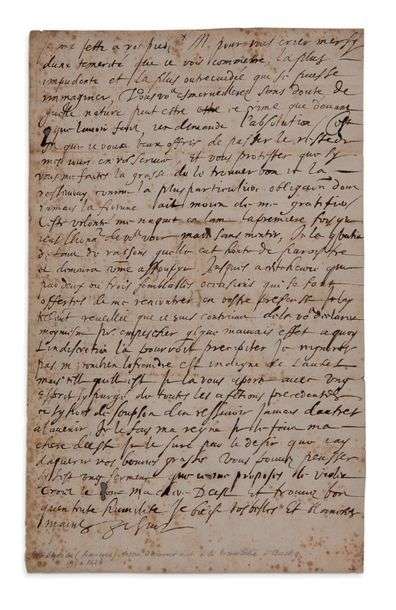
L.A. (minute), [May 1608?, to the countess of LA ROCHE]| 1 page in-fol. (31.5 x 19.5 cm| foxing, 2 small holes by ink corrosion, slight repairs to folds on verso). 8
Minute of a beautiful declaration of love.
[This letter was once considered to be addressed to the viscountess of Auchy, sung by Malherbe in his verses under the name of Caliste. It was published as early as 1630 in Les Œuvres de François de Malherbe (Paris, Chappelain, 1630, book III, letter 1), without the mention "To Caliste". It is more probably the first declaration of love of Malherbe to the one whom, tired of Caliste's indifference, he chooses to love: the countess Marthe de LA ROCHE, born of Clermont d'Amboise, who had married in 1590 Balthazar Flotte, count of La Roche (1554-1613). He addressed to her in May 1608, probably at the same time of this letter, the beautiful Stances "The last of my days is above the horizon"..., followed a few months later by the Complaint on an absence "Complices of my servitude"... An old copy of this letter, whose autograph had remained unknown and presents some variants, appears in the collection Baluze 133 (f° 36) in the National Library of France].
"I throw myself at your feet, M[adame], to cry out to you for the temerity I see committed, the most impudent and the most impudent that can be imagined. You will no doubt be amazed at the nature of this crime, and before I have done it I ask for absolution. It is, Madame, that I want to offer you to spend the rest of my days in your service, and to protest to you that if you do me the grace of finding it good, I will accept it as the most particular obligation that fortune has ever graced me with. This will was born in my mind the first time I had the honor of seeing you, but without lying, I combated it with so many reasons that it was ashamed to appear and remained as if it were dormant. Until now, when two or three similar occasions have arisen to meet me in your presence, I have been so awakened that I am obliged to declare it to you myself in order to prevent any bad effects that indiscretion might precipitate. I don't know, Madam, how unworthy the affair is of the altar, but as it is, I bring it to you with a mind so purged of all previous affections and so free from the desire to have any more in the future. I do it my queen I do it my dear goddess I swear by the desire I have to acquire your good fortune. You can think if it is an oath that I propose to violate. Believe it therefore my dear Goddess and find good that in all humility I kiss your beautiful and white hands. I am ".
Œuvres (Bibl. de la Pléiade), p. 324.
L.A. (minute), [May 1608?, to the countess of LA ROCHE]| 1 page in-fol. (31.5 x 19.5 cm| foxing, 2 small holes by ink corrosion, slight repairs to folds on verso). 8
Minute of a beautiful declaration of love.
[This letter was once considered to be addressed to the viscountess of Auchy, sung by Malherbe in his verses under the name of Caliste. It was published as early as 1630 in Les Œuvres de François de Malherbe (Paris, Chappelain, 1630, book III, letter 1), without the mention "To Caliste". It is more probably the first declaration of love of Malherbe to the one whom, tired of Caliste's indifference, he chooses to love: the countess Marthe de LA ROCHE, born of Clermont d'Amboise, who had married in 1590 Balthazar Flotte, count of La Roche (1554-1613). He addressed to her in May 1608, probably at the same time of this letter, the beautiful Stances "The last of my days is above the horizon"..., followed a few months later by the Complaint on an absence "Complices of my servitude"... An old copy of this letter, whose autograph had remained unknown and presents some variants, appears in the collection Baluze 133 (f° 36) in the National Library of France].
"I throw myself at your feet, M[adame], to cry out to you for the temerity I see committed, the most impudent and the most impudent that can be imagined. You will no doubt be amazed at the nature of this crime, and before I have done it I ask for absolution. It is, Madame, that I want to offer you to spend the rest of my days in your service, and to protest to you that if you do me the grace of finding it good, I will accept it as the most particular obligation that fortune has ever graced me with. This will was born in my mind the first time I had the honor of seeing you, but without lying, I combated it with so many reasons that it was ashamed to appear and remained as if it were dormant. Until now, when two or three similar occasions have arisen to meet me in your presence, I have been so awakened that I am obliged to declare it to you myself in order to prevent any bad effects that indiscretion might precipitate. I don't know, Madam, how unworthy the affair is of the altar, but as it is, I bring it to you with a mind so purged of all previous affections and so free from the desire to have any more in the future. I do it my queen I do it my dear goddess I swear by the desire I have to acquire your good fortune. You can think if it is an oath that I propose to violate. Believe it therefore my dear Goddess and find good that in all humility I kiss your beautiful and white hands. I am ".
Œuvres (Bibl. de la Pléiade), p. 324.