
&w=3840&q=75)
&w=3840&q=75)
&w=3840&q=75)
&w=3840&q=75)
&w=3840&q=75)
&w=3840&q=75)
&w=3840&q=75)
&w=3840&q=75)


78
BOSSUET Jacques-Bénigne (1627-1704) Prélat, théologien, prédicateur et his
The item was sold for 2 860 €
Fees include commission and taxes.
BOSSUET Jacques-Bénigne (1627-1704) Prélat, théologien, prédicateur et historien
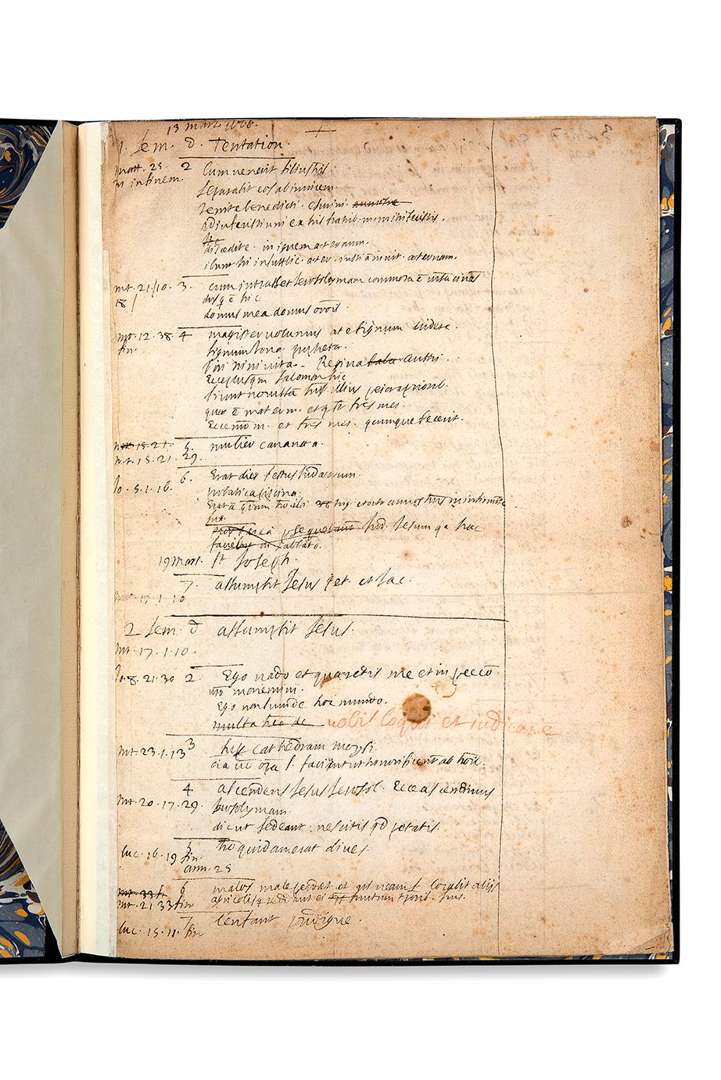
Bishop of Condom then of Meaux TWO autograph MANUSCRIPTS of preparatory plans for his sermons, [1662-1666]| 2 pages in-4 and 6 pages in-fol. mounted on tabs, and bound in one volume in-fol. soft black morocco, case (Alix).
Precious plans and preparatory manuscripts for his Lenten sermons preached before the Court in 1662 and 1666. This is an exceptional document, which allows us to grasp Bossuet's oratory art at the very moment of its conception.
A. Plan of his sermons for Lent preached in the Louvre in 1662| 2 pages in-4 with erasures and corrections (small marginal tear well restored).
Each page is divided into 3 columns: on the central column, Bossuet lists for each of the 5 weeks, day by day beginning with Sunday, the Gospel texts that are to be read according to the liturgy| this preparation ends in the fifth week, before Palm Sunday| the left-hand column is loaded with references to Sacred Scripture, the Church Fathers and various authors, even Bossuet's own preaching| on the right-hand column, in French, Bossuet outlines the plan and the broad outlines of the sermons, of which we will give a few examples.
First week: "1 Penser a son salut.
Predication.
2 Rechutes.
3 Faith. Impiety.
libertinism. curiosity.
Living according to the faith".
Fourth week: "Ambition. [...]
Vain glory. Hidden pride.
State of man.
Death. Life a dream. Misery of this century".
Fifth week: "Magdelaine.
One can overcome the inclinations.
Penitence.
false conversions.
degoust.
do not differ.
To undertake one's conversion with courage".
Following are notes on Penance and on conversion. "The third, pressed by their conscience and by the apprehension of death, put their hand to it, albeit weakly, and only half do it.
B. autograph manuscript, dated at the top "13 March 1666", for the preparation of his sermons for Lent 1666 preached at Saint-Germain-en-Laye| 6 pages folio with erasures and corrections. Bossuet has divided his pages into 3 columns: in the center, he lists for each of the 5 weeks, day by day, beginning with Sunday, in Latin, the themes of the Gospel of the day| on the left, references to the Gospels| the right column is left blank.
In the third of the fourth page, Bossuet draws a line of separation and traces the plan of his Lent in 18 numbered sermons, starting with the feast of the Purification, and, in each week, on Sunday, Wednesday, Friday (except Thursday March 25 for the Annunciation). He stops (n° 18) with Good Friday where he has to preach the Passion. We know only 12 sermons of this Lent. Follows a list of the principal themes of the preaching of Bossuet.
On pages 5 and 6, Bossuet throws, in very first draft, the ideas which come to him, and drafts his sermons 1, 2, 3, 5, 6 and 8 to 15, mainly in French. We give some quotations of them.
"1. laws. pleasure of transgressing them. [...] inevitable events. curiosity to know them by the stars [...] evils which please, evils which afflict, those useful.
2. Temptation. hopes and eagerness of the world. one becomes dizzy oneself and does not think of one's salvation. [...] It is very difficult for men to do good. Presumption. segregation from God. wanting to know what he has reserved for himself. the time he gives to penance. [...] [...] enchainment of sins. [...] weeping for those who are in such bonds. You are accustomed to the evils and remedies of the remorse of conscience. O misfortune of misfortunes. [...] 8. eternity of punishment. [...] against those who make fun of the expressions of fire of brimstone etc. or the things are literal how much thus terrible or metaphorical. mark that the human spirit did not find anything which equals them. [...] free will as the cause of evil what horror one must have of voluntary depravity. [...] 12. aumosnes. honor divine mercy by imitating it. [...] 14. Justice. the three virtues that accompany it. [1. constancy for the will to follow loyalty. is attacked by interest. against the love of money. one does everything by money and this is what makes it desirable. therefore by the same reason one pushes everything to the limit by drawing money. 2 the prudence for the detail. here against the artifices of the meditation which prevent to know well the persons. 3 clemency to support weaknesses. condescension. [...] that it is not he but you who believe
Bishop of Condom then of Meaux TWO autograph MANUSCRIPTS of preparatory plans for his sermons, [1662-1666]| 2 pages in-4 and 6 pages in-fol. mounted on tabs, and bound in one volume in-fol. soft black morocco, case (Alix).
Precious plans and preparatory manuscripts for his Lenten sermons preached before the Court in 1662 and 1666. This is an exceptional document, which allows us to grasp Bossuet's oratory art at the very moment of its conception.
A. Plan of his sermons for Lent preached in the Louvre in 1662| 2 pages in-4 with erasures and corrections (small marginal tear well restored).
Each page is divided into 3 columns: on the central column, Bossuet lists for each of the 5 weeks, day by day beginning with Sunday, the Gospel texts that are to be read according to the liturgy| this preparation ends in the fifth week, before Palm Sunday| the left-hand column is loaded with references to Sacred Scripture, the Church Fathers and various authors, even Bossuet's own preaching| on the right-hand column, in French, Bossuet outlines the plan and the broad outlines of the sermons, of which we will give a few examples.
First week: "1 Penser a son salut.
Predication.
2 Rechutes.
3 Faith. Impiety.
libertinism. curiosity.
Living according to the faith".
Fourth week: "Ambition. [...]
Vain glory. Hidden pride.
State of man.
Death. Life a dream. Misery of this century".
Fifth week: "Magdelaine.
One can overcome the inclinations.
Penitence.
false conversions.
degoust.
do not differ.
To undertake one's conversion with courage".
Following are notes on Penance and on conversion. "The third, pressed by their conscience and by the apprehension of death, put their hand to it, albeit weakly, and only half do it.
B. autograph manuscript, dated at the top "13 March 1666", for the preparation of his sermons for Lent 1666 preached at Saint-Germain-en-Laye| 6 pages folio with erasures and corrections. Bossuet has divided his pages into 3 columns: in the center, he lists for each of the 5 weeks, day by day, beginning with Sunday, in Latin, the themes of the Gospel of the day| on the left, references to the Gospels| the right column is left blank.
In the third of the fourth page, Bossuet draws a line of separation and traces the plan of his Lent in 18 numbered sermons, starting with the feast of the Purification, and, in each week, on Sunday, Wednesday, Friday (except Thursday March 25 for the Annunciation). He stops (n° 18) with Good Friday where he has to preach the Passion. We know only 12 sermons of this Lent. Follows a list of the principal themes of the preaching of Bossuet.
On pages 5 and 6, Bossuet throws, in very first draft, the ideas which come to him, and drafts his sermons 1, 2, 3, 5, 6 and 8 to 15, mainly in French. We give some quotations of them.
"1. laws. pleasure of transgressing them. [...] inevitable events. curiosity to know them by the stars [...] evils which please, evils which afflict, those useful.
2. Temptation. hopes and eagerness of the world. one becomes dizzy oneself and does not think of one's salvation. [...] It is very difficult for men to do good. Presumption. segregation from God. wanting to know what he has reserved for himself. the time he gives to penance. [...] [...] enchainment of sins. [...] weeping for those who are in such bonds. You are accustomed to the evils and remedies of the remorse of conscience. O misfortune of misfortunes. [...] 8. eternity of punishment. [...] against those who make fun of the expressions of fire of brimstone etc. or the things are literal how much thus terrible or metaphorical. mark that the human spirit did not find anything which equals them. [...] free will as the cause of evil what horror one must have of voluntary depravity. [...] 12. aumosnes. honor divine mercy by imitating it. [...] 14. Justice. the three virtues that accompany it. [1. constancy for the will to follow loyalty. is attacked by interest. against the love of money. one does everything by money and this is what makes it desirable. therefore by the same reason one pushes everything to the limit by drawing money. 2 the prudence for the detail. here against the artifices of the meditation which prevent to know well the persons. 3 clemency to support weaknesses. condescension. [...] that it is not he but you who believe