
&w=3840&q=75)
&w=3840&q=75)
&w=3840&q=75)
&w=3840&q=75)
&w=3840&q=75)
&w=3840&q=75)
&w=3840&q=75)
&w=3840&q=75)


75
BALZAC Honoré de (1799-1850)
The item was sold for 67 600 €
Fees include commission and taxes.
BALZAC Honoré de (1799-1850)
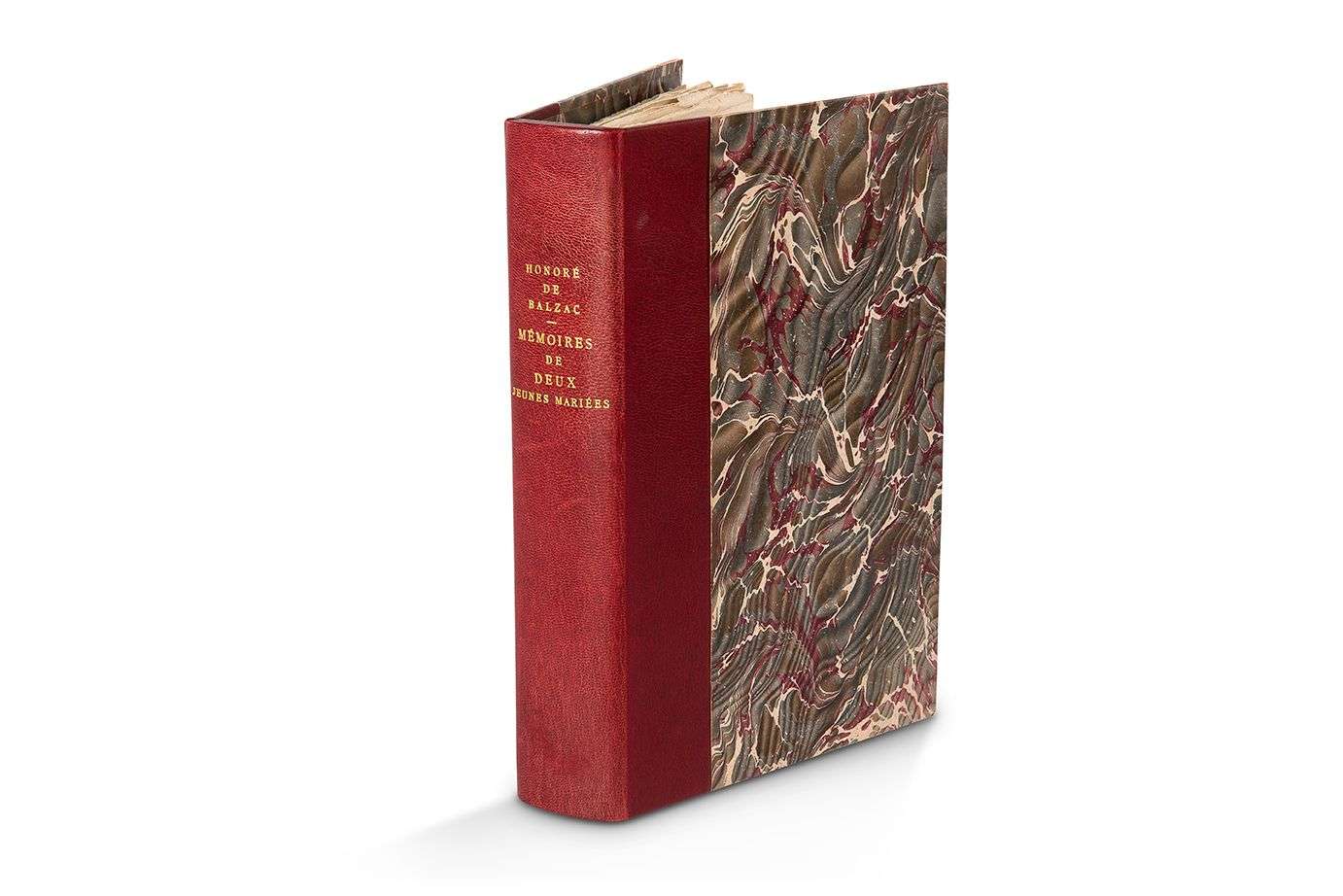
Corrected PROOFS, Memoirs of Two Young Brides, 1841-1842| 188 leaves in-8 (21,5 x 14,5 cm), in sheets (some light foxing, tear repaired on page 263-264 of volume I), in a red half-maroquin folder and slipcase.
A proof copy with numerous autograph corrections and additions by Balzac, for the second edition of the novel.
In this novel by letters between two friends, Balzac tackles the great question of marriage and love (and it is not for nothing that this novel is dedicated to George Sand), by staging the debate between the devouring romantic passion embodied by Louise de Chaulieu and the domestic devotion characterized by the marital stability to which Renée de Maucombe, who became Countess de L'Estorade, resigns herself. The epistolary novel Mémoires de deux jeunes mariées first appeared in serial form in La Presse, from November 26, 1841 to January 15, 1842, before being published in bookstores by Hippolyte Souverain, in early 1842. Balzac then included the novel, without the preface, in volume II of La Comédie humaine published by Furne in September 1842. These proofs are in fact the preparatory work for this second edition of the novel in La Comédie humaine, for which Balzac used a defaced copy of the Souverain edition. These proofs include the dedication sheet to Georges [sic] Sand and pages 19 to 348 of the first volume, that is, the complete text minus the preface and the last seven pages, and pages 265 to 325 (and last) of the second volume, dated in fine "Paris, 1841" [1842]. The autograph note at the head of the proofs specifies the place of the novel in the edition of La Comédie humaine: "Premier livre - Scènes de la vie privée tome II" [First book - Scenes of private life, volume II] (and at the bottom this note: "According to my calculations, this copy must give between 12 and 13 leaves. A daughter of Eve will go next"). As for the other novels that he gathered in La Comédie humaine, Balzac suppressed the preface. He also took care of the typographical presentation, thus suppressing the blanks of the Souverain edition| he orders to the typographers, at the head of the first page (19) of the novel: "One will separate the letters by a thin net of the half of the justification, with two lines of white, above and below, then the suscription, then the date, in all a value of nineteen lines - and for the interior dates of the letters, two lines of white". Balzac corrects his text abundantly, with sentences added in the margins ("Say, Renée, can a man deceive us?" p. 63, "on your part an abnegation much more beautiful than the pretended servitude of your love when it is sincere" p. 191, "with us in everything, grace is mystery" p. 196), up to entire paragraphs (p. 80, 84, 118, or p. 199 whose margin is filled with additions)| he also makes a few deletions. He also changes the dates of certain letters, or adds some, thus specifying the chronology of the novel| he modifies the affectionate names that the young girls give themselves (thus, instead of "mignonne", "chère biche" at the beginning of the 1st letter, or "belle biche blanche" p. 48). Secondary characters change their names, to link them to the staff of La Comédie humaine| thus (p. 39) Mlle de Fontenille, friend of Talleyrand, becomes "Chargebœuf", and (p. 44) the young lady of Fontenille becomes "Vandenesse". At the end of the novel, he has added the date: "Paris, 1841".
PROVENANCE
Jean Davray (ex-libris JD on the back cover of the folder| sale Collection JD, Paris 6-7 December 1961, n° 123).
EXHIBITIONS
Balzac (Librairie Pierre Berès, 1949, n° 379)| George Sand (Bibliothèque nationale, 1954, n° 143).
Corrected PROOFS, Memoirs of Two Young Brides, 1841-1842| 188 leaves in-8 (21,5 x 14,5 cm), in sheets (some light foxing, tear repaired on page 263-264 of volume I), in a red half-maroquin folder and slipcase.
A proof copy with numerous autograph corrections and additions by Balzac, for the second edition of the novel.
In this novel by letters between two friends, Balzac tackles the great question of marriage and love (and it is not for nothing that this novel is dedicated to George Sand), by staging the debate between the devouring romantic passion embodied by Louise de Chaulieu and the domestic devotion characterized by the marital stability to which Renée de Maucombe, who became Countess de L'Estorade, resigns herself. The epistolary novel Mémoires de deux jeunes mariées first appeared in serial form in La Presse, from November 26, 1841 to January 15, 1842, before being published in bookstores by Hippolyte Souverain, in early 1842. Balzac then included the novel, without the preface, in volume II of La Comédie humaine published by Furne in September 1842. These proofs are in fact the preparatory work for this second edition of the novel in La Comédie humaine, for which Balzac used a defaced copy of the Souverain edition. These proofs include the dedication sheet to Georges [sic] Sand and pages 19 to 348 of the first volume, that is, the complete text minus the preface and the last seven pages, and pages 265 to 325 (and last) of the second volume, dated in fine "Paris, 1841" [1842]. The autograph note at the head of the proofs specifies the place of the novel in the edition of La Comédie humaine: "Premier livre - Scènes de la vie privée tome II" [First book - Scenes of private life, volume II] (and at the bottom this note: "According to my calculations, this copy must give between 12 and 13 leaves. A daughter of Eve will go next"). As for the other novels that he gathered in La Comédie humaine, Balzac suppressed the preface. He also took care of the typographical presentation, thus suppressing the blanks of the Souverain edition| he orders to the typographers, at the head of the first page (19) of the novel: "One will separate the letters by a thin net of the half of the justification, with two lines of white, above and below, then the suscription, then the date, in all a value of nineteen lines - and for the interior dates of the letters, two lines of white". Balzac corrects his text abundantly, with sentences added in the margins ("Say, Renée, can a man deceive us?" p. 63, "on your part an abnegation much more beautiful than the pretended servitude of your love when it is sincere" p. 191, "with us in everything, grace is mystery" p. 196), up to entire paragraphs (p. 80, 84, 118, or p. 199 whose margin is filled with additions)| he also makes a few deletions. He also changes the dates of certain letters, or adds some, thus specifying the chronology of the novel| he modifies the affectionate names that the young girls give themselves (thus, instead of "mignonne", "chère biche" at the beginning of the 1st letter, or "belle biche blanche" p. 48). Secondary characters change their names, to link them to the staff of La Comédie humaine| thus (p. 39) Mlle de Fontenille, friend of Talleyrand, becomes "Chargebœuf", and (p. 44) the young lady of Fontenille becomes "Vandenesse". At the end of the novel, he has added the date: "Paris, 1841".
PROVENANCE
Jean Davray (ex-libris JD on the back cover of the folder| sale Collection JD, Paris 6-7 December 1961, n° 123).
EXHIBITIONS
Balzac (Librairie Pierre Berès, 1949, n° 379)| George Sand (Bibliothèque nationale, 1954, n° 143).