
&w=3840&q=75)
&w=3840&q=75)
&w=3840&q=75)
&w=3840&q=75)
&w=3840&q=75)
&w=3840&q=75)
&w=3840&q=75)
&w=3840&q=75)


59
[VAUBAN (Sébastien Le Prestre De) (1633-1707)]
The item was sold for 66 976 €
Fees include commission and taxes.
[VAUBAN (Sébastien Le Prestre De) (1633-1707)]
ERRATUM: It is now certain that the handwritten notes in this copy are not in Vauban's hand. They are also not in the hand of Boisguilbert, who was not Vauban's secretary, as indicated by mistake in the notice.
Projet d'une dixme royale: qui supprimant la taille, les aydes, les doüanes d'une province à l'autre, les décimes du Clergé, les affaires extraordinaires| & tous autres impôts onéreux & non volontaires... S. l. [Rouen: François Maurry], 1707
In-4 (188 x 250 mm), (8)-204-(20) pp. and a folding table + 2 ff. of handwritten annotations between pp. 170 and 171. (Paper a little reddened, scattered foxing).
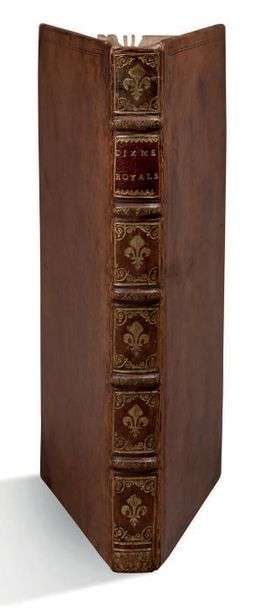
Contemporary fawn calf, ribbed spine with fleur-de-lys, burgundy morocco title-piece, framed with a triple cold fillet on the boards, decorated edges, brown half-basin folder (uninsulated) and later lined case. (Some discreet restorations to the binding, hinges a little cracked).
Rare first edition of one of the most original economic works of the 18th century.
Second issue copy, with the error corrected on page 16: "le septier pesant net deux censante livres", instead of one hundred and seventy as erroneously indicated in the first issue.
During the last decade of his life, Vauban progressively changed from a favorite of the king to an adversary, disapproving of the religious, military and commercial policies of Louis XIV. In June 1700, he nevertheless presented him with his project of a royal tithe. To solve the financial crisis, Vauban proposed to replace the taille, a tax that he considered unfair and uncertain, with a mobile state tax, levied on the income of all the inhabitants of the kingdom, in a proportion varying from one twentieth to one tenth according to the resources of each. This principle of a mobile tax is the first attempt in economic science to replace rigid systems by a variable-scale mechanism. Louis XIV applauded, but Vauban knew full well that he would never accept a tax system that would charge even the king's lands, and whose principle of equality of all taxpayers before the law was contrary to the spirit of the feudal regime. Feeling his end approaching, he decided to take all the risks. "December 1706: a seventy-three year old marshal of France [Vauban], introduces himself in his carriage crossing the door of Saint Denis, two bundles of sheets clandestinely printed in Rouen, which he immediately has bound at the Widow Fétil, rue Saint Jacques. A beautiful quarto that he had to distribute to influential friends who could have contributed to the success of his action. The Orders of the King's Privy Council were to enjoin that all the copies (276 in number) be seized, confiscated and put to the rammer" (In French in the text). Vauban died the following month, in March 1707.
Unique copy, with remarkable particularities:
- The engraved headbands and footnotes of the edition were covered at the time with banners and vignettes with Vauban's arms (OHR, pl. 343). A vignette with his arms was also affixed to the title page just above the date.
- Two sheets of handwritten notes in ink have been bound between pages 170 and 171, correcting and expanding on points V and VI on page 171. The same hand has crossed out the next two leaves (page 171-174). These notes were formerly considered as autographs, in the catalog of the sale of the library of H. de Lassize (1867, n° 1288) or by Brunet (supplement, volume II, 848), which appears today uncertain. Nevertheless, they could have been taken under the dictation of the author, perhaps by one of his collaborators and secretaries, Pierre Le Pesant de Boisguilbert or Vincent Ragot de Beaumont. The content of these notes is daring, as the last lines testify, which reflect well the state of mind of Vauban at the time of the printing of his work: "It is necessary to distinguish between two kinds of nobles: some who are noble by merit [...] the others for having bought nobility by money. Some are useful to the State, because they support it and bring it honor, while the others are a burden to it. Thus what is going to be said concerns the true nobility, of which it would be good to make a catalog in each province, and even in each generality, so as not to be mistaken. It could therefore be the author's personal copy.
REFERENCES
In French in the text, n° 134| Kress n° 2583| Goldsmith, n° 4431| Walter Braeuer, " Quelques remarques sur l'œuvre économique de Vauban ", Revue d'histoire économique et sociale, vol. 29, no. 1, 1951, pp. 8-25| Arthur Michel de Boislisle, La Proscription du projet de Dime Royale et la mort de Vauban (Mémoire lu à l'Académie des sciences morales et politiques), Paris,
ERRATUM: It is now certain that the handwritten notes in this copy are not in Vauban's hand. They are also not in the hand of Boisguilbert, who was not Vauban's secretary, as indicated by mistake in the notice.
Projet d'une dixme royale: qui supprimant la taille, les aydes, les doüanes d'une province à l'autre, les décimes du Clergé, les affaires extraordinaires| & tous autres impôts onéreux & non volontaires... S. l. [Rouen: François Maurry], 1707
In-4 (188 x 250 mm), (8)-204-(20) pp. and a folding table + 2 ff. of handwritten annotations between pp. 170 and 171. (Paper a little reddened, scattered foxing).
Contemporary fawn calf, ribbed spine with fleur-de-lys, burgundy morocco title-piece, framed with a triple cold fillet on the boards, decorated edges, brown half-basin folder (uninsulated) and later lined case. (Some discreet restorations to the binding, hinges a little cracked).
Rare first edition of one of the most original economic works of the 18th century.
Second issue copy, with the error corrected on page 16: "le septier pesant net deux censante livres", instead of one hundred and seventy as erroneously indicated in the first issue.
During the last decade of his life, Vauban progressively changed from a favorite of the king to an adversary, disapproving of the religious, military and commercial policies of Louis XIV. In June 1700, he nevertheless presented him with his project of a royal tithe. To solve the financial crisis, Vauban proposed to replace the taille, a tax that he considered unfair and uncertain, with a mobile state tax, levied on the income of all the inhabitants of the kingdom, in a proportion varying from one twentieth to one tenth according to the resources of each. This principle of a mobile tax is the first attempt in economic science to replace rigid systems by a variable-scale mechanism. Louis XIV applauded, but Vauban knew full well that he would never accept a tax system that would charge even the king's lands, and whose principle of equality of all taxpayers before the law was contrary to the spirit of the feudal regime. Feeling his end approaching, he decided to take all the risks. "December 1706: a seventy-three year old marshal of France [Vauban], introduces himself in his carriage crossing the door of Saint Denis, two bundles of sheets clandestinely printed in Rouen, which he immediately has bound at the Widow Fétil, rue Saint Jacques. A beautiful quarto that he had to distribute to influential friends who could have contributed to the success of his action. The Orders of the King's Privy Council were to enjoin that all the copies (276 in number) be seized, confiscated and put to the rammer" (In French in the text). Vauban died the following month, in March 1707.
Unique copy, with remarkable particularities:
- The engraved headbands and footnotes of the edition were covered at the time with banners and vignettes with Vauban's arms (OHR, pl. 343). A vignette with his arms was also affixed to the title page just above the date.
- Two sheets of handwritten notes in ink have been bound between pages 170 and 171, correcting and expanding on points V and VI on page 171. The same hand has crossed out the next two leaves (page 171-174). These notes were formerly considered as autographs, in the catalog of the sale of the library of H. de Lassize (1867, n° 1288) or by Brunet (supplement, volume II, 848), which appears today uncertain. Nevertheless, they could have been taken under the dictation of the author, perhaps by one of his collaborators and secretaries, Pierre Le Pesant de Boisguilbert or Vincent Ragot de Beaumont. The content of these notes is daring, as the last lines testify, which reflect well the state of mind of Vauban at the time of the printing of his work: "It is necessary to distinguish between two kinds of nobles: some who are noble by merit [...] the others for having bought nobility by money. Some are useful to the State, because they support it and bring it honor, while the others are a burden to it. Thus what is going to be said concerns the true nobility, of which it would be good to make a catalog in each province, and even in each generality, so as not to be mistaken. It could therefore be the author's personal copy.
REFERENCES
In French in the text, n° 134| Kress n° 2583| Goldsmith, n° 4431| Walter Braeuer, " Quelques remarques sur l'œuvre économique de Vauban ", Revue d'histoire économique et sociale, vol. 29, no. 1, 1951, pp. 8-25| Arthur Michel de Boislisle, La Proscription du projet de Dime Royale et la mort de Vauban (Mémoire lu à l'Académie des sciences morales et politiques), Paris,