
&w=3840&q=75)
&w=3840&q=75)
&w=3840&q=75)
&w=3840&q=75)
&w=3840&q=75)
&w=3840&q=75)
&w=3840&q=75)
&w=3840&q=75)


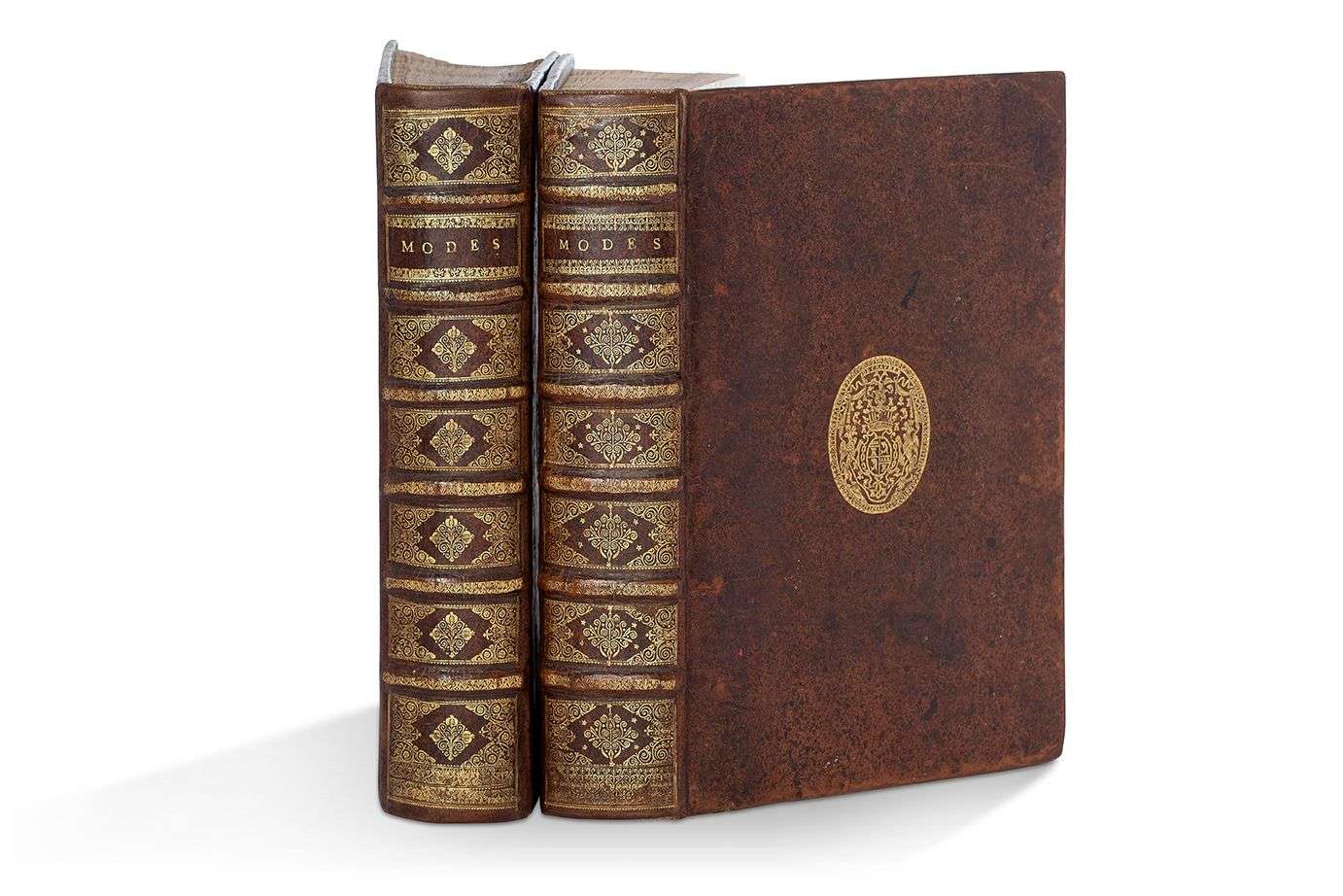
[Collection of fashions from the reign of Louis XIV]. Paris, 1680-1696. 2
2 volumes in-folio (246 x 376 mm and 253 x 378 mm) gathering about 682 plates engraved with etching and burin, including 7 colored and enhanced with silver.
Contemporary speckled brown calf, spine with gilt titling, arms in the center of the boards, decorated edges. Modern bordered cases. (Skilful restorations to the headpieces and corners| a dozen tears without missing restorations, 3 prints restored with damage to the composition).
Exceptional collection, constituted at the time by Louis I de La Tour du Pin de La Charce (1655-1714) and bound with his arms.
The engravings are dated from 1680 to 1696| the collection was thus bound between this last date and 1714, death of its owner. Godson of Louis XIV, from one of the oldest families in France, Louis I de La Tour du Pin was a captain of cavalry, knight of Saint Louis, member of the States of Burgundy and first gentleman of the Prince of Condé. He bore, among others, the titles of Marquis de la Charce, Count of Montmorin and Oulle and, by his marriage, Marquis of Fontaine-Française and Sovereign Prince of Chaume, which are shown around his coat of arms. (Richard-Édouard Gascon, Histoire de Fontaine-Française, Paris, 1892, pp. 314-315).
These two volumes offer a spectacular review of characters, costumes and trades of the century of Louis XIV. The "fashion portraits" are particularly well represented, engraved by several members of the Bonnart dynasty - Henri II, the most famous, his brothers Nicolas I and Robert -, representing the celebrities of the time under the aspect of young attractive mannequins, starting with the king, Madame de Maintenon, the royal family, the Court... Henri Bonnart also appears in several prints of the series of his allegories put in fashion. The other engravings of fashion contained in these volumes are due to Jean Dieu de Saint-Jean, today considered as the inventor of the genre, and to his Parisian followers Claude-Au - guste Berey, Nicolas Arnoult, or Antoine Trouvain. Finally, there is a very important set (75 plates) of "gro - tesque costumes" by Nicolas de Larmessin, a fascinating series of allegorical portraits composed from the tools and products of their trade.
REFERENCES
Pascale Cugy, " La fabrique du corps désirable : la gravure de mode parisienne sous le règne de Louis XIV ", Histoire de l'art, n° 66, 2010, pp. 83-93.
2 volumes in-folio (246 x 376 mm and 253 x 378 mm) gathering about 682 plates engraved with etching and burin, including 7 colored and enhanced with silver.
Contemporary speckled brown calf, spine with gilt titling, arms in the center of the boards, decorated edges. Modern bordered cases. (Skilful restorations to the headpieces and corners| a dozen tears without missing restorations, 3 prints restored with damage to the composition).
Exceptional collection, constituted at the time by Louis I de La Tour du Pin de La Charce (1655-1714) and bound with his arms.
The engravings are dated from 1680 to 1696| the collection was thus bound between this last date and 1714, death of its owner. Godson of Louis XIV, from one of the oldest families in France, Louis I de La Tour du Pin was a captain of cavalry, knight of Saint Louis, member of the States of Burgundy and first gentleman of the Prince of Condé. He bore, among others, the titles of Marquis de la Charce, Count of Montmorin and Oulle and, by his marriage, Marquis of Fontaine-Française and Sovereign Prince of Chaume, which are shown around his coat of arms. (Richard-Édouard Gascon, Histoire de Fontaine-Française, Paris, 1892, pp. 314-315).
These two volumes offer a spectacular review of characters, costumes and trades of the century of Louis XIV. The "fashion portraits" are particularly well represented, engraved by several members of the Bonnart dynasty - Henri II, the most famous, his brothers Nicolas I and Robert -, representing the celebrities of the time under the aspect of young attractive mannequins, starting with the king, Madame de Maintenon, the royal family, the Court... Henri Bonnart also appears in several prints of the series of his allegories put in fashion. The other engravings of fashion contained in these volumes are due to Jean Dieu de Saint-Jean, today considered as the inventor of the genre, and to his Parisian followers Claude-Au - guste Berey, Nicolas Arnoult, or Antoine Trouvain. Finally, there is a very important set (75 plates) of "gro - tesque costumes" by Nicolas de Larmessin, a fascinating series of allegorical portraits composed from the tools and products of their trade.
REFERENCES
Pascale Cugy, " La fabrique du corps désirable : la gravure de mode parisienne sous le règne de Louis XIV ", Histoire de l'art, n° 66, 2010, pp. 83-93.