
&w=3840&q=75)
&w=3840&q=75)
&w=3840&q=75)
&w=3840&q=75)
&w=3840&q=75)
&w=3840&q=75)
&w=3840&q=75)
&w=3840&q=75)


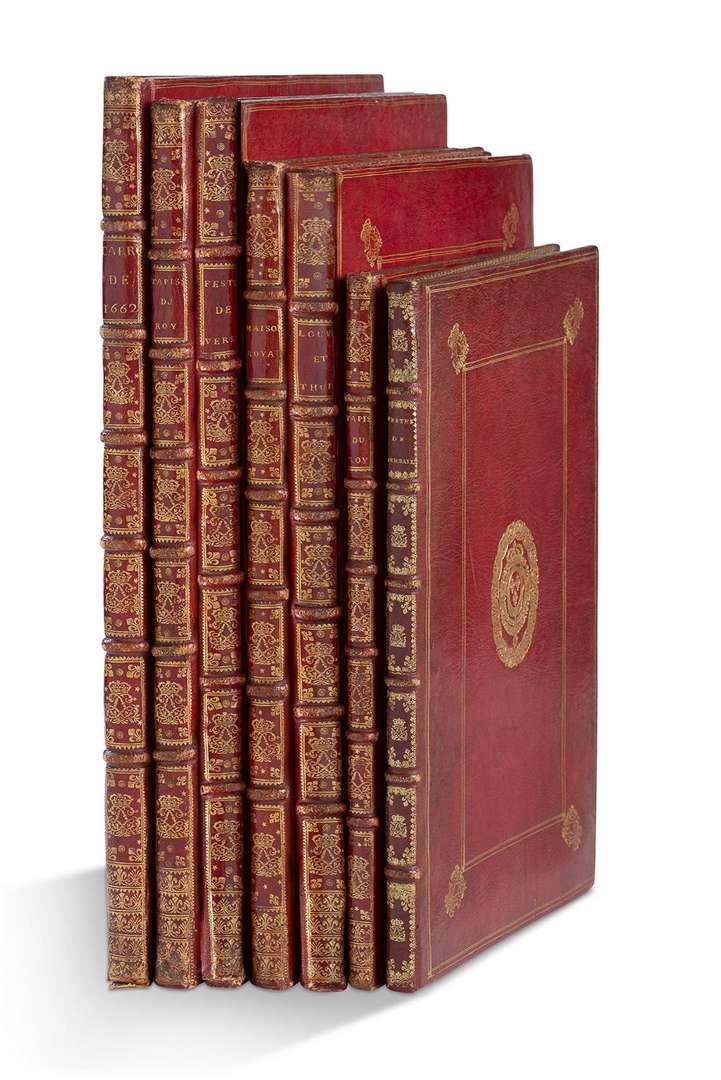
Set of seven volumes of prints testifying to the splendor of the reign of Louis XIV.
6 folio volumes of different sizes, uniformly bound in red morocco à la Duseuil with the arms of Louis XIV (OHR, pl. 2494, iron no. 10| dimensions of the armorial block: 128 x 105 mm, the largest of the four formats cited by OHR), spines decorated with fleur-de-lys fleur-de-lys caissons with the royal cipher (OHR, pl. 2494, iron no. 21), boards decorated with a double frame of triple gilt fillet, royal cipher in the corners of the inner frame, royal arms in the center, roulette on the edges and the counterpanes, gilt edges. (Minor defects, a few corners dulled.) And: an additional volume from a different collection, also bound in red morocco à la Duseuil with the royal arms (same armorial block as on the other 6 volumes but smaller in size, 92 x 76 mm, the second format cited by OHR), with different irons on the spine.
Remarkable set of famous prints from the King's Cabinet, in first printing.
The Cabinet du Roi, an artistic and political tool for the dissemination of the magnificence and glory of Louis XIV through prints, was created in 1667 by Jean-Baptiste Colbert and stopped in 1683 upon his death. This monumental undertaking, which included a total of 956 matrices, was intended to exalt the person of the king, to magnify his festivals and entertainments, to show the royal buildings, to exhibit the king's artistic collections and to promote the sciences and arts. The prints were first published separately, in various formats with printed explanations. Then, from 1670 on, they were collected in collections, some of which were luxuriously bound in red morocco, as here, to be offered to foreign sovereigns and to the great figures of the royal entourage. Finally, they were published in a homogeneous way in a collection entitled Cabinet du Roi, comprising 23 volumes all of the same large eagle format, executed by the Royal Printing House in 1727.
- Les plaisirs de l'Isle enchantée, ou les festes, et divertissements du Roy, à Versailles, Diviséz en trois journées, et commencéz le 7.me Jour de may, de L'année 1664. [Paris, Imprimerie royale, 1673]. In-folio (530 x 370 mm), 20 plates mounted on tabs with illustrated title (275 x 420 mm), engraved by Israël Silvestre, Chauveau and Le Pautre.
This famous album immortalizes the first of the great festivities given at Versailles by Louis XIV, six days of fabulous rejoicings from May 7 to 13, 1664 in honor of Anne of Austria and Queen Maria Theresa on the romantic theme of the magician Alcine holding Roger and his valiant knights captive in her palace. In reality, the festival was dedicated to Mademoiselle de La Vallière, the king's mistress. The engravings recreate the great moments of these festivities: equestrian parade, ring race, ballet on the theme of the four seasons, sumptuous feast, fireworks and illuminations of the gardens of Versailles, etc.
- PERRAULT (CHARLES) and FLÉCHIER (Esprit)]. Festiva ad Capita Annulumque Decursio, a Rege Ludovico XIV Principibus, summisque aulae proceribus edita anno M DC LXII. Scripsit Gallicè Carolus Perraul. Latinè reddidit, & Versibus Heroïcis expressit Spiritus Flechier. Paris, Imprimerie royale, 1670, large folio (420 x 545 mm), (5) ff. (title, title-frontispiece with portrait of the king, title with vignette of the royal coat of arms, dedication to the dauphin), 105-(1) pp. containing 40 plates, one of which is double, and 7 double plates mounted on tabs, 3 of which are folded. This work relates the grandiose equestrian celebration given by Louis XIV in 1662 in honor of the birth of the dauphin. Charles Perrault was in charge of writing the text. The present copy contains the Latin version, published simultaneously with the French one and due to Esprit Fléchier. The compositions were engraved by François Chauveau after Henry Jissey. The first 4 double plates mounted on tabs, each containing 2 engravings arranged in bands, represent the parade of 117 horsemen or groups crossing Paris, including the king, the prince of Condé, the duke of Guise and other personalities of the Court. These engravings offer the great interest of showing streets and buildings of Paris today disappeared, like the street Saint-Nicaise. There follow 30 plates, one of which is a double plate, of riders in arms in superb armor or feathered costumes. These are interspersed with 10 plates of emblems of the main participants. Finally, there are 3 double plates on tabs which are general views of the festival. Menessier de La Lance II, 300-301.
- Tapestries of the King, where are represented the four elements and the four seasons. Avec les devises qui les accompagnent, et leur explication [bound in 2 volumes]. Paris, Sébastien Marbre Cramoisy, 1679. 2 volumes in-folio with one volume of text (428 x 284 mm
6 folio volumes of different sizes, uniformly bound in red morocco à la Duseuil with the arms of Louis XIV (OHR, pl. 2494, iron no. 10| dimensions of the armorial block: 128 x 105 mm, the largest of the four formats cited by OHR), spines decorated with fleur-de-lys fleur-de-lys caissons with the royal cipher (OHR, pl. 2494, iron no. 21), boards decorated with a double frame of triple gilt fillet, royal cipher in the corners of the inner frame, royal arms in the center, roulette on the edges and the counterpanes, gilt edges. (Minor defects, a few corners dulled.) And: an additional volume from a different collection, also bound in red morocco à la Duseuil with the royal arms (same armorial block as on the other 6 volumes but smaller in size, 92 x 76 mm, the second format cited by OHR), with different irons on the spine.
Remarkable set of famous prints from the King's Cabinet, in first printing.
The Cabinet du Roi, an artistic and political tool for the dissemination of the magnificence and glory of Louis XIV through prints, was created in 1667 by Jean-Baptiste Colbert and stopped in 1683 upon his death. This monumental undertaking, which included a total of 956 matrices, was intended to exalt the person of the king, to magnify his festivals and entertainments, to show the royal buildings, to exhibit the king's artistic collections and to promote the sciences and arts. The prints were first published separately, in various formats with printed explanations. Then, from 1670 on, they were collected in collections, some of which were luxuriously bound in red morocco, as here, to be offered to foreign sovereigns and to the great figures of the royal entourage. Finally, they were published in a homogeneous way in a collection entitled Cabinet du Roi, comprising 23 volumes all of the same large eagle format, executed by the Royal Printing House in 1727.
- Les plaisirs de l'Isle enchantée, ou les festes, et divertissements du Roy, à Versailles, Diviséz en trois journées, et commencéz le 7.me Jour de may, de L'année 1664. [Paris, Imprimerie royale, 1673]. In-folio (530 x 370 mm), 20 plates mounted on tabs with illustrated title (275 x 420 mm), engraved by Israël Silvestre, Chauveau and Le Pautre.
This famous album immortalizes the first of the great festivities given at Versailles by Louis XIV, six days of fabulous rejoicings from May 7 to 13, 1664 in honor of Anne of Austria and Queen Maria Theresa on the romantic theme of the magician Alcine holding Roger and his valiant knights captive in her palace. In reality, the festival was dedicated to Mademoiselle de La Vallière, the king's mistress. The engravings recreate the great moments of these festivities: equestrian parade, ring race, ballet on the theme of the four seasons, sumptuous feast, fireworks and illuminations of the gardens of Versailles, etc.
- PERRAULT (CHARLES) and FLÉCHIER (Esprit)]. Festiva ad Capita Annulumque Decursio, a Rege Ludovico XIV Principibus, summisque aulae proceribus edita anno M DC LXII. Scripsit Gallicè Carolus Perraul. Latinè reddidit, & Versibus Heroïcis expressit Spiritus Flechier. Paris, Imprimerie royale, 1670, large folio (420 x 545 mm), (5) ff. (title, title-frontispiece with portrait of the king, title with vignette of the royal coat of arms, dedication to the dauphin), 105-(1) pp. containing 40 plates, one of which is double, and 7 double plates mounted on tabs, 3 of which are folded. This work relates the grandiose equestrian celebration given by Louis XIV in 1662 in honor of the birth of the dauphin. Charles Perrault was in charge of writing the text. The present copy contains the Latin version, published simultaneously with the French one and due to Esprit Fléchier. The compositions were engraved by François Chauveau after Henry Jissey. The first 4 double plates mounted on tabs, each containing 2 engravings arranged in bands, represent the parade of 117 horsemen or groups crossing Paris, including the king, the prince of Condé, the duke of Guise and other personalities of the Court. These engravings offer the great interest of showing streets and buildings of Paris today disappeared, like the street Saint-Nicaise. There follow 30 plates, one of which is a double plate, of riders in arms in superb armor or feathered costumes. These are interspersed with 10 plates of emblems of the main participants. Finally, there are 3 double plates on tabs which are general views of the festival. Menessier de La Lance II, 300-301.
- Tapestries of the King, where are represented the four elements and the four seasons. Avec les devises qui les accompagnent, et leur explication [bound in 2 volumes]. Paris, Sébastien Marbre Cramoisy, 1679. 2 volumes in-folio with one volume of text (428 x 284 mm