
&w=3840&q=75)
&w=3840&q=75)
&w=3840&q=75)
&w=3840&q=75)
&w=3840&q=75)
&w=3840&q=75)
&w=3840&q=75)
&w=3840&q=75)


56
BLAEU (Joan) (1596-1673)
The item was sold for 21 482 €
Fees include commission and taxes.
BLAEU (Joan) (1596-1673)
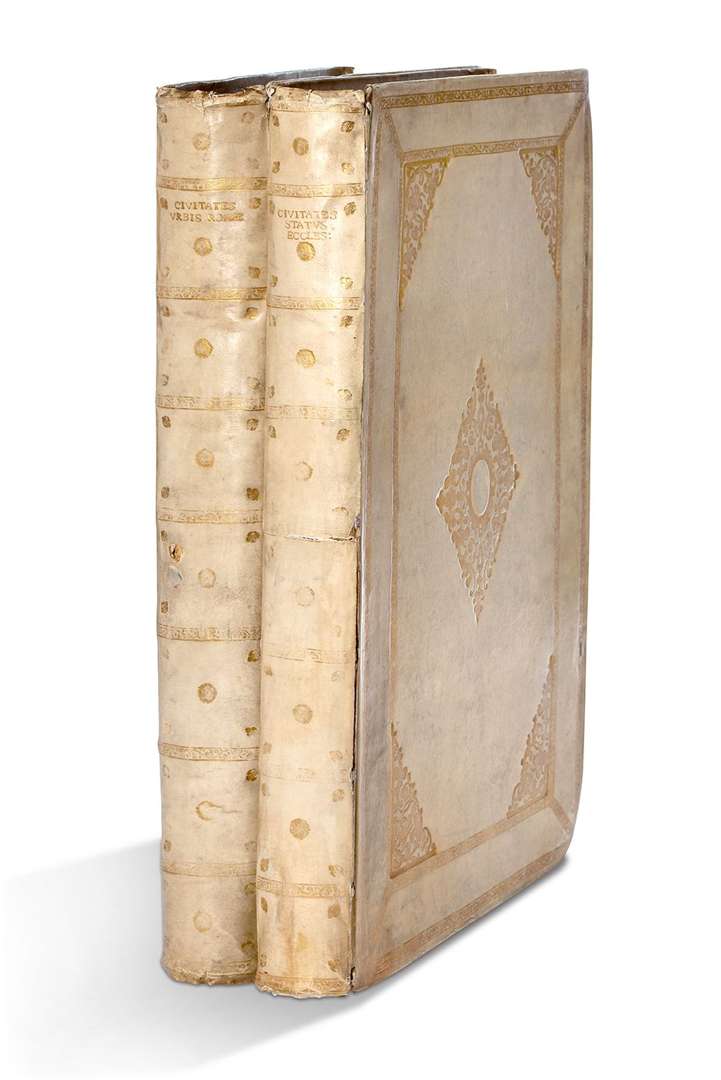
Theatrum Civitatum et Admirandorum Italiae. [And:] Civitatum et admirandorum Italiae pars altera, in qua urbis Romae admiranda aevi veteri et huius seculi continentur. Amsterdam: "following the true copy of Bourdeaux", Louis and Amsterdam, Joan Blaeu, 1663.
2 volumes large folio (550 x 350mm), frontispiece, (7) ff. (title, dedication, privilege, intermediate title (part I), notice to the reader, intermediate title part I section 1), 110 pp., (9) pp, pp. 111-253, (1) f. (index), 66 plates (some on double page) and 8 large vignettes in the text| frontispiece, (4) ff. (general title and intermediate title part II section 1), 54-40- 315-50 pp. and (1) f. index, and 44 plates (some on double page). Completely mounted on tabs.
Contemporary stiff vellum with flaps, smooth ornate spine, double framed with gilt fillets and roulette on the boards, gilt spandrels on the inner corners, large central diamond ornament, gilt edges (Dutch binding). (Corners a little dulled, ties missing. Vol. I: first hinge cracked and horizontal split in the spine at mid-height with lifting of the vellum, folding extension of the "Bononia" plate scorched, marginal tear restored to the "Frascati" plate, with small damage to the composition| vol. II: small hole in the spine, small tears without missing in the center of the folds of some obelisk plates).
Rare first edition of Blaeu's superb atlas dedicated to Rome and the Papal States.
In parallel to the publication of his famous Atlas Major, begun in 1662, the great Dutch cartographer Joan Blaeu undertook the publication of a monumental atlas of the cities and monuments of Italy, in several volumes, entitled Theatrum civitatum et admirandorum Italiæ, thus taking advantage of the renewal of the practice of the Grand Tour among the young European elite. Originally, this atlas was to have had two parts, each consisting of five volumes. The first part, entitled Civitates Italiæ, was to be devoted to Italian cities, the second, Admiranda Urbis Romæ, to the monuments of Rome. Blaeu finally succeeded in publishing only three volumes in 1663: a volume on the Papal States (part 1, volume 1), a volume on Rome (part 2, volume 1), and an incomplete volume on the cities of Naples and Sicily. This Grand Tour, Blaeu had himself made it in his youth. Around 1660, when his project of an atlas of Italian cities took shape, he sent his son Pieter to Italy to revive the friendly ties he had made at the time. It was through them that Blaeu acquired the material sources for his atlas. The main supplier of illustrations and texts was the Italian philosopher and lawyer Carlo-Emanuele Vizzani (1617-1661). Blaeu also relied on older works. The first volume, dedicated to the Papal States, begins with a remarkable map of baroque Rome bearing the emblems of the 14 rioni, followed by a presentation of the Eternal City. Then come the descriptions, abundantly illustrated, of the main historical cities of the Papal States, listed in alphabetical order, from Ancona to Urbino, including Assisi, Bologna, Ferrara, Orvieto, Perugia, Rimini and Tivoli. The second volume, opening with a double-page map, deals with ancient Rome and its splendors, especially the theaters, amphitheaters and circuses. An important part of this volume is also dedicated to obelisks, based on the works of Athanasius Kircher (Œdipus Ægyptiacus, Rome, 1652-1654 and Obeliscus Pamphilius, Rome, 1650): historical aspects, links with ancient Egypt, interpretations of hieroglyphs, detailed illustration of Bernini's Fountain of the Four Rivers, relation of the transport of the Vatican obelisk in 1586, set off by a magnificent suite of 14 plates from Domenico Fontana's Della trasportatione dell'obelisco vaticano (Rome, 1590) (see lot 50). A fine copy in contemporary gilt Dutch vellum, complete with all plates, including the folding extension to the "Bononia" plate in volume I. Volume I corresponds to the variant C described by Van der Krogt, containing 6 additional plates, and volume II to the variant A. In volume II, the verso of page 262, which should have contained the plate "Obeliscus Vaticanus", is blank, as in all copies (see Koeman).
REFERENCES
Koeman, BL 72-73| Van der Krogt, Koeman's Atlantes Neerlandici, 43:211.1L and 43:211.2L.
Theatrum Civitatum et Admirandorum Italiae. [And:] Civitatum et admirandorum Italiae pars altera, in qua urbis Romae admiranda aevi veteri et huius seculi continentur. Amsterdam: "following the true copy of Bourdeaux", Louis and Amsterdam, Joan Blaeu, 1663.
2 volumes large folio (550 x 350mm), frontispiece, (7) ff. (title, dedication, privilege, intermediate title (part I), notice to the reader, intermediate title part I section 1), 110 pp., (9) pp, pp. 111-253, (1) f. (index), 66 plates (some on double page) and 8 large vignettes in the text| frontispiece, (4) ff. (general title and intermediate title part II section 1), 54-40- 315-50 pp. and (1) f. index, and 44 plates (some on double page). Completely mounted on tabs.
Contemporary stiff vellum with flaps, smooth ornate spine, double framed with gilt fillets and roulette on the boards, gilt spandrels on the inner corners, large central diamond ornament, gilt edges (Dutch binding). (Corners a little dulled, ties missing. Vol. I: first hinge cracked and horizontal split in the spine at mid-height with lifting of the vellum, folding extension of the "Bononia" plate scorched, marginal tear restored to the "Frascati" plate, with small damage to the composition| vol. II: small hole in the spine, small tears without missing in the center of the folds of some obelisk plates).
Rare first edition of Blaeu's superb atlas dedicated to Rome and the Papal States.
In parallel to the publication of his famous Atlas Major, begun in 1662, the great Dutch cartographer Joan Blaeu undertook the publication of a monumental atlas of the cities and monuments of Italy, in several volumes, entitled Theatrum civitatum et admirandorum Italiæ, thus taking advantage of the renewal of the practice of the Grand Tour among the young European elite. Originally, this atlas was to have had two parts, each consisting of five volumes. The first part, entitled Civitates Italiæ, was to be devoted to Italian cities, the second, Admiranda Urbis Romæ, to the monuments of Rome. Blaeu finally succeeded in publishing only three volumes in 1663: a volume on the Papal States (part 1, volume 1), a volume on Rome (part 2, volume 1), and an incomplete volume on the cities of Naples and Sicily. This Grand Tour, Blaeu had himself made it in his youth. Around 1660, when his project of an atlas of Italian cities took shape, he sent his son Pieter to Italy to revive the friendly ties he had made at the time. It was through them that Blaeu acquired the material sources for his atlas. The main supplier of illustrations and texts was the Italian philosopher and lawyer Carlo-Emanuele Vizzani (1617-1661). Blaeu also relied on older works. The first volume, dedicated to the Papal States, begins with a remarkable map of baroque Rome bearing the emblems of the 14 rioni, followed by a presentation of the Eternal City. Then come the descriptions, abundantly illustrated, of the main historical cities of the Papal States, listed in alphabetical order, from Ancona to Urbino, including Assisi, Bologna, Ferrara, Orvieto, Perugia, Rimini and Tivoli. The second volume, opening with a double-page map, deals with ancient Rome and its splendors, especially the theaters, amphitheaters and circuses. An important part of this volume is also dedicated to obelisks, based on the works of Athanasius Kircher (Œdipus Ægyptiacus, Rome, 1652-1654 and Obeliscus Pamphilius, Rome, 1650): historical aspects, links with ancient Egypt, interpretations of hieroglyphs, detailed illustration of Bernini's Fountain of the Four Rivers, relation of the transport of the Vatican obelisk in 1586, set off by a magnificent suite of 14 plates from Domenico Fontana's Della trasportatione dell'obelisco vaticano (Rome, 1590) (see lot 50). A fine copy in contemporary gilt Dutch vellum, complete with all plates, including the folding extension to the "Bononia" plate in volume I. Volume I corresponds to the variant C described by Van der Krogt, containing 6 additional plates, and volume II to the variant A. In volume II, the verso of page 262, which should have contained the plate "Obeliscus Vaticanus", is blank, as in all copies (see Koeman).
REFERENCES
Koeman, BL 72-73| Van der Krogt, Koeman's Atlantes Neerlandici, 43:211.1L and 43:211.2L.